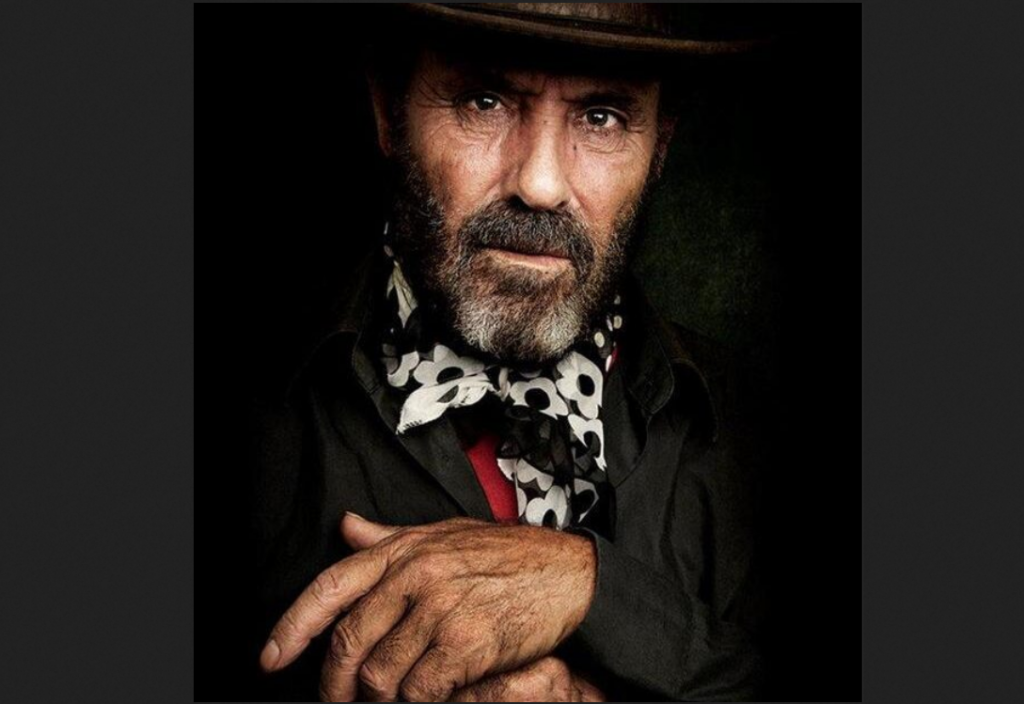
The living legend of Flamenco always sang against abuses of power
~ José Maria Polo Sáez, Redes Libertarias ~
Flamenco mourns the death of one of its most emblematic singers, and with him, like a flash of lightning, his powerful and charismatic voice has vanished. His name was José Domínguez Muñoz, “El Cabrero” (The Goatherd), and Andalusia has lost one of its most authentic, uncompromising, and profound voices. He died at the age of 81 in Bormujos on May 13, 2026, and Andalusia, its countryside, its mountains, its wind, its waters, and even its goats will feel the loss of this lamentable event.
José never needed artifice to be great. A goatherd since the age of six (he never stopped herding), his art sprang from the very earth he walked on, nourished by the harshness of the countryside and the dignity of the worker. He was the artist who brought the truth of the mountains to the theaters. The singer-songwriter of freedom and rebellion.
The immense flow of truth and sincerity from this unique artist flowed undiminished—as he himself would say—downhill, between crags and cliffs, through ravines and narrow gorges, until it unleashed a veritable avalanche, an overflowing of emotion in the consciences of all those men and women who seek in his singing, in his singular yet profound truth, the solace of that unattainable dream of equality and freedom.
His style, rooted in the most austere flamenco tradition—fandangos from Huelva, soleares, seguiriyas, and tonás—became a tool for social protest during the Transition. With defiant lyrics and a libertarian philosophy of life, El Cabrero always sang against the abuses of power and the lack of freedom.
“When there is something to say,
one cannot remain silent,
because to remain silent is to die.”
El Cabrero can be considered the flamenco singer who best captured the very essence of the working man, the man who tills the land and gives it life. He himself is also part of that anonymous and heroic worker who each day merges with the landscape to perform the miracle of life and, at the same time, allow and enable life for the beings around him.
El Cabrero was a true living legend, a flamenco singer for the most eternal of popular traditions, because a century from now people will still be talking about El Cabrero, recounting his deeds and exploits as fabulous tales that will fly from mouth to mouth in the purest style of oral tradition, because he, better than anyone, knew how to resonate with the people, and the people love and respect him, and will continue to respect, admire, and above all, love him as a living symbol of a utopian Andalusia that neither remains silent nor bows down to anyone.
El Cabrero was one of those rare human beings that are so hard to find these days, mainly because of his sincerity and authenticity. Or, to put it another way, in him we find a man—to paraphrase Machado—in the truest sense of the word, good. But a kind of combative goodness, a goodness understood and won through daily struggle. A man who was deeply rooted in the land, as he was, and who needed it like a fish needs water. Yes, he was deeply rooted in the land he cherished and adored, and he never abandoned it, no matter how many temptations came his way from that other world, as he would say, “deceitful and vile.”
El Cabrero can be considered one of those rare voices in the entire history of flamenco that best captured the authentic socio-economic and labor reality of Andalusia. Moreover, he was able to publicise it, denounce it, and fight against it with his singing, something neither the powerful figures of the time nor his own flamenco colleagues—especially those who sought only the art of flamenco for its own sake—have ever forgiven him for.
In short, El Cabrero has been, or can be considered, a true and unrepeatable social phenomenon within the world of flamenco. Therefore, what has always most captivated us about him is his singing, his essentially pure singing, without pandering to the audience, a singing fought for in every verse, with passion and rigor.
And El Cabrero will always be there to remind us that we must never stop, never settle, that we must always walk alert, always mindful of our destiny so that it is not predetermined for us. May he rest in peace.
Machine translation