A furious sixteen-minute documentary responding to the coup in Chile remains a defining work of anti-fascist cinema
~ Bleart Thaçi ~
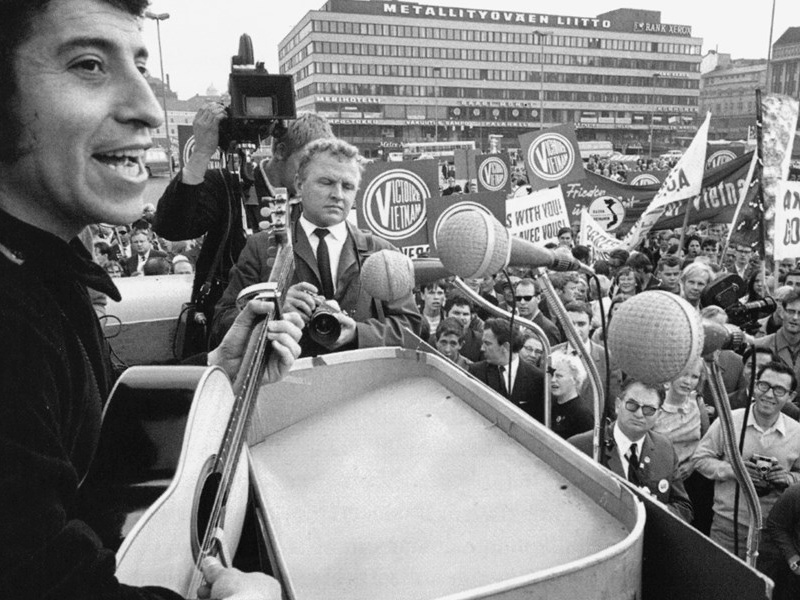
Three months after the Chilean military coup of 11 September 1973, while the smoke of La Moneda still lingered in public memory and thousands of Chileans remained imprisoned, tortured, or disappeared, Cuban filmmaker Santiago Álvarez released The Tiger Leaps and Kills, But It Will Die… It Will Die…, a furious sixteen-minute documentary that remains one of cinema’s earliest responses to the overthrow of Salvador Allende. The film was among the first works to confront the new dictatorship and to draw explicit parallels between Augusto Pinochet’s regime and twentieth-century fascism. More than a chronicle of political events, however, it serves as an obituary for the murdered singer Víctor Jara, whose voice, image and music form the emotional core of the film.
One of the film’s opening titles describes it as “an account in four songs.” Álvarez uses those songs as the framework for a furious montage of photographs, newsreel footage, political posters and newspaper headlines. The songs guide the images, the images reshape the songs. More than fifty years later, the film retains a startling immediacy, not because of the events it depicts but because of the confidence with which Álvarez transforms fragments of history into a work of agitation, mourning and resistance.
The opening sequence is set to Violeta Parra’s Que dirá el Santo Padre. As Chilean soldiers march in immaculate formation, the song questions those who invoke freedom while trampling it underfoot. Álvarez quickly fractures the official image of military order, cutting from the parade to soldiers firing into crowds, civilians being rounded up, prisoners packed into detention cells and tanks aimed at demonstrators. Military spectacle is stripped of its ceremonial grandeur and revealed for what it is, an instrument of repression.
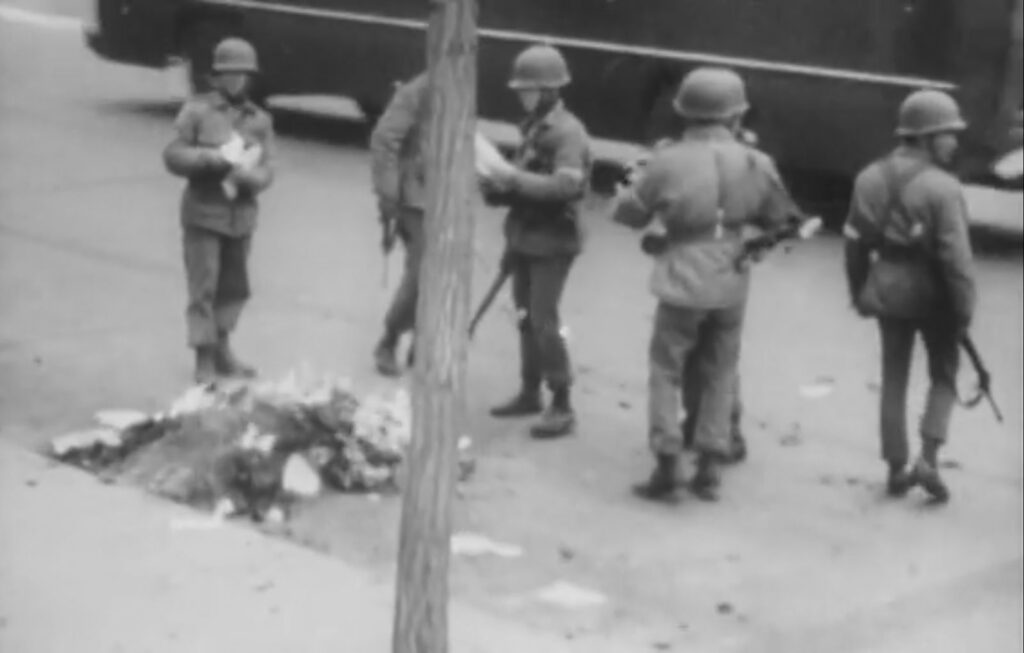
The film’s first great editorial leap arrives when soldiers removing books from Chilean libraries are intercut with footage of Nazi book burnings. Pinochet’s dictatorship was still in its infancy, but Álvarez already reads the destruction of books as something beyond censorship, an attack on memory itself that pulls Chile out of national specificity and into a recurring historical pattern of authoritarian violence. The association resurfaces in the title sequence, which unfolds over John Heartfield’s anti-fascist photomontage As in the Middle Ages… So in the Third Reich, which depicts fascism as a continuation of older forms of brutality, while Víctor Jara’s El Alma Llena de Banderas plays beneath a dedication to the victims of the “fascist sadism” perpetrated by the Chilean armed forces and the CIA since 11 September 1973.
If the opening section is driven by anger, El Alma Llena de Banderas introduces grief. As Jara’s voice emerges over images of Salvador Allende, the song’s lyrics take on the character of an elegy, particularly in the line, “There, underground, you are not sleeping, brother, friend.” Álvarez lingers on the connection, allowing Jara’s words to mourn the fallen president with the weight of a personal farewell.
The emotional centre of the film arrives with Te Recuerdo Amanda, one of the most tender songs in Latin American popular music. Telling the story of Amanda and Manuel, two factory workers whose love survives in moments stolen between shifts, the song is marked by an extraordinary warmth and simplicity. Álvarez understands precisely what that warmth can accomplish, waiting until the viewer is fully absorbed in Jara’s performance before introducing a series of titles describing the singer’s torture and murder:
They broke his hands to silence his guitar.
They broke his skull to extinguish his thought.
They left him bleeding to stifle his rebelliousness.
Moments after watching Jara sing of love and ordinary working lives, the viewer is confronted with the circumstances of his death. Arrested in the aftermath of the coup and imprisoned in Santiago’s Estadio Chile alongside thousands of others, Jara was tortured by soldiers who reportedly mocked him to sing after smashing his hands; according to his autopsy, he was ultimately killed with 44 bullet wounds. The titles underscore the futility of the attempt to silence him. Even as the film describes the destruction of his hands, his voice continues to fill the soundtrack.
The film’s final movement is built around Plegaria a un Labrador (Prayer to a Labourer). perhaps Jara’s most overtly political composition. Structured as a prayer, the song turns Christian language into a call for collective action as images of repression unfold across the screen: police violence, military occupations, political crackdowns and scenes of suffering from Chile, Puerto Rico, Brazil, Colombia, the Dominican Republic, Vietnam, Indonesia and Aden. With each new location, the film widens its frame, linking distant struggles through a shared experience of military repression and foreign intervention.
Then comes the film’s most inspired transition, as images of contemporary repression give way to nineteenth-century Latin American independence battles: Boyacá, Chacabuco, Maipú, Araure and Ingavi. The memory of liberation struggles interrupts the imagery of dictatorship, folding past and present into one another and placing those who fought colonial domination alongside those confronting military repression in the twentieth century.
By this point Jara’s voice seems to have outgrown the boundaries of individual performance. Songs that began as expressions of personal feeling acquire a broader political resonance, carried across a montage that stretches from Chile to the wider continent and back again. For a moment, it feels as though Latin America itself is speaking through Jara.
More than fifty years later, The Tiger Leaps and Kills, But It Will Die… It Will Die… remains one of the defining works of anti-fascist cinema, capturing the emotional reality of a historical rupture while it was still unfolding, before grief had settled into memory and anger cooled into analysis. By the film’s end, Jara’s presence extends far beyond that of a murdered singer, his voice carrying the weight of a broader struggle against repression and forgetting. The military intended his death to serve as a warning; Álvarez transformed it into a rallying cry, preserving not only the memory of Jara but the ideals for which he lived and died. As long as his songs continue to echo through the film’s montage, the dictatorship’s attempt to erase him remains incomplete.
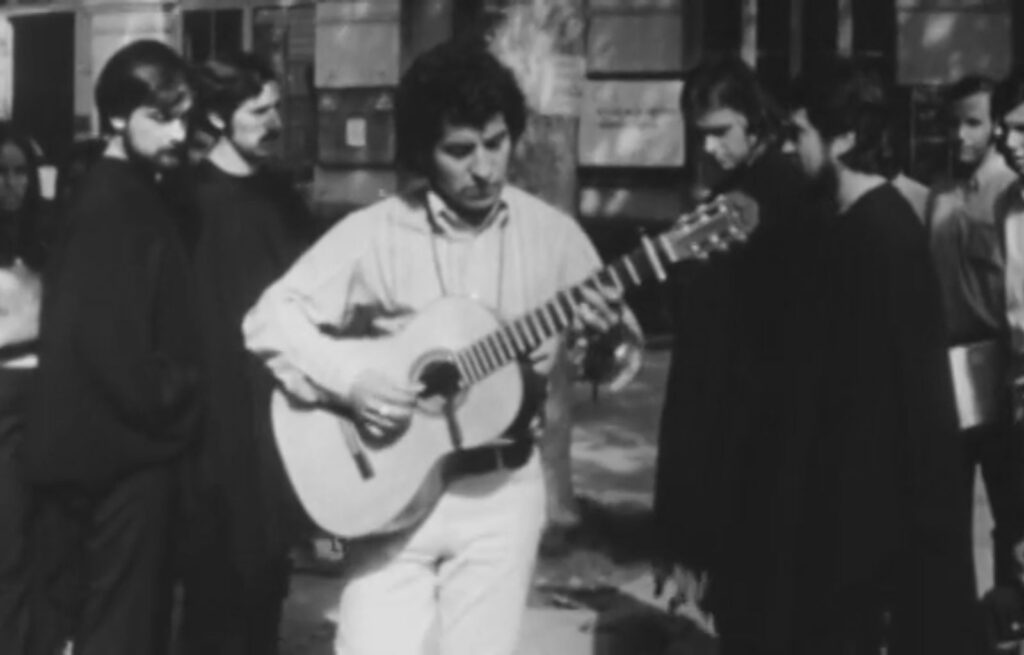
Top image: Víctor Jara performing in Helsinki at a protest against the war on Vietnam, 1969 (Photo by Hannu Lindroos/Lehtikuva)