Hundreds of arrests, demonstrations repressed, journalists and opponents targeted as Erdoğan bears down on opposition
~ Osservatorio Repressione ~
As Ankara prepares to welcome the heads of state and government of the 32 NATO countries, Turkey offers the world the most authentic image of the regime built by Recep Tayyip Erdoğan: not that of diplomatic ceremonies and official photographs, but that of a militarised country, where dissent is pre-emptively repressed and counterterrorism continues to be used as a tool of governance.
The NATO summit on 7 and 8 July comes at a crucial moment for the Atlantic Alliance. On the table will be US President Donald Trump’s request to increase military spending to 5% of GDP by 2035, a goal already endorsed by the Italian government at the previous summit. This represents a further acceleration of the arms race as wars and international tensions continue to escalate.
For Erdoğan, however, the summit represents above all an opportunity for international legitimacy. After years of accusations regarding the repression of opposition, the persecution of the Kurdish movement, control of information, and the erosion of the rule of law, the Turkish president is once again presenting himself as an indispensable interlocutor for the West. Turkey’s geopolitical weight, control of the Straits, and its role in the Mediterranean and the Middle East now seem to matter far more than the continued violations of fundamental rights.
Preparation for the summit was accompanied by a full-fledged preventative operation against any form of dissent.
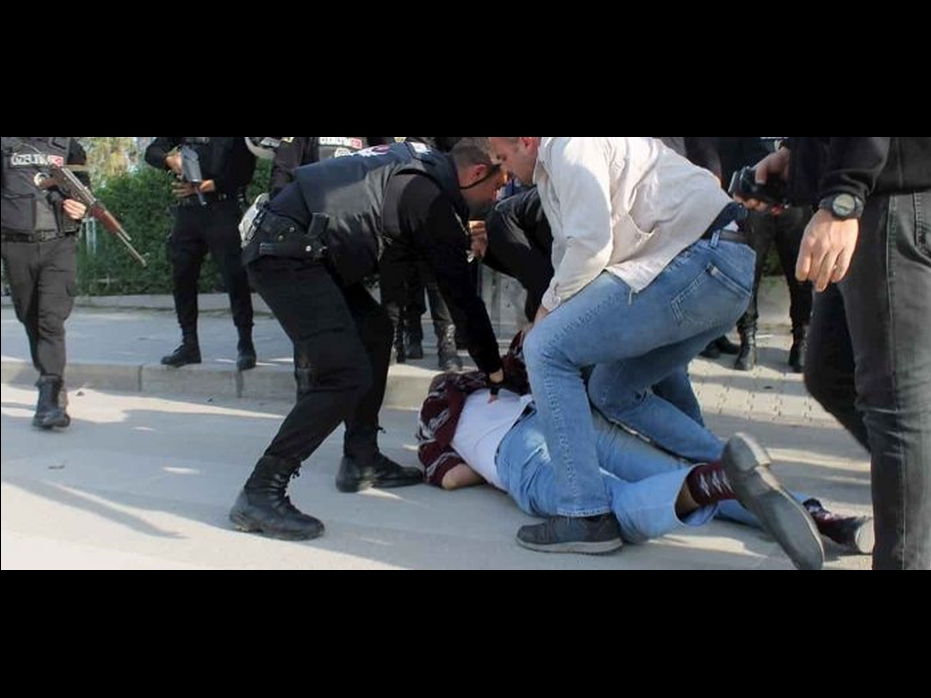
On Sunday, over one hundred protesters were arrested in Ankara during an anti-NATO demonstration organised by left-wing and opposition forces. Riot police dispersed the march with a massive deployment of tear gas, while similar protests took place in Istanbul under a widespread security presence.
But the repression was not limited to the streets.
In the days leading up to the summit, authorities conducted extensive “anti-terrorism” operations across the country. The raids targeted journalists, lawyers, academics, trade unionists, activists, and civil society representatives. Many were arrested without detailed charges being made public. Human rights organisations denounce the systematic use of anti-terrorism legislation as a tool to criminalise political dissent and prevent any mobilisation during the summit. The authoritarian climate was further highlighted by the denial of accreditation to dozens of journalists from independent outlets who were supposed to be covering the summit. This decision was even contested by the Turkish Journalists Association, which claims it excludes precisely those voices most critical of the government from coverage of the event.
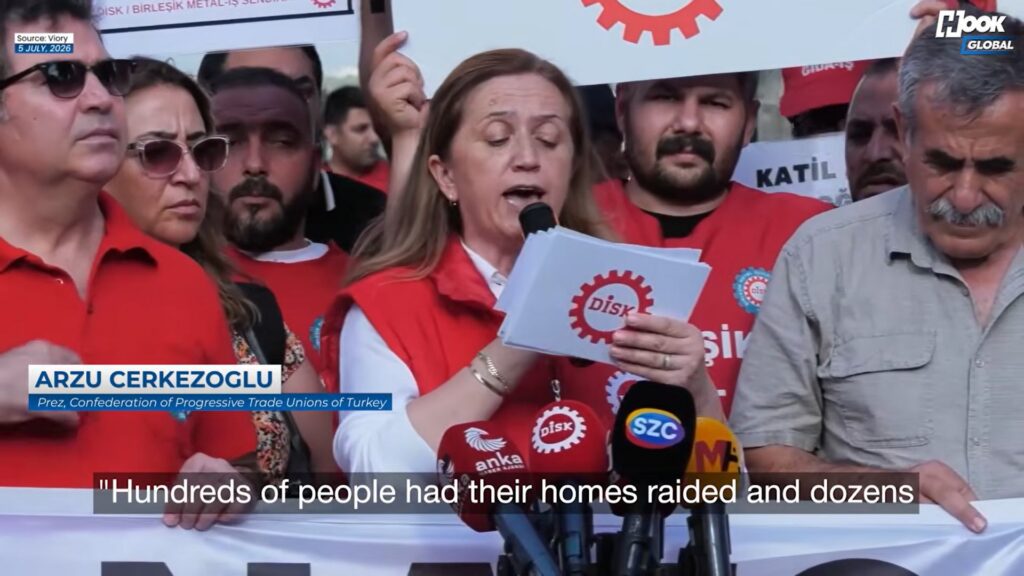
Meanwhile, Ankara has been transformed into a city under lockdown. Thousands of police officers, a blanket ban on demonstrations, extraordinary checks, and restrictions on freedom of movement accompany the arrival of international delegations. According to Amnesty International, the blanket ban on demonstrations constitutes a disproportionate attack on freedom of assembly and expression, while Human Rights Watch has denounced the arbitrary arrest of over two hundred people in the weeks preceding the summit.
This new repressive offensive is part of a now consolidated process. After the failed coup of 2016, Erdoğan has gradually transformed the exception into the norm: the state of emergency has been replaced by permanent legislation that continually expands the executive’s powers, restricts the opposition’s space, and makes the accusation of terrorism an extremely flexible tool against journalists, local administrators, social movements, and political opponents. In recent months, repression has also affected the main opposition party, with the arrest of Istanbul Mayor Ekrem İmamoğlu, considered Erdoğan’s most serious challenger, along with hundreds of administrators, officials, and activists. At the same time, the persecution of Kurdish organisations, feminist associations, the LGBTQIA+ movement, and independent civil society groups continues.
Yet all this seems to be taking a back seat.
For Western governments, the priority is to strengthen the Alliance’s military, increase defence spending, and consolidate strategic cooperation with Ankara. Human rights violations, the restriction of civil liberties, and the repression of opposition are relegated to secondary issues, if not completely ignored.
It’s an increasingly evident contradiction. The Atlantic Alliance continues to present itself as the guarantor of democracy and freedom, yet it is holding one of its most important summits in a country where demonstrating against NATO risks arrest, where journalists are excluded from reporting, and where counterterrorism is used to silence dissent.
This isn’t just a Turkish problem. It’s the sign of an increasingly widespread political paradigm: security becomes the principle justifying the restriction of freedoms, rearmament proceeds alongside the restriction of democratic spaces, while war abroad is accompanied by the expansion of repressive instruments within.
Erdoğan’s Turkey represents one of the most advanced forms of this model. But the silence of Western governments demonstrates that, when strategic and military interests prevail, even the defence of fundamental rights can easily be set aside.
Machine translation