Ninety years after anarchism’s greatest experiment, we revisit Nicolas Walter’s reflections on its fiftieth anniversary
~ punkacademic ~
Anniversaries—milestones on the highway of memory—are important to everyone in terms of ordering their senses of self and shaping their own history. But they are particularly important to social and political movements, and especially to anarchists. As Nicolas Walter notes in the article from 1986 reprinted here, the anniversary of the Spanish revolution is an opportunity to reflect on what was arguably anarchism’s greatest experiment, and greatest success.
As many writers have noted, what happened in Spain is often discussed exclusively in terms of the Civil War, rather than the anarchist revolution that took place during it. And though the historiography has improved greatly—and as I once wrote elsewhere—Anglophone writers need to be careful not to let their own lack of linguistic competence show by imagining ‘nothing has been written.’ It’s fair to say that even now the anarchist revolution is underplayed, to put it mildly. As with other major historical events that somehow don’t get the place they should in ‘mainstream history’, there’s reasons for that.
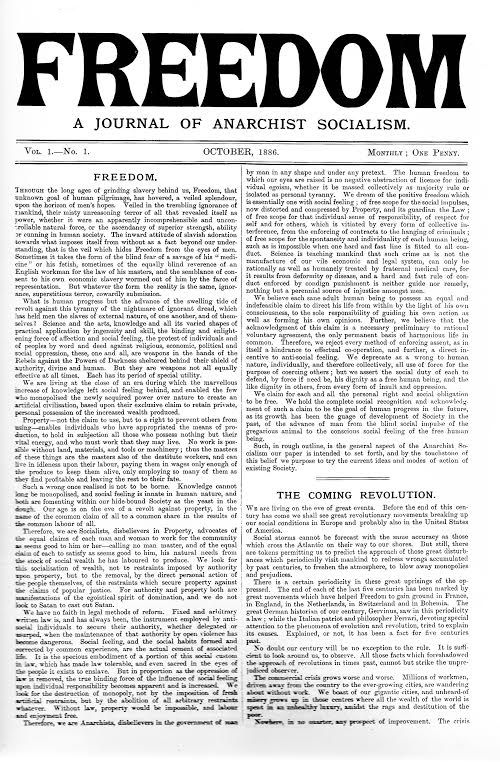
Walter’s essay penned four decades ago naturally can’t benefit from the more recent insights into the revolution offered by a wide range of historians, but it remains a useful primer. Written in the year of Freedom‘s centenary by an historian who was well-versed in appreciating the significance of anniversaries and historical examples, the essay reflects on lessons from Spain that have become fundamental to contemporary anarchist practice. This year, it’s the 140th anniversary of Freedom Press, and the ninetieth of the outbreak of a revolution which saw workplaces and farms collectivised, a ‘living anarchism’ in Catalonia and beyond to borrow the title of Chris Ealham’s book on Spanish anarcho-syndicalist Jose Peirats.
Freedom for a time became Spain and the World, and as Walter reminds us Emma Goldman came to London to propagandise on behalf of the Spanish anarchists. The compromises, the defeats, the failures are well-known, but with this piece, and in these difficult times, we invite readers to muse on the beautiful idea as it was put into practice on a large scale. The French anarcho-syndicalist, Gaston Leval, reminisced that he encountered a comrade at the height of the revolution in Levante who said “Now I can die, I have seen my ideal realised”‘. As Leval put it pithily, ‘his ideal’ was ‘libertarian communism, or anarchy’.
Ninety years on, that ideal lives—just as Freedom, one hundred and forty years after its foundation, continues to fight for it.
(From Freedom, vol. 47 no. 6, July 1986)
SPAIN: CIVIL WAR AND REVOLUTION
OF ALL the many significant events whose 50th or 100th anniversaries are being commemorated during 1986, none means so much to anarchists as the beginning of the Spanish Civil War and Revolution in July 1936. The dramatic developments then and during the subsequent three years represent the most important example and test of anarchism in practice throughout the whole history of our movement, and the present anniversary provides a good opportunity to reconsider the episode from the anarchist point of view. It would be impossible to tell the full story here — indeed it is unnecessary, since there are several excellent books which describe and discuss the general pattern or particular aspects – but it is worth indicating some of the areas which deserve special attention.
Civil War and World War
The historians and the media always concentrate on the Civil War. This began when the various polarisations between the various extremes in Spanish society eventually developed into a full-scale armed confrontation, under the bourgeois Republic which had been proclaimed in 1931, between the Liberal Popular Front Government which was elected in February 1936 and the reactionary Army which began a rebellion against it in July 1936.
The military rebellion began in Spanish Morocco on l7 July and spread throughout the Spanish mainland on 18 July. It was intended to be a rapid pronunciamiento (rising) leading to the establishment of a junta (committee) exercising a right-wing dictatorship, following the long tradition of Spain and Spanish America, which had most recently been expressed by the regime of Miguel Primo de Rivera from 1923 to 1930. If the confrontation had simply been between the rebel Army and the civilian Government, this is indeed what would have happened. The Army was determined, and the Government was willing to negotiate a compromise rather than risk arming people. But the situation was not so simple. The social and political divisions in Spain were highly complex, involving not just rich and poor and Right and Left, but semi-feudal landowners and landless labourers, great industrialists and industrial workers, the powerful and wealthy Catholic church and the alienated and anti-clerical intelligentsia, Fascist Falangists on the extreme right and revolutionary anarchists on the extreme left, with all sorts of conservatives and liberals and radicals and socialists and syndicalists in between.
In the event the military rebellion was resisted by the bulk of the ordinary people over most of the country, and on 19 July the Government surrendered to its own citizens and distributed arms. The two sides quickly occupied about half the country each and mobilised mass support. On one side – the Nationalists — the Army was joined by the landowners and industrialists, the Church and most of the political Right. On the other side – the Loyalists or Republicans – the Government was joined by the workers and peasants, the intellectuals and most of the political Left.
Roughly speaking, the Nationalists gained control of most of traditionalist Spain – the north-west, the centre, and the south-west — whereas the Republic gained control of most of progressive Spain — the north-east, the south-east. There were some important anomalies — the Basque country in the north supported the Republic , and libertarian Andalucia in the south was immediately conquered by the Nationalists — but the general pattern of the war was the slow advance of the Nationalists from old, Catholic Spain into new, industrial Spain. The heart of the Republic was the north-eastern region of Catalonia, with its capital at the industrial centre of Barcelona; but Madrid, although the capital was moved away, was held against repeated Nationalist attacks until the very end of the war in March 1939, two months after the fall of Barcelona.
The Civil War was really many civil wars, between social and political and religious and regional and ideological and cultural interests and groups, recapitulating all the bitter conflicts of the previous century and more. At the same time the Civil War was an international war, between various countries and classes and parties outside Spain, rehearsing the even more bitter conflict of the Second World War. Throughout Europe and beyond, politically conscious people identified with their parallel groups in Spain. On the Right, Fascist Italy and Nazi Germany helped the Nationalists from beginning to end; on the Left, Soviet Russia helped the Republic from soon after the beginning until nearly the end. The Western democracies (including Britain) maintained a policy of ‘Non-intervention’ – which meant letting the Nationalists win and risking the Fascists taking control, rather than helping the Republic and risking the revolutionaries taking control (rather like the Spanish Government in July 1936) — but their left-wing parties supported the Republic, and thousands of left-wing individuals went to fight Fascism in Spain.
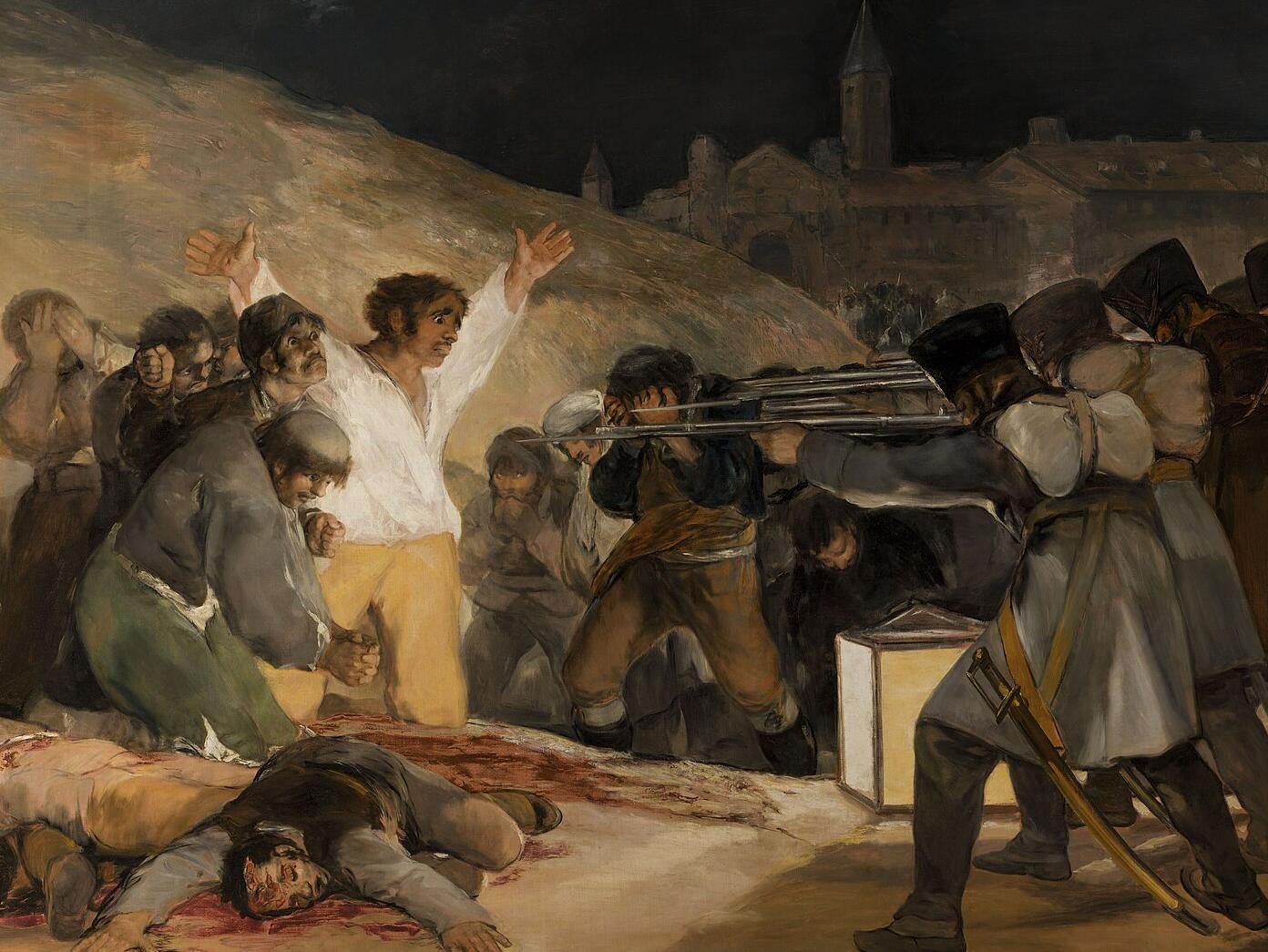
In the event the dominant factor was not which forces were superior in Spain, but whether Hitler and Mussolini would give more assistance than Stalin or the International Brigades; and when Stalin began to withdraw his assistance in late 1938, the Republic was doomed. The complex story of these developments is the tragic history of the Spanish Civil War. But although it was obviously the most important event in Spain during the late 1930s, a very significant event of the same period was the social revolution in the Republic.
Revolution and Counter-revolution
The Civil War occurred because the mass of the people in general and the forces of the revolutionary left in particular ignored the Government and resisted the Army in July 1936. But many of those who thus saved the Republic still ignored the Government and at the same time started a radical revolution against it.
The bourgeois state lost virtually all its power either to the rebelling Armyor to the resisting people. In the Nationalist zone a new militarist state was established, but in the Loyalist zone the state was not abolished but withered away – as Engels had said it would, though not how he had hoped it would. In the Republic political affairs were taken over by the revolutionary parties and the people’s committees, and economic affairs were taken over by the syndicalist and socialist trade unions. A large proportion of the land and of trade and industry was collectivised, the former owners and managers being replaced by workers’ and peasants’ councils and assemblies.
The result was the most profound and at the same time the most popular large-scale revolution in history — much more so than the English, American, Mexican and Russian revolutions before it, or the Chinese, Cuban, Vietnamese and other revolutions after it – but it has been widely neglected or distorted, partly because it took place in the middle rather than before or after a bitter civil war, and partly because it was dominated by libertarian ideas and actions which were then, and still are, disliked by most journalists and historians. Nevertheless it was well documented at the time and it has been well described and discussed since then.
Of course there were all sorts of errors and excesses in the Spanish Revolution – such as the use of terrorism (involving the murder of several thousand civilians in the Republic during the second half of 1936) and of authoritarianism (involving the enforcement of collectivisation on unwilling workers and peasants as well as on middle-class dissidents) – but this has been true of every revolution in history. Of course it did not last – but it was destroyed not so much by internal defects as by external attacks, from the Nationalist Army and Fascist regime which gradually conquered the Republic and imposed an overt counter-revolution in its growing territory, and also from the Republican Government as it recovered its power (and especially from the Communist Party), which tried to keep Spain safe for democracy and imposed a more covert counter-revolution in its shrinking territory.
The Communist Party of Spain was relatively small in 1936, but it immediately opposed both the rebel Army and the revolutionary people, adopted a firmly middle-class position, supported the Republic and exploited the military assistance from Soviet Russia to increase its power in the Government. Just as in the Russian revolution 20 years earlier and as in so many revolutions since, Communism emerged as a major counter-revolutionary force and one of the most serious and successful opponents of liberty, equality and fraternity in the revolutionary movement.
But if the reactionary nature of Communism is the main negative lesson of the Spanish revolution, the main positive lesson is the revolutionary nature of anarchism in the country which had the largest anarchist movement.
Anarchists and Syndicalists
All the essential elements of anarchism- the urge for liberty, the spirit of revolt, the tendency towards decentralisation, the practice of direct action and mutual aid — were strong traditions in Spanish history, in opposition to the dominant traditions of authority, conformity and centralisation and in the face of social hierarchy, economic corruption and political dictatorship. As usual, there was a double libertarian tradition — the advocacy of mutualism and federalism by some upper-middle-class followers of Proudhon and of co-operativism and communalism by some lower-middle-class followers of Fourier, and the collectivism and communism of working-class rebels both on the land and in the growing industry. There was a series of social experiments and of popular rebellions throughout the nineteenth and early twentieth centuries which showed increasingly libertarian features.
Conscious anarchism, which developed during the 1860s especially among French-speaking and Italian-speaking socialists, was introduced into Spain from 1868 by associates of Bakunin in the International Working Men’s Association (the First International). A permanent national movement was established in 1870 with the formation of an open section of the International and of a parallel semi-clandestine anarchist organisation designed to dominate the labour movement — a pattern which was followed for the next 70 years.
Anarchists took part in the federalist and communalist rebellions of the Cantonalist movement of the early 1870s, which was inspired by the Paris Commune of 1871, and continued to dominate the Spanish section of the International after the split between the authoritarian Marxists and the libertarian Bakuninists at the Hague Congress in 1872. The anarchist movement grew, despite official and unofficial persecution from the Government and the ruling classes, at first mainly in rural Andalucia in the south and then mainly in urban Catalonia in the north-east, and it always had more support and influence in Spain than the socialist movement – contrary to the pattern almost everywhere else.
Anarchists were persecuted with great violence, and from the 1880s “they responded with violence; the persecution continued, they resorted to terrorism, and the authorities retaliated with torture. This pattern of polarisation, which followed that in the rest of society, led to a series of strikes and risings culminating in the virtual civil war of the Tragic Week in Barcelona in 1909. There were also constructive aspects of the movement.Attempts to spread libertarian education culminated in the work of Francisco Ferrer, until he was executed after being framed for responsibility for the Tragic Week. Attempts to improve the status of women led to the formation of independent women’s groups, such as Mujeres Libres (Free Women).
Attempts to develop the labour movement culminated in the rise of syndicalism, which spread from France to Spain and led in 1910 to the formation of the CNT (Confederacion Nacional del Trabajo — National Confederation of Labour). This became the largest labour organisation in Spain and, although it was never officially anarchist and always included many non-anarchists, it exerted a powerful libertarian influence. At the same time anarchism attracted many middle-class people, especially young professionals and intellectuals, and became an integral part of cultural life.
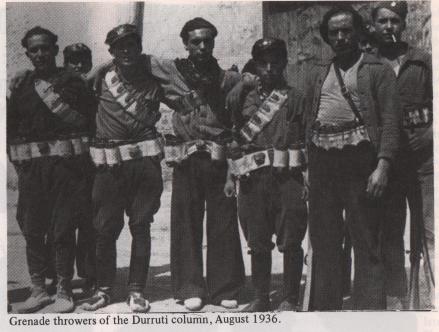
The syndicalists were persecuted with great violence, just as before. After the First World War there was a virtually continuous series of strikes and risings, during which the authorities used pistoleros (hired assassins) to murder syndicalist leaders, and some anarchists (especially Durruti and Ascaso) replied in kind. In 1921 the CNT provisionally affiliated to the Communist International, under the influence of the Russian Revolution; but in 1922 it affiliated instead to the revived International Working Men’s Association, which followed a libertarian line in reaction to the Communist regime. In 1927 the pure anarchists formed the FAI (Federacion Anarquista Iberica – Iberian Anarchist Federation) as the latest of the semi-clandestine organisations designed to dominate the labour movement, and most CNT leaders were also FAI members.
Under FAI influence the CNT continued its insurrectionary line. In 1931 a group of 30 moderate CNT leaders (the Treintistas) protested against the intransigent policy and proposed closer relations with the new Republic. They were expelled, causing a split in the CNT until 1936, and many syndicalists and even anarchists did at least vote for left-wing parties in 1936 ~ hence the victory of the Popular Front, which prompted the Army rebellion, and thus the Civil War and the Revolution.
But despite the nature and extent of the Revolution, the anarchists and syndicalists came under increasing pressure, trying at the same time to win the War and the Revolution, fighting Fascists on one side and Communists on the other. During late 1936 the CNT-FAI leaders felt forced to join the Government, first in the regions and then in the Republican Cabinet, which alienated many of the followers. Then, during 1937 the Communists forced the Government to attack militant anarchists and syndicalists, as well as left-wing socialists. Meanwhile the Revolution was gradually co-opted and then destroyed. By the time the Civil War was lost, in early 1939, the libertarian movement, crushed from both sides, had already lost the peace.
Spain and us
Anarchists in Britain responded to the Spanish Civil War and Revolution like anarchists in other countries and other socialists in this country, by giving all the support and solidarity they could. But for nearly 20 years anarchism had been in deep decline, following the First World War and the Russian Revolution, and it took some time and much work to mount effective help for the Spanish comrades. Nevertheless, money and supplies were collected, orphans and refugees were given hospitality, and the anarchist case was presented in the media. Emma Goldman came to London as the representative of the CNT-FAI, and formed the SIA (Solidaridad Internacional Antifascista – International Antifascist Solidarity) as a propaganda front.
The British anarchist press was almost non-existent in July 1936, but after some false starts Vernon Richards began Spain and the World, an ‘Anti-fascist Fortnightly’ which appeared from December I936 to December 1938 and which resumed the periodical work of the Freedom Press (and eventually led to the present series of Freedom). By that time, of course, the Civil War and the Revolution were both well under way – indeed the Civil War was already beginning to go wrong and the Revolution was already coming under pressure.
Spain and the World tried to present the truth about the Civil War and the Revolution, and even about the anarchist and syndicalist movements,without either concealing the facts or dividing the libertarian forces, avoiding both mere propaganda and mere sectarianism. It remains one of the few publications of the period which were worth reading at the time and are still worth re-reading 50 years later, and which have value, as a source of both information and comment that don’t need revision or recantation.
It is therefore not surprising that one of the most valuable books on the part played by anarchists and syndicalists in Spain is Vernon Richards’s Lessons of the Spanish Revolution (1953, 1972, 1983). And if Freedom and the Freedom Press have played a worthy part since then it is by maintaining the same tradition of combining sympathetic with critical comment on the basis of truth and reason.
It is all too easy here and now to draw the lessons of the Spanish Civil War and Revolution, but things were different outside Spain then and things are even more different now even inside Spain. Perhaps the most important lesson is to learn the lessons at the time and place rather than later or elsewhere. But it is still worth returning to that wonderful and awful episode to discover what some people did for the libertarian revolution there and then and to consider what we could do here and now.
NW