The debate over the term ‘anarchism’ as an asset or liability rears its head in this comment piece from 1966
~punkacademic~
Back in February 1966 Freedom wasn’t thinking forward to the World Cup that year (or whether there’d be a boycott, for that matter), but instead contemplating a question that bugs all of us trying to promote our beliefs amongst the public. This was the issue of the ‘A’ word – you know the one, anarchism – and whether or not its historical baggage makes it more hassle than its worth when trying to promote, well, anarchism.
This was a live question in the post-war period for the Freedom group. Colin Ward, the most familiar figure from those decades, frequently used other language to describe his views – he was particularly fond of autonomy – and on a number of occasions had to be reined in by the Group as a whole, in particular over the title of the journal Anarchy (Ward had wanted to call it Autonomy, as David Goodway notes in his long interview with Ward, Talking Anarchy).
This is not to say that Ward denied he was an anarchist — quite the contrary, Ward had testified to that on plenty of occasions including explicitly in a BBC interview in 1968. But Ward’s view was that the baggage associated with the term anarchism led to its immediate dismissal from discussion in the world of ‘respectable’ political and social ideas. In Anarchy in Action, he famously used the phrase that anarchist beliefs in contemporary society had to be ‘let in the back window’. And Ward was promoting anarchist ideas beyond Freedom and Anarchy; in the 1970s he fronted a BBC documentary on community in the New Towns drawing on his professional expertise as a town planner, but it is telling that in the BBC billing he is dubbed as a ‘writer’ rather than an anarchist.
Ward also wrote a series of articles in New Society, which at that time was a popular read amongst Labour-supporting intellectuals, where he described anarchism under the name of ‘self-help socialism’. His views were the same, but they were rebranded for an audience that would, he felt, be more receptive if he dropped the A-word.
Did it work? The jury’s out, given that Ward’s wider activities were often conducted without his audience’s knowledge that he himself was an anarchist, and thus that the ideas they were receiving often had anarchist origins. For Ward that was less of a problem. A key contention of Anarchy in Action, following (as Ward described himself) ‘in the Kropotkin tradition’ was that anarchism as a practice was a real, existing, everyday presence in society, conducted and enacted by people who would never even think of the ‘A’ word. On that basis, maybe Ward’s repackaged ‘self-help socialism’ cut through with some who it wouldn’t have convinced the same way if titled anarchism.
But whilst that’s difficult to prove, it remains the case was that Ward’s ideas, packaged in this fashion, were seized on by politicians such as David Owen, who saw in the language of ‘self-help socialism’ a way of reconciling a Thatcherite political discourse in the later 1970s and the early 1980s with a nominal commitment to retaining the term ‘socialism’, which Ward would wholly have disagreed with.
There’s a parable there. In the late 1970s, socialism as a term — one which Labour politicians of different wings of the party had used in an unproblematic and ideologically-varied way since the pre-war period – was being driven out of public discourse, as anarchism had been before it. Owen’s seizure on Ward’s language (if not his ideas), as shown in Owen’s book Face the Future, is similar to how right-wing libertarians seized on the language of mutualism to endorse privatisation.
As noted above, Ward wouldn’t have agreed with Owen’s usage, just as he wouldn’t have agreed with party politics in general or Owen’s SDP in particular (although as Goodway noted in Talking Anarchy, there are similarities with SDP intellectual Michael Young’s views, which Young himself acknowledged). But that matters less here than the substantive point, that the problem of the name is less to do with the ‘baggage’ (the well-known popular imagery of assassins and bombs) than erasure and appropriation.
Whilst the public can be made to be scared of any term elites choose through the hegemonic propaganda of the media, be it anarchism or socialism, what elites fear are the ideas themselves.
John St. Lawrence’s piece reproduced below was an intervention in a live debate not only in the Freedom group but also in the anarchist movement more widely, and one that continues to this day. Two years after its publication, anarchism would get a shot in the arm from the student revolt in France, which explicitly drew on anarchism as well as Maoism, and which would draw the attention of the BBC to Freedom — as well as that of the police. Anarchy’s 99th edition in 1969 would pay attention to that welcome revolt and revival, and the 100th edition was Nicolas Walter’s introduction to anarchism for a wider audience.
By 1969 the A-word was definitively back, and whilst its fortunes wax and wane, its usage and invocation remain vital, as John St Lawrence argues below.
———–
WHAT’S IN A NAME?
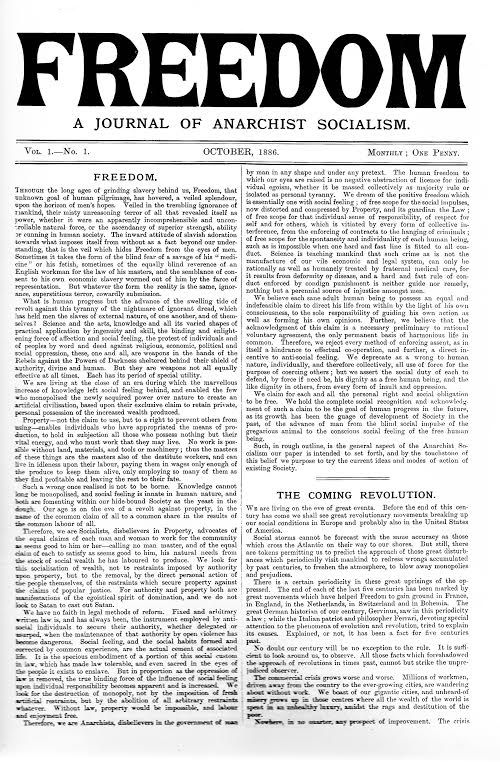
Freedom, February 12, 1966, Vol 27 No 5
So often anarchists are asked why don’t we find some other name with less emotive connotations.
Occasionally one tries, when one finds oneself in a position where people will listen to libertarian ideas until they hear the word, or where the actions of those who share the name appear unanarchist and no advertisement. But what other name? Libertarian? Longer and sounds like Liberal or at best socialist-Liberal. Fraternalist? Koinoniaist? Communitarian socialist? Voluntarist socialist? Cooperator? All suggest withdrawal from the world as it exists, a somewhat pietist elite building an Utopia away from contamination; which even if it were desirable would be impossible.
Acephalist? All right philologically but too academic.
SOCIALISM AND ANARCHISM
Perhaps this is to start at the wrong end; we have not yet clarified adequately what we wish to convey. One might start to equate anarchist communism with activist, applied, authentic socialism; but immediately one is faced with the necessity to insist that socialism has nothing to do with state ownership and control; and to those who quote the dictionary definition ‘principle that individual freedom should completely be subordinated to interests of community’ one has to recount the history of the International. So even if one had not as yet-used the word anarchism, it would then have to be introduced.
We may now—with reason—have considerable doubts on the ideas of Bakunin; undoubtedly he devised conspiratorial forms of organization which Lenin copied to fashion Bolshevism, and at that point in his criticism of Bakunin Marx was right and more anarchist than was Bakunin. But having admitted this, the fact remains that Marx’s formulation of the State withering away was totally at variance with the rest of Marx’s analysis of power. We cannot fairly argue from the experience of the Bolshevist revolution in Russia— the only occasion when Industrial workers have ever even temporarily captured an whole nation state—that inevitably all leaders and all capture of state power must lead to tyranny, for this is an unjustifiable argument from the particular, to the general; but we can say, as Marx himself said, that never in recorded history has a ruling elite willingly surrendered power, and we can say from this that the evidence is that they probably never will.
So ‘anti-state socialism, opposition to all ruling elites whether founded on the ownership of money or the control of the state apparatus’. Fair enough, but there are many socialist groups which believe sincerely that the policies that they propound at elections or within the Labour Party would lead to this; so we have to add that it is socialism with a do-it-yourself kit. However, since Marx himself said ‘the emancipation of the working class is the task of the working class itself, it is clear that we have to add that ‘do it yourself in this context means that the working class must free itself by its own direct action to take direct control of industry and society; and that moreover we do not hold (as do, for instance, the writers of ‘Towards Socialism’) that therefore whether in a Bolshevist elite or pervading an hegemonic party, middle class intellectuals have a right to lead the workers.
So immediately we have to define the role of the anarchist in trying to convert his fellows and build a mass revolutionary movement; since he does not constitute a vanguard elite any more than he believes in staying within ‘the mass party of the workers’, it is necessary to talk of militant minorities and propaganda by the need. So again, even if the word anarchism was not so far used, it would be necessary to refer to Just those parts of the anarchist past which one was presumably trying to forget, in order to show that it is possible for a revolutionary minority to act in a selfless way in order to raise the consciousness of others with no intention of later imposing leadership.
ANARCHY AND COMMUNITY
We are therefore trying to convey not merely the concept of anti-authoritarian socialism, not merely the need for self-activity but also the need for the absence of directing intellectuals within the movement; moreover, incidentally, that this Is not just for those who wish to opt out but a total change in society, since it is integral to anarchist thinking that where power groups exist it is their nature to attempt to expand their power.
Not merely would those who were still authoritarian wish to subject any libertarian communities near them to their rule, but they would also fear them as a danger to their own power.
The fact that a community within an industrially advanced society has to compete with it on terms dictated by that society; means that it must inevitably fight constantly to maintain itself or become corrupted. One may find an exceptional community, such as that at Stapleton which consistently refuses to compromise, but at the cost of continual harrying by the state, and at the cost of living without all luxuries; one finds, too, the occasional equally courageous community such as Koinonia in Kentucky, which miraculously survives despite almost weekly bomb attempts from the Klan.
ANARCHISM AND SYNDICALISM
Of course much of all this is denoted by Syndicalism; though now that the Liberals are talking of Democratic Syndicalism this is becoming less a synonym for an aspect of anarchism, and so it is again necessary to talk of anarcho-syndicalism to make the distinction—just as it was necessary at one stage to use the longer term to distinguish oneself from national-syndicalism. But since Syndicalism is the industrial application of anarchism there is no real distinction of terms; few will have heard of the term who have not heard of anarchism and those that have heard of a perversion of it.
Syndicalism is a method for getting anarchism. This makes it in no way less important since to anarchists there is no distinction between ends and means; but though the syndicate is an anarchist society in embryo, nevertheless since anarchism is essentially pluralist not all the facets of an anarchist society will be syndicalist, and no syndicalist would deny the importance of other facets.
But even by suggesting the term Syndicalist one refers back to that emotive past which the innocent inquirer thinks one ought to wish to disown.
Let it be clearly admitted there is a lot in the anarchist past of which anarchists may well be ashamed; many of our foremost personalities have been essentially authoritarian in nature; many of our acts have been mistaken; people who have used our name have so behaved that at the turn of the century in France the term was used to denote armed bandits of quite apolitical and anti-social thieves; and we can all think of traditions of anarchism with which we would rather not be associated. But though there are many bad things associated with the term, not only are there immeasurably more that are good; but most of the bad ones even if we wish to disown them, we cannot do so, since it is essential to be able to refer to them in order to illustrate from the good points in them the possibilities for better for the future.
John St. Lawrence.