We must resist today’s official efforts to falsify history, as if the working class was merely defending the Republic
~ CNT Confederal Committee ~
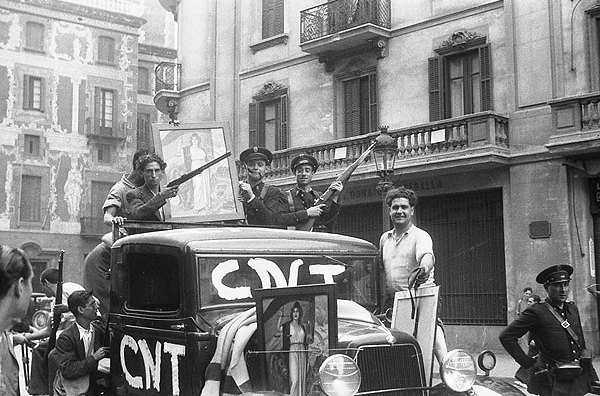
This weekend we marked 90 years since the working class defeated the coup d’état. The people, who rose up in arms, managed to halt not only the ambitions of all the factional forces behind this military uprising (namely, the Catholic Church, monarchist forces, the most reactionary elements of the bourgeoisie, and international finance capital), but even after their own victory, they did not stop there and began the most profound social revolution in history.
But what is a Social Revolution? A Social Revolution is certainly not a change of government, nor even a change in the form of the State. A Social Revolution is a change in the social relations that underpin the existing order. It replaced the organisation of the economy by private enterprise or the State with organisation by the working class itself, through collectivisation, both in industry and in agriculture.
The transformation of social relations, however, was not limited to the economic sphere. This very change, aimed at overcoming capitalism with a new libertarian communist economy, enabled the implementation of measures of all kinds to address the social problems of the time, many of which remain unresolved in our society today.
From the role of instruction and education in society, to the housing problem, conscious motherhood, gender equality, and the national question and its federalist resolution, among other issues that sought to eliminate the old institutions of society and create a new libertarian society, these exemplify the profound nature of a revolution made by workers in both rural and urban areas.
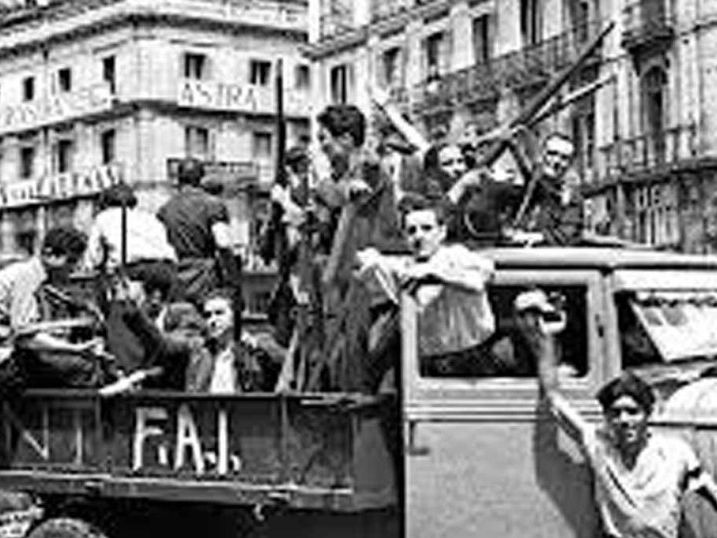
This revolutionary impulse of the people, of the anonymous figures of history who nevertheless shape the world every day of their lives, was sustained thanks to their effort and sacrifice, including on the military front through the workers’ militias. Even in the organisation of the military struggle, the outdated and rigid authoritarian forms of the armies were transformed into militias sustained by the workers’ and revolutionary movement itself.
The Spanish Civil War, triggered by the defeat of the fascist military coup of 1936, was the continuation of a class war simmering in revolutionary struggles: from the Asturian Commune of 1934 to communist-libertarian uprisings like that of Fígols. This class struggle dates back to the time of the First International in Spain, and to all social struggles in which the proletariat has played a leading role throughout the world.
Ninety years after this landmark event in history, which has never been surpassed and serves as an example for our daily struggles, we must also point out that the regime that fought against this process from the outset was also the Republic itself, along with the liberal and republican bourgeois forces, social democrats, and Stalinists. The defeat of the revolution preceded the military defeat of the Second Republic and the imposition, through bloodshed and genocide, of a regime of terror led by the criminal Francisco Franco.
The regime change that, almost 40 years later, gave rise to the current Kingdom of Spain, in the form of a constitutional monarchy, was nothing more than a pact, a transaction between the forces that administered Francoism and those of a new liberal and social-democratic bourgeoisie, against the backdrop of a significant new episode in the class struggle on the Iberian Peninsula, the 50th anniversary of which is also being commemorated this year, 2026. The defeat of the proletariat in the “Spanish transition” has, once again, entrenched new reactionary forces in power, even though they dress in sheep’s clothing. And one of the clearest examples is the falsification of historical memory, now called Democratic Memory.
From public institutions, the official academy, and the shipwreck of social democracy and Stalinism, a reinterpretation of historical memory is being promoted in which there was never a Social Revolution, where the anarcho-syndicalist and anarchist women and men of the CNT, the FAI, Mujeres Libres, or the Libertarian Youth fought, not for a radical transformation of social relations that would overcome Capitalism in a libertarian communist regime, but now they rewrite history to say that they fought for a Republic that fought and imprisoned them before the civil war, fought them during the civil war, and whose political heirs of today try to erase them from history.
It is no coincidence that, just a few years after the last comrades who personally experienced the Social Revolution of 1936 passed away—comrades who are no longer here to confront the falsifiers of history—efforts are proliferating to erase democratic memory from the revolutionary process.
It is within our power to prevent this from happening, and to ensure that the aspirations that motivated those who anonymously built the greatest Social Revolution known to this day also guide us in addressing the current problems of the working class in our society and throughout the world.
Machine translation from CNT.es