Sixteen arrested as main caravan regroups in Greece (interview)
~ Gabriel Fonten ~
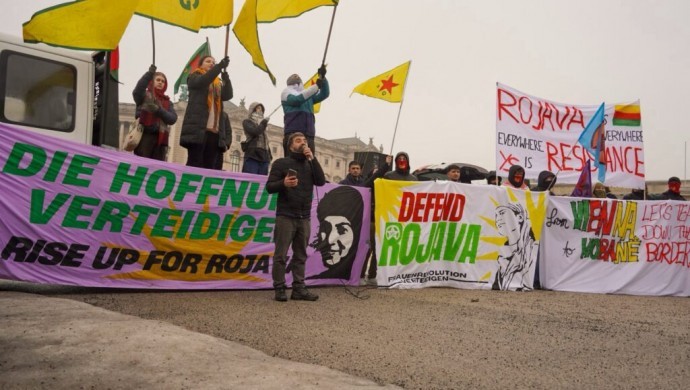
Sixteen members of the People’s Caravan to Kobane, who were travelling inside Turkey toward the Syrian border, were detained by Turkish police yesterday (28 January), said organisers. The group included many young people and several female journalists, and it is unclear whether and when they will be deported. At the same time, the main car convoy of the caravan was stopped at the Greek-Turkish border and denied entry. Activists are currently considering their next steps.
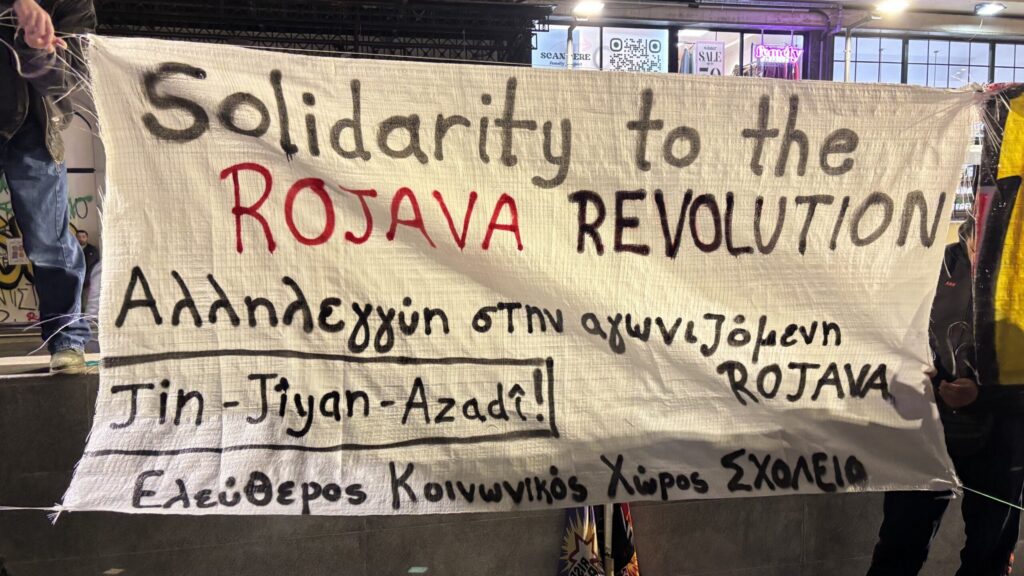
The caravan is drawing attention to the Syrian state’s attack on Kurdish Rojava, with Western complicity.
Earlier, Freedom interviewed a participant in the Caravan, which left Vienna on 25 January.
Could you talk about the progress of the caravan so far, how many people have joined and what organisations are involved?
We started from Cologne in two cars with ten people. This morning we met with the other routes coming from Berlin and the south of Europe, we met in Vienna and are now over 100 people.
So I would say that with each step and each city that we go through, we increase in number and also morale and energy.
There are many different organisations inspired by the Kurdish freedom movement, but also organisations that are connected to the cause like comrades from No Borders.
We are travelling many hours each day in the car. At first in German cities we were able to participate in demonstrations with many Kurdish comrades. We stopped in feminist centres and community centres in general.
This morning we began our conference in Vienna and now we are heading to Belgrade. I think this is like really a reflection of how much the revolution of Rojava could inspire activists in Europe and how much it can make people leave behind the inertia that the system lulls us into. So I think this is a really important aspect of this journey. Of course our objective is to protect the revolution and the people of Rojava. But at the same time it’s also something for us to get out of passivity and to react to a world that is more and more intense every day. Also it’s not just Europeans, but some Kurdish friends and also some friends from Colombia. We are from Germany, France, Colombia and other countries. Austria, UK, Ireland.
What are the aims of the Caravan?
The aim is also to break the silence that we find especially in European and Western institutions and mainstream media about what is going on. It’s unacceptable because, yes, it’s also the legitimation of the European Union that made this (the attack on Rojava) happen. Obviously also the USA and Israel also.
We are concerned here with developments like Ursula von der Leyen sending 260 million Euros to Al Jolani, the interim President of Syria. This is something that legitimises this authority and is basically something we cannot accept.
I mean, there are different things we could say also. How much we should take responsibility for what the revolutionaries in Rojava gave for the whole world by defeating ISIS. So this also I think.
12 years ago, four years in war against ISIS, many people gave their lives, and now European institutions are legitimising the government that is opening the prisons that were guarded by the comrades and freeing thousands of ISIS militias.
So actually, our action to defend Rojava is an action to defend all of us from a threat that just a few years ago was terrorising the whole world. It’s important for us to remember this.
Why did you choose Kobane as your destination in Rojava?
I think the fact is Kobane is under siege. It’s surrounded by the forces of the enemy and the villages around it are attacked by jihadist forces and the city itself is at risk of falling in the hands again of jihadist forces such as the HTS, the militia that is at the head of the Syrian transitional government. Also, Kobane is an important symbol of resistance for the Rojava revolution. It was freed 11 years ago on the 26th January by the revolutionaries of the Autonomous Administration from the Islamic State. And I think it was, if I’m not wrong, one of the first big victories also against the Islamic State. And so it has big meaning also that Kobane stays free. And so that is why we are we’re going towards Kobane and trying to break the siege of Kobane.
At this moment the situation is really difficult. There are there are a lot of people that have had to move (to Kobane) from other areas, so it’s overcrowded and not everybody has a place to sleep. There was news of four children dying of cold in their sleep. So yes, it’s also a humanitarian issue at the same time as being, as I said, a strong symbol.
When do you expect to arrive?
I expect to arrive… There is a bit uncertainty in this moment because yes, we are afraid that the Turkish state will block us at the border. So right now we’re trying to to pass them and we will see.
The idea is to coordinate with the comrades in Turkey. So we will not probably arrive to Kobane, but we will reach the border from Turkey to Syria to be able to put pressure and raise attention on what is happening at the border. The Turkish border is very close to Kobane geographically. We are organising day by day. It’s not certain who will arrive or when, it will be seen with time.
But there are also comrades that could arrive in Bakur, that is Turkish Kurdistan by plane. So yeah, actually there’s already people that under the name of the People’s Caravan are in Kurdistan and are, yes, documenting the repression by the Turkish state and are bringing solidarity to the comrades there.
How are you funded? Can you tell us more about how you’ve managed the logistics of moving a large group of people across Europe?
Well, at the beginning it was I think mainly private money or money from the organisations that are organised (the caravan), but I’m not sure because I wasn’t part of the organisation in this sense. I was just doing media and also same thing for the logistics. But what I can say is that this started from a small group of very determined people who with this objective in 3-2 days could organise this and also by working everyday.
So making the first step until Vienna, where there are more solidarity structures. So that is structured in the Kurdish community centres where we could go to eat dinner or lunch or yes, just make a break from travel. And then from Vienna on, yes, it was planned basically day by day, finding contacts of comrades, yes, asking for support and asking to bring cars also. And also from Vienna, we tried to really move as a caravan. So we decided to have the biggest car at the beginning, at the end, so that we could really be at unity and also from an external point of view be seen as all together and be all together.
But it was managed mainly by like pure will of doing it and also from people coming. In the end they came also self organising.
What can people do to help and what is best way for people/our readers to follow/contact you?
I think a lot of things are needed and a lot of different things. Yes, it is good to donate money, but I think the best, most important thing is really in this moment is to organise in your local place.
If you cannot or don’t want to go to to the Rojava in this time, to organise, to mobilise the society in your place. For example, to open a group of RiseUp4RoJava, get in contact and link with the network.
Talk with people about it to get informed. Also this is really important because the war also is a lot on information level. There are a lot of propaganda against the SDF, against the revolution in a lot of media. Al Jazeera for example, there was a campaign announced by young internationalist women to boycott Al Jazeera because it was spreading, yes, information that SDF was attacking the population, which was not true.
Basically how to help is basically to get yourself organised because to support the change in Roava we also have to change our our self and our surrounding, especially with the focus of keeping attention on what is happening and mobilising.
The best way to contact us is probably the Instagram account of the people’s caravan. There’s also a website and there is a mail address in their website.