Locked in a Hungarian prison, Maja has been living in a cell without social interaction for two years: “It’s an inhumane system that prevents even minimal forms of mutual support”
~ Marta Massa, Il Manifesto ~
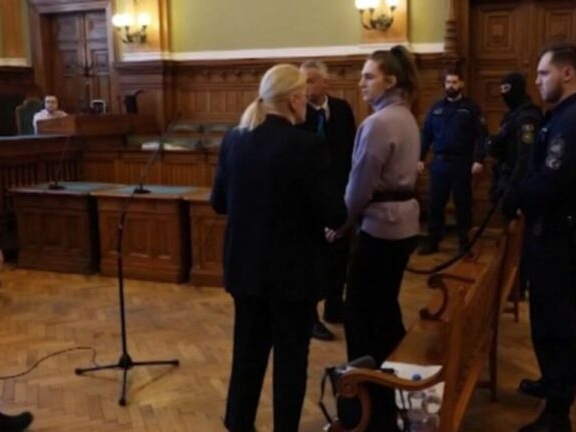
It’s a sunny morning in Budapest. A few meters from Parliament, Maja T. is being held in solitary confinement for two years. Since being illegally extradited (in February 2025, the German Constitutional Court definitively ruled that extradition to Hungary was without legal basis), on the night between 27 and 28 June 2024, Maja has lived and endured in complete isolation. The prison guard awaits our arrival, leads us to the visiting room, and we await his arrival. An armed guard, a translator, and a prison officer sit on the left side of the room. Maja arrives, handcuffed, a lilac notebook in her hand, a pastel-coloured T-shirt, a delicate smile on her face.
How are you?
I’m really tense: it’s strange to be here now, with you and all these people, when just ten minutes ago I was in my cell. I haven’t spoken to anyone in 25 hours. But I’m happy to have a moment to open up and talk, even if it’s difficult to express how I feel and how I’m feeling.
What was the period between February, when the eight-year sentence was announced, and today like?
I knew I wouldn’t be able to return home after the verdict, but this period marked the end of a chapter. It was a nightmare being in court that day, but at the same time, I felt the strength of my family and friends. It was wonderful to feel the support and solidarity of people, but I was immersed in the reality of a profound injustice orchestrated by a system intent on destruction and suppression. I could only sit there in handcuffs, with so many eyes on me. I felt trapped, unable to exist as a human being, only as an object to be observed, onto which ideas could be projected. In the afternoon, I was back in jail, trying to find the strength and new hope to face the next chapter. Sitting in the courtroom, I felt Gabriele, Ilaria, and the other defendants close to me. It was as if they were there beside me. I thought about how Gabriele and Anna must have felt upon receiving their verdict.
This closeness has given me strength and hope. I know we’re enduring a difficult period in our lives, one in which our freedom is being stolen. But there’s always the awareness of how important it is to fight, because there’s so much to lose, and we feel this loss everywhere. After the last hearing, I realised that prison isn’t a nightmare, but my reality. I feel isolated, oscillating between two realities. I’d like to go home but I can’t. I’d like to feel part of this community but I can’t. Then I see my resources, my strength, the solidarity outside, and I’d like to share it with other people, but there’s a wall in front of me and I don’t know what to do. The prison system deprives you of the possibility of existing in a community and experiencing solidarity. The other day I heard that an inmate in a neighbouring cell didn’t have any bread. I wanted to share mine but I couldn’t.
We are forced to endure absurd and cruel rules, which only create competition and loneliness. I try to fight in my own small way, even by creating moments of light-heartedness. I don’t want to give up hope for a joyful life. After the verdict, I felt disoriented and confused because I didn’t know how to fight. I feel the need to, yet I don’t have the ability. Now I’ve learned that fighting isn’t always a matter of speaking out loud; you can fight with the little things. I continue to write letters describing what’s happening here and trying to understand the prison system and the authoritarian system in Hungary. For me, fighting means finding ways to share my resources with other inmates, too, because I see the ways in which our humanity is being stolen. It’s difficult; I often feel hopeless.
Have the prison conditions changed since the verdict?
I’m still in a cell alone. They moved me to the fourth floor, to a cell very similar to the previous one, but I occasionally meet other inmates as I walk down the corridor, and sometimes I can share a smile. Then I hear their voices, I hear them arguing, and I don’t feel so alone, despite the isolation. I have the opportunity to call a German psychologist from the Ministry of Foreign Affairs; I waited almost a year for this meeting. Now I can talk to someone about my situation in prison, my doubts, and my emotions. When my family comes to visit me or during our phone calls, I can ask questions and talk about good things, without distressing them.
What did the arrival of spring and summer mean?
I felt the lightness of spring, the first ray of sunshine in March. At least for an hour a day, when I go out into the inner courtyard, I can see the sun. The winter was long. The 10-meter inner courtyard is the only place where plants and flowers can grow. There was even a tree, but it was cut down and now there’s nothing left. It was a sad day for us. But now, of course, there are already new small plants between the walls. I sense the arrival of the warm season through my family, friends, and their stories. I sit here with my family and they tell me about our garden, about the vegetables they’ve planted in the garden, and I feel the change of season.
What are my expectations and hopes now?
I expect a very hot summer full of anticipation. I know that more months must pass until the next hearings, which will begin in the fall, and I want to be prepared. In the meantime, I write a lot. I received a typewriter; it took a year for them to accept this request. I’ve been sitting in my cell for 23 hours, in front of the desk, only reading and writing, so I’m very happy with this change, because I have something to do. It’s the most important change since the verdict. I still hope to be able to go home; I feel so tired and worn out. Not just within me, but also in my family and friends. I want this situation to end for everyone and I hope to be able to start a new chapter in which I can actively contribute, because I can’t here. I know I’m important to my family, who can’t wait to meet me and be together. But all of this is difficult for me here; I often feel only tiredness, and from there, it’s difficult for hope for change to blossom.
What does resistance mean in this time?
Resisting means defending our will to live, our will to share and defend our spaces, even if we fail in this attempt. Resisting means having the opportunity to love, because we are allowed to exist in freedom. Resistance means being able to act together, to support each other when necessary. For me, resistance means joining forces, without taking anything away from others, without repressing or exploiting anyone. It means not losing hope and realising that even the most difficult situations can change. Even if there isn’t a happy ending, there will be better days if we keep fighting.
Does the change of government in Hungary bring new hope? Do you think it can change anything?
On election night, I felt a great tension in the air, like the first summer storm that pushes you to go out and dance in the rain with strangers. I heard the music at night, the crowd, I felt the people’s joy and the desire to celebrate. I hold out hope that the Hungarian people will now experience a lighter period, with less repression, but I don’t think this new government will change my situation. The conditions of detainees don’t change with governments. Maybe I’m not this government’s main enemy now (as I was for the Fidesz party and Viktor Orbán), maybe they’ve relegated themselves to a lower level on the scale of priorities. In reality, what I see here isn’t hatred but indifference, like a constant, subtle tension. So far, I’ve managed to tolerate the disappointment, feel light-hearted moments, laugh, and enjoy visits with my family. I know that disappointment isn’t all I’m dealing with, and if something else can exist in the world, it’s right and necessary to fight. Over the past few months, I’ve tried to nurture my self-confidence, knowing that I’m never alone. Even though I feel so tired, I try to cultivate strength and courage within myself, and for that, confidence is necessary.
The interview is over; the officer and the guard tell us we must wrap up. Maja T hopes to see us outside soon, in freedom. We exchange a few last smiles before Maja disappears behind the door of the visiting room, crossing the threshold into a world inaccessible to us. A world that for Maja T. is normal daily life.
Machine translation