Community campaign resists reactors built for data centres
~ CCC Team ~
Climate Camp Cymru supported the No Nuclear Llynfi campaign in the Llynfi valley, South Wales, this summer. The group backs local struggles for environmental and social justice by resisting ecocidal developments. This year’s camp squatted land within a mile of the proposed site for four small modular nuclear reactors (SMRs). Venture capitalists Last Energy, a US firm that has never built a reactor, are applying for planning permission. SMRs have almost no precedent, and Last Energy is currently suing the US Nuclear Regulatory Commission to weaken safety regulations while lobbying for similar deregulation in the UK.
No Nuclear Llynfi highlight major concerns: radioactive waste would be stored on-site with no plan for transfer, and below the water table in a zone 3 flood risk area—the highest designation. The site is close to housing and two schools, and would require armed security. Campaigners also note that electricity would not benefit the local community: some would go to a nearby paper mill, but most would be ring-fenced for data centres consuming vast amounts of energy to run artificial intelligence. Many, including voices within the nuclear industry, see this model as a reckless experiment, especially given climate instability and an uncertain security future.
The campaign is especially relevant after Keir Starmer and Donald Trump announced plans to open the UK to US tech corporations—seen by many as vulture capitalism and asset stripping. Those companies are being promised reliable nuclear power for their data servers, to be delivered through SMRs sited on post-industrial “sacrifice zones” by US firms such as Last Energy. Members of No Nuclear Llynfi are doing detailed research, and controversy is likely to deepen as further questionable practices emerge.
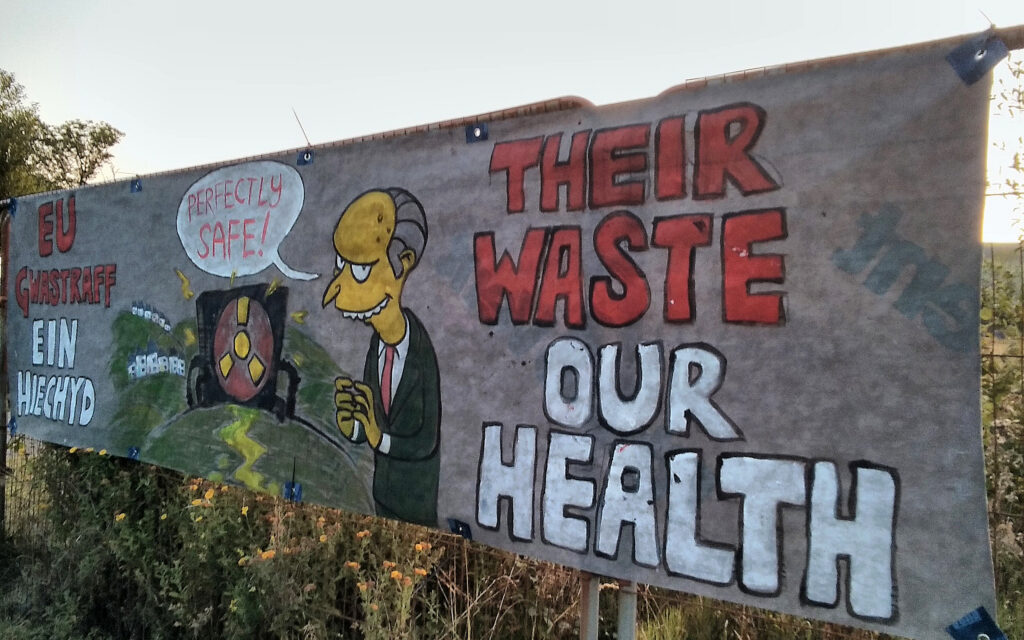
Over the August bank holiday weekend, Climate Camp Cymru established a self-supported site, with kitchens, marquees, toilets and tents. Banners along the busy A4063 were seen by thousands of motorists, flyers were distributed, and door-knocking reached nearly a thousand homes. A well-attended public meeting followed at Maesteg Rugby Club on 25 September, beginning a strategy of tactical opposition. The camp drew steady local interest, with many visiting the welcome desk, and passing drivers signalling support with frequent beeps.
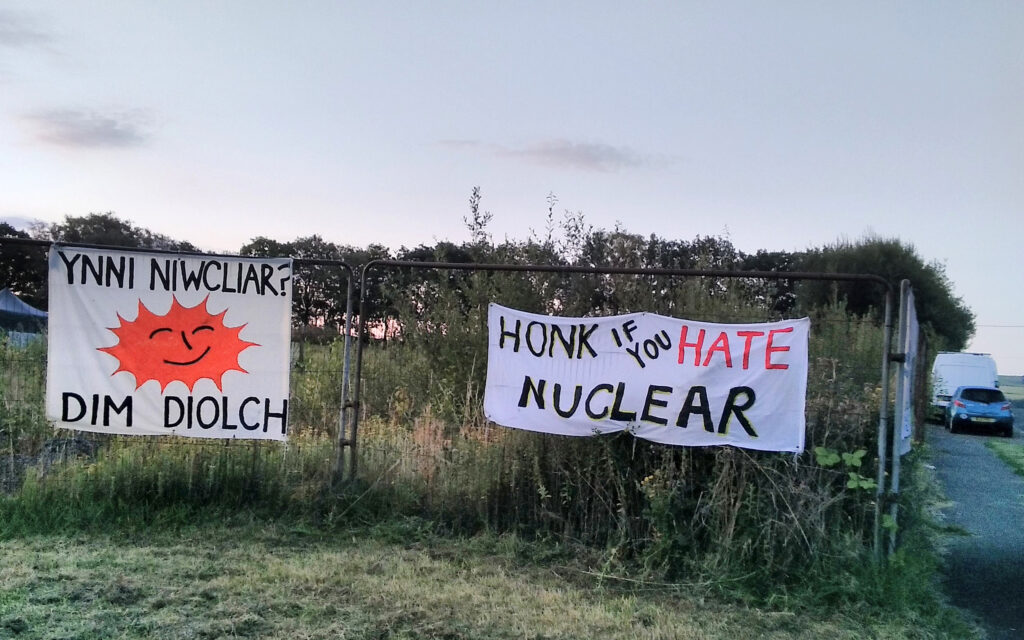
Door-knocking almost a thousand houses revealed that most local residents were unaware of the nuclear proposal, despite Last Energy’s legal obligation to consult. Many expressed shock, seeing it as part of the continued neglect of their communities, written off as sacrifice zones.
Alongside outreach, the camp hosted talks and workshops. Campaigners from Save Kilvey Hill in Swansea gave updates on resisting Skyline’s plan to turn the city’s wooded hill into a theme park. Members of CND and No Nuclear Llynfi detailed Last Energy’s plans, while the Initiative for Nature Conservation Cymru explained their independent legislative work. An academic from Cardiff University offered a radical history of the valleys, followed by a radical Welsh language lesson. Other sessions linked current crises, trained door-knockers, and made banners. Evenings featured conversation and impromptu music around the fire.
The weekend successfully raised awareness in the Llynfi valley, deepened the campaign, and encouraged local involvement. The camp brought together people of varied backgrounds, genders and ages, working collectively in a respectful and vibrant space. The land was left as it was found, neighbours were supportive, and the landowner gave permission to stay. Many locals welcomed Climate Camp Cymru’s presence and commitment to the community.
The camp was part of a long tradition of climate camps worldwide, supporting communities against destructive developments. Climate Camp Cymru is now planning its next gathering, and invites local campaigns to get in touch.