Burnham’s decentralisation of power from Westminster still represents undemocratic centralisation at the local level
~ Jon Bigger ~
Bit by bit, the UK is starting to resemble a collection of semi-autonomous city states, run by powerful barons with little scrutiny. The process began at the end of the 1990s with the devolution of powers to administrations in Edinburgh, Cardiff, and Belfast, but accelerated with the creation and the extension of regional mayors in England. Of course, the devolution in Scotland, Wales and Northern Ireland is different as it represents a shift of power from Westminster to nations within the UK but it undoubtedly reinforces the power of the cities where those administrations are based.
In England, the regional mayors are definitely going to get more money from the new prime minister, Andy Burnham. In the long run, I expect they, and the national devolved administrations, will get more powers. The idea of decisions being made at a more local level can sound smart and desirable if it means enhanced input from local populations. It will be done in the name of decentralisation and democracy but it will be anything but democratic. It obviously won’t be the sort of decision making that would satisfy us anarchists.
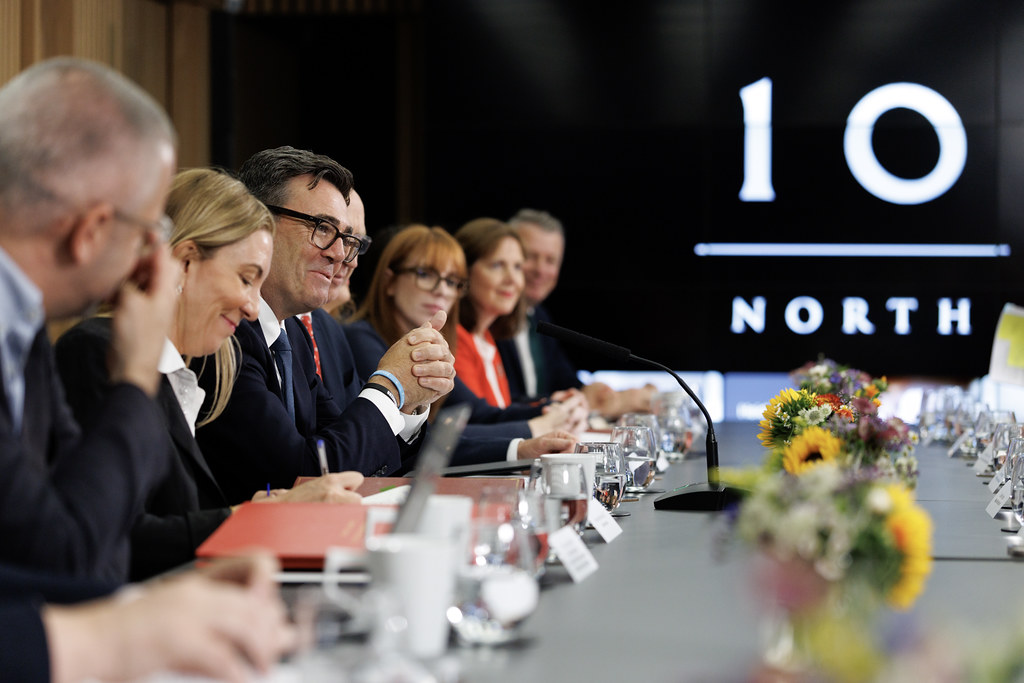
The mayors have few checks and balances, save for largely local media and the occasional election. No wonder they were beaming after their first meeting with the new Prime Mayor in Manchester’s No.10 North. The mix of mayors from the Labour, Conservative and Reform parties are incredibly powerful and while the argument can be made that this represents a decentralisation of power from Westminster, it undoubtedly represents an undemocratic centralisation of power at a local level.
Burnham has indicated his desire to enhance devolution and he has also said that he seeks to reverse the last 40 years of neoliberalism. It’s difficult to know what he means by this, but we can speculate that he will be slightly more positive about state intervention in the economy and will not be demonising the trade unions as much as the average Thatcherite. It might mean a more rigorous approach to regulating public services that are provided by private companies. One of the impacts of neoliberalism rarely discussed in public discourse is the decentralisation of powers via deregulation.
At the same time as power being taken from Westminster and handed to devolved administration and mayors, public service deregulation has often left central government with little control. An example comes via the reforms of the health service during David Cameron’s time in power. A dismantling of the hierarchies of the health service was useful for the Tories in many ways. It showed their ideological commitment to cutting the power of the state. It meant the operational control of the NHS was pout into the hands of a multitude of managers, rather than politicians. On the flip side. it also meant organising from the centre to combat the Covid pandemic was a total nightmare, with nobody knowing who was responsible for doing what. Likewise, central government has little control over the water companies gaining huge profits at our expense and providing a sub-basic service.
Central governments, of both left and right, have spent the last 40 years decentralising. They’ve done it through the economy and they’ve done through devolution. The result is a country they can’t actually govern very well. The UK seems rarely out of a crisis. Burnham might well seek to reverse neoliberalism, and in doing so take back some control in the economy, but his devolution plans will be giving powers away at the same time. He is setting Westminster on a path towards less influence around the country and this will likely diminish his status as prime minister in ways that can’t yet be known.
His is a difficult task, beyond a headline grabbing first week. He has to keep the public on side, his party, his cabinet and now a collection of regional mayors from multiple parties plus devolved administrations in Scotland, Wales and Northern Ireland. The more powers that leave Westminster, the more he will need to hold meetings with the mayors. Effectively, this group could become a second cabinet. As the mayors and devolved administrations get more powers, they could become a much more effective cabinet than the one in Westminster, with Burnham himself resembling the chief of the mayors. One cabinet with reduced powers, deciding less and less policy in England and UK-wide. Another more like the-decision making bodies of centuries past, full of regional barons with extensive powers over their specific areas. In this way we will come to see him as Britain’s first Prime Mayor.
Photo: Lauren Hurley, No.10 on Flickr CC BY-NC-ND 4.0