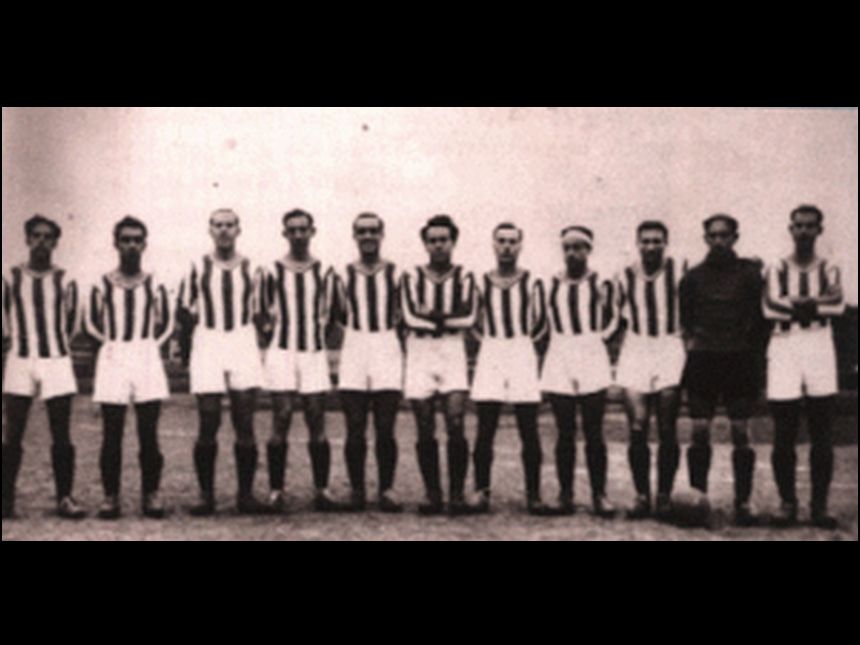
At the forefront of the 1936 uprising, the Júpiter stadium was a rallying point and clandestine arsenal
~ Yann Dey-Helle ~
Little remains of historic Poblenou. This working-class neighbourhood has been transformed by urban renewal. In the collective work Barcelona Rebelde, published in 2003, Agustín Guillamón revisited a chapter in the history of the neighbourhood and its football club: Club Esportiu Júpiter, which distinguished itself by supporting the anarchist workers who took up arms against the military uprising launched by Franco.
At the beginning of the 20th century, it wasn’t uncommon for a football club to be born at a corner of a table in the back of a bar. This was the case with Club Esportiu Júpiter, founded on May 12, 1909, by the Mauchan brothers, British workers at the Fabra & Coats factory in the heart of the Poblenou district, the industrial heart of Catalonia. David, one of the three Mauchan brothers, had previously played for El Escosès, the Scottish diaspora club. CE Júpiter is a team that blends Catalan and British players. While its mythological name comes from the winner of one of the hot air balloon competitions held on Sunday mornings on Mar Bella beach, from its very beginnings CE Júpiter developed alongside the identity of the neighbourhood which, as Agustín Guillamón recalls, in the 1920s and 30s “was a predominantly working-class and manufacturing district, CNT and Republican.” The CNT, an anarcho-syndicalist organisation illegal under the dictatorship of Primo de Rivera, remained very active underground, and Poblenou, sometimes nicknamed the “Catalan Manchester,” was one of its strongholds.
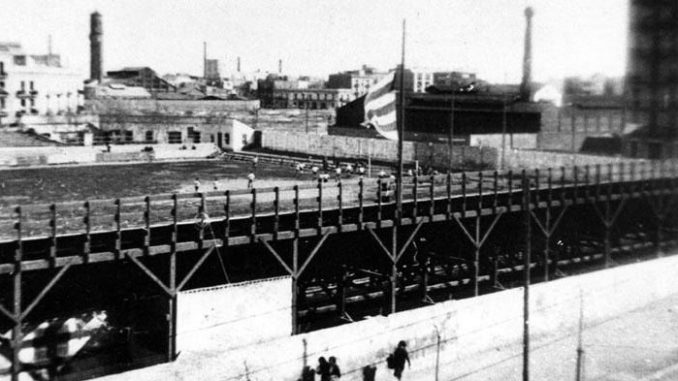
In 1921, after its early years on the vacant lot of Campo de la Bota, the club, which was achieving good results, acquired a plot of land on Lope de Vega Street. There, it built a wooden grandstand. Júpiter enjoyed great popularity at the time. More broadly, sports were gaining importance within the workers’ movement. The club had its own football academy and had developed athletics and hiking sections—a recreational form of group outings in nature, similar to hiking. The club, whose crest depicts the Senyera (Catalan flag) surmounted by a five-pointed blue star, was also known for its Catalan sympathies. This, under the dictatorship of Primo de Rivera, was considered an affront to the regime. As early as 1924, its crest was banned. The club was then forced to adopt a new one, without Catalan symbols. These pressures did not prevent Júpiter from winning the Catalan Second Division championship the following season, finishing undefeated. The First Division title went to Barça, another standard-bearer of Catalan nationalism. To celebrate these two titles, Barça and Júpiter faced off in a match honouring the Catalan nationalist choir Orfeó Català on June 14, 1925. This match became infamous because the Spanish national anthem was vehemently booed, leading to Barça’s suspension from all activities for several months.
Júpiter’s first acts of activism date back to this period. Agustín Guillamón recounts that at one time, “anarchist militants took advantage of the team’s travels to transport pistols hidden inside the balls, which at that time consisted of an inner tube encased in leather and fastened with laces. All that was needed was to replace the inner tube with the pistol in pieces.” Few authentic accounts definitively confirm this anecdote, which might seem more like legend than fact. But given the club’s close ties to working-class and revolutionary circles, it’s a highly plausible story. In those years, employer-sponsored gun violence was rampant. This practice of assassinating strike leaders—as happened to the CEN-affiliated Salvador Seguí—pushed anarchists to organise and arm themselves to confront it. Thus, several activists created the armed group “Los Solidarios”: Buenaventura Durruti, Juan García Oliver, Antonio Ortiz, Francisco Ascaso, Ricardo Sanz, and Aurelio Fernández. With their group, then renamed “Nosotros,” almost all of them would be involved in leading the Poblenou Defense Committee in July 1936.
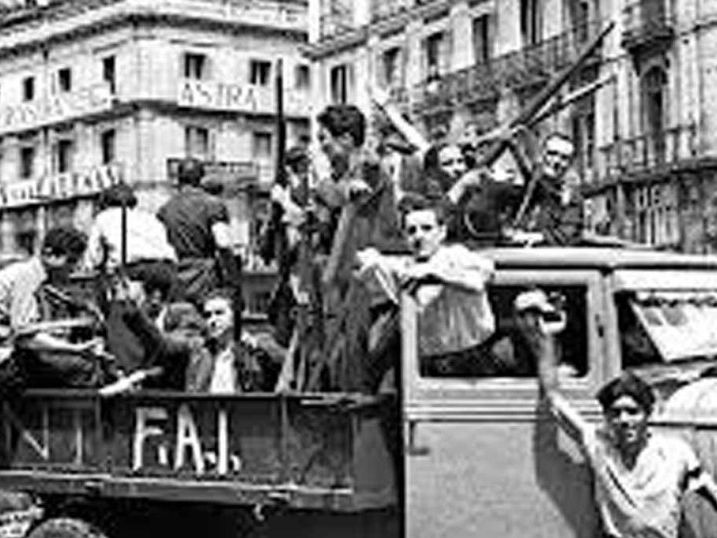
At the forefront of the uprising, the Júpiter stadium served as a rallying point and clandestine arsenal for organising the workers’ resistance against the mutinous military. The Defense Committee had requisitioned two trucks from a nearby textile factory, parked next to the stadium. Gregorio Jover lived at number 276 Pujades Street. Throughout the night of July 18-19, his apartment was transformed into a meeting room for members of Nosotros, awaiting the announcement of the military uprising led by Franco. The stadium’s proximity to the homes of several Nosotros members, who lived within a few hundred meters of each other, was convenient for avoiding alerting the authorities.
Jover’s apartment was a strategic vantage point from which the gates of the Júpiter stadium, as well as the two trucks, were visible. At 5:00 a.m., the troops’ departure from the barracks was announced. “The workers’ tactic was to let them go out into the streets without harassing them, because it would be easier to defeat them away from their barracks. The streets of Lope de Vega, Espronceda, Llull, and Pujades, which surrounded the Jupiter stadium, were full of armed anarchist militants. About twenty of them, the most hardened, seasoned in street fighting, climbed into the trucks. Antonio Ortiz and Ricardo Sanz installed a submachine gun in the truck that led the way,” recounts Agustín Guillamón. The factory sirens in the neighbourhood began to wail—the signal intended to trigger the fighting—followed by “Hijos del Pueblo” and “A las barricadas,” the anthems of the CNT and the Iberian Anarchist Federation, respectively. After about thirty hours of fighting, the city’s military and fascist forces were defeated.
From Francoists to Urban Planners
Between 1936 and 1938, Júpiter participated in local competitions while playing an active role in the formation of the Comitè Català Pro Esports Populars (CCEP). This anti-fascist sports organisation, linked to the Catalan nationalist left, was behind the Olimpiada Popular de Barcelona, scheduled to begin on July 19, 1936, and organised in opposition to the Nazi Berlin Olympics. But the tide turned quickly against the revolutionaries. The advance of the fascist troops was inevitable. Poblenou experienced bombings, famine, and defeat, leading to the exile of many of its inhabitants. For the others, executions awaited them at the Campo de la Bota, or the El Cánem prison, named after the former textile factory where several hundred Republicans were imprisoned. “To satisfy the insatiable thirst for fascist revenge, more than 3,000 people were shot between 1939 and 1952, the majority of them completely innocent, murdered in the name of God, Franco, and the Church,” Agustín Guillamón writes.
Later, the urban development projects undertaken for the 1992 Olympic Games and the “22@Barcelona” renovation plan ultimately drove out the last of the neighborhood’s long-standing residents. Urban planning is also a convenient way to erase all traces of Poblenou’s working-class and subversive past. “Yesterday, Campo de la Bota was a miserable shantytown and the site of the extermination of the rojos (Reds). The neighbourhood was gradually dismantled, and its last inhabitants, a large number of Roma families, were relegated to the La Mina district,” he continues.
After the fascist victory, Júpiter lost its crest with the star and four stripes a second time. The club, accused of financially supporting the Red Aid, was to be punished by the regime. In 1940, the Franco dictatorship wanted to make Júpiter a subsidiary of Español Barcelona and changed the club’s name to Hércules. Then, in 1948, on the regime’s orders, the stadium on Lope de Vega Street was destroyed, and CE Júpiter was moved to its current stadium in La Verneda, a world away from Poblenou, practically light-years away.
Machine translation from Dialectik Football