One hundred and fifty years after his death, Bakunin’s emphasis on freedom and action still holds force of purpose
~ Matthew Harshman, Deirdre Ruscitti Harshman ~
In 1848, amidst the wave of revolutions that were sweeping across central Europe, Mikhail Bakunin – then a rising figure in the field of radical politics – was walking with his fellow revolutionary Aleksandr Herzen. As the two moved through the countryside, they came across a group of peasants who were demonstrating near a local baron’s castle. In his memoirs, Herzen describes how Bakunin approached the group and suggested that a more effective way to air their grievances would be to just burn down the castle. Herzen was shocked while Bakunin provided them with specific recommendations for how to do so, and the two left as the peasants started to light the flames.
In an era when many revolutionary thinkers, including Marx, seemed interested in putting forth theoretical concepts and making plans for the future, Bakunin’s emphasis on immediate radical action (as the 1848 anecdote implies), as well as the resultant paucity of his written theory, have often resulted in difficulty in understanding Bakunin’s long-term goals. As a result, Bakunin – and the unending, fluid anarchism he espoused – has at times languished amidst discussions of particularities of wealth redistribution and the re-consolidation of power amidst varied oppressed classes.
Mikhail Bakunin was born 1814 at his family estate in Priamukhino in the Russian Empire. As the term “family estate” suggests, the Bakunin family was wealthy and privileged; in the year of Bakunin’s birth, 837 individuals were held in serfdom on the family estate, forcing the young Mikhail to come face-to-face with the realities of a stark, hierarchical system. His social position also required him to serve as a junior officer in the imperial Russian Army, an experience that his friend and biographer James Guillaume noted “deepened his hatred of despotism.” Looking to chart an alternative course, Bakunin began to explore alternative systems of thought. He delved into a variety of philosophies– most notably Romanticism and pan-Slavism – but he flitted from one school of thought to the next. Still, throughout these shifts, he always emphasised the importance of freedom and the right to choose.
It was those impulses that drove Bakunin ever closer to radical politics, particularly anarchism. By the time the revolutions of 1848 broke out, Bakunin was well established as a major thinker within radical circles; the revolution offered him a chance to focus on the action that he so deeply valued. In 1849, he would be arrested and sentenced to death for his revolutionary activities, but the sentence was commuted to exile, from which Bakunin escaped in 1861. He immediately rejoined the revolutionary struggle, playing a major role in building up the First International and contributing to the Paris Commune. Although his focus always remained on action, near the end of his life, he authored two major works (God and the State and Statism and Anarchy) that elucidated his major lines of thought.
Although Bakunin’s ideas were built in relation to the dynamics of the nineteenth century, they still have deep relevance today. In an era of growing global authoritarianism (often presented, ironically, as a means to protect “individual freedom”), and as proponents and propagators of generative AI seek to ensure its use in both national politics and economies, as well as in everyday personal queries, Bakunin’s views on freedom, authority, and everyday action seem particularly germane. In his unfinished and posthumously published God and the State, Bakunin noted that the now (and then) commonly accepted view of “individual freedom” as an a priori trait of mankind often meant a view of humanity that saw itself as “untrammeled beings sufficient unto themselves and in need of no other person, not even God, for, being immortal, they are themselves gods.”
Yet Bakunin’s view of individual freedom was at its core a communal one. “Man becomes conscious of himself and his humanity only in society…to be free means to be acknowledged and treated as such by all his fellowmen. The liberty of every individual is only the reflection of his own humanity…I am not free or human until or unless I recognize the freedom and humanity of all my fellowmen.” Here, individual freedom, rather than an assumed truth or a competitive commodity, is a product of an engaged and self-critical populace. Similarly, Bakunin forewarned the dangers of a state – or individual – giving over its capacity for choice to either man or machine. “I have no absolute faith in any person…it would immediately transform me into a stupid slave, the tool of other people’s will and interests.”
While Bakunin’s continued hope was instead for individual recognition of the need for purposeful revolutionary action against the many forms of consolidating power, he was also aware of the frustrations and difficulties that came alongside these struggles. In a letter to his friend Élisée Reclus from February 1875, a little more than a year before his death, Bakunin placed a heavy emphasis on what seemed broken. “To my intense despair, I have found and find more and more each day, that there is absolutely no revolutionary thought, hope, or passion left among the masses; and when these qualities are missing, even the most heroic efforts must fail and nothing can be accomplished,” he wrote, adding “Poor humanity!” Such perspectives, too, might seem familiar in the modern era – feelings of being caught in ideological and social upheavals too entrenched and outmatched to comprehend – much less feeling capable of effecting change.
Yet in the very same short letter, Bakunin could not help but be at least a little hopeful. Speaking of those he saw as continuing the struggle, he notes, “their labor is all the more praiseworthy in that they will not see the fruits of their sacrifices; but they can be certain that their labor will not be wasted. Nothing in this world is ever lost: tiny drops of water form the ocean.”
For Bakunin, every meaningful form of action – whether in 1876 or in 2026 – was itself a critical part of the broader movement: a drop that formed the ocean.
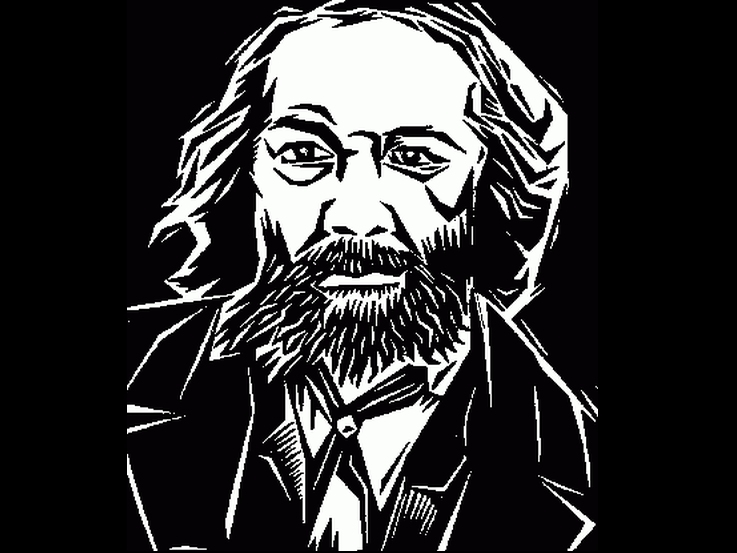
Illustration: Clifford Harper