A century since the General Strike of 1926
~ punkacademic ~
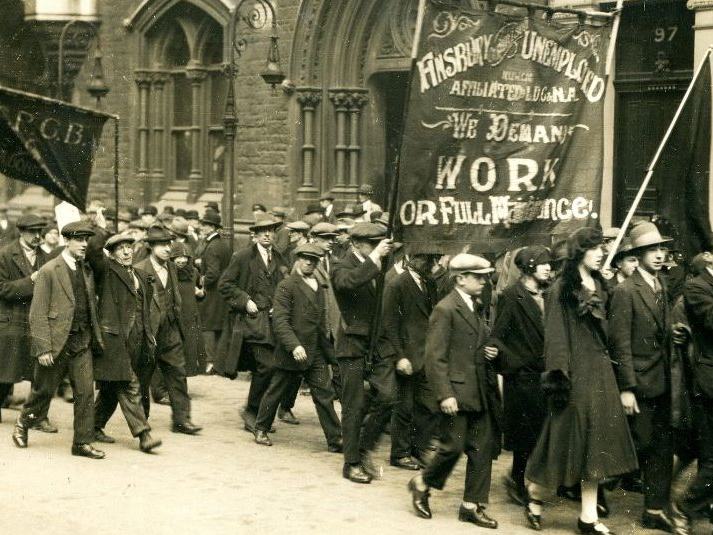
In the opening week of May 1926, Britain had its first, last, and only General Strike. Three million workers walked out of their workplaces, in a colossal effort to defend mineworkers facing both pay cuts and increases in their hours. As the popular slogan of the miners put it, ‘not a penny off the pay, and not a minute on the day’.
The strike has been almost erased from mainstream history in Britain. Insofar as it is remembered, it is as a failure, as living proof that British society has never possessed revolutionary potential, as a nine-day wonder that demonstrated unequivocally the impotence of extra-parliamentary action and the necessity of the electoral route.
There’s a good reason for that of course, and it isn’t just down to the right. The Labour Party never really backed the strike, with Ramsay MacDonald pulling out all the stops to prevent it. Lest we forget, Labour didn’t back the miners in 1984-85 either, and in 1926 the strike was driven, in parts of the country, by the thing the party most feared – a spontaneous organisation of workers and the commitment of the rank and file. Just as the anarchists’ role in the Spanish revolution had to be erased by the historiography which followed, so too did the potential of the strike of 1926 have to be forgotten.
The high-water mark of syndicalism in Britain had already passed by 1926, reaching its zenith in the pre-war period known as the Great Unrest (1911-1914) when miners in Wales published The Miners’ Next Step and anarchists were present both in the Durham coalfield (as Lewis Mates has shown us) and the Liverpool Transport Strike. But the General Strike similarly bypassed bureaucrats and officials, being an avalanche of resistance to persecution begun directly by workers.
The miners were victims of both employers’ greed and government arrogance. Employers were unwilling to countenance any decline in profits as the economic outlook worsened due to Germany’s return to the coal export market, having been frozen out following the First World War. Meanwhile the government’s economic incompetence – exemplified by Churchill’s decision to put Britain back on the gold standard (immediately making coal exports unattractive to many potential purchasers) – reflected hubris and a lack of concern for the fates of millions.
Churchill’s fondness for using the military in the pursuit of a particular approach to “industrial relations” is well-known, and would recur during the 1926 strike. In 1910 he had been Home Secretary as part of a Liberal government, when the military had been deployed to repress miners in Tonypandy; in 1911 the army and the navy were deployed to Liverpool at Churchill’s behest in the face of the Liverpool Transport Strike. In 1926 Churchill was the Tory Chancellor of the Exchequer, and his anti-union bona fides were undimmed.
A general strike had been narrowly averted a year prior. On what became known as “Red Friday” – 31st July 1925 – the government apparently backed down and agreed to subsidise the coal industry for a period of months until, supposedly, a solution could be found. The issues relating to the economic position of the coal industry were kicked into a committee.
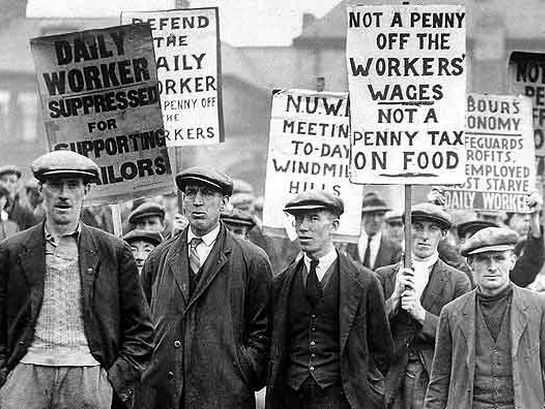
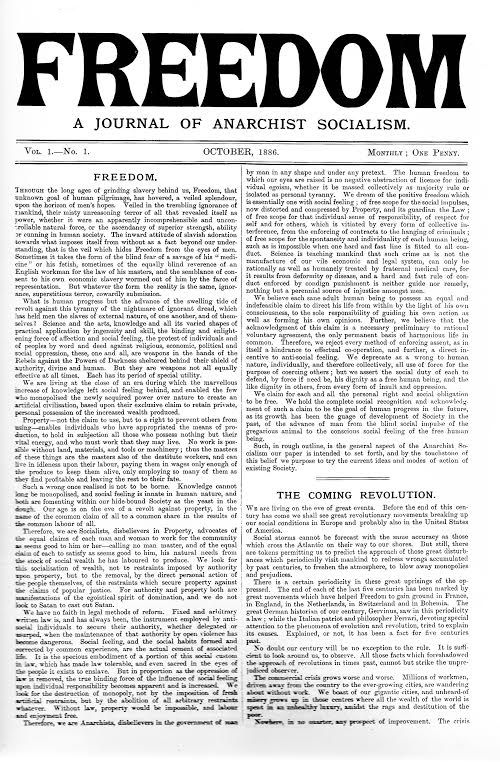
But here was another precedent. The government was not idle in those months, and instead prepared for conflict with the trade unions through the development of a scab army and a flying squad of special constables, as Tom Brown remembered in War Commentary (the wartime incarnation of Freedom) in 1942. The hiatus after July 1925 was an ‘interlude in battle’ according to Brown: “It was obvious to all that the nine months’ grace was merely a time of preparation for the ruling class.”
This was a devious scheme that would echo through history. The Organisation for the Maintenance of Supplies, as the “scab army” was called, was a precursor to Margaret Thatcher’s strategy in 1984-85 to defeat Arthur Scargill’s NUM. Following Thatcher’s defeat in the 1981 miners’ dispute, a secret government committee was convened to prepare for the next dispute, and wasted no time in implementing measures discussed by the Ridley Plan in the late 1970s, including stockpiling coal at power stations.
Six decades earlier, Prime Minister Stanley Baldwin’s own false truce fractured in March 1926 when the committee reported and proposed significant wage cuts for miners. Union umbrella body the Trades Union Congress (TUC) fought hard to frustrate the strikers’ ambitions, as Brown remembered bitterly in War Commentary. On May 4th, 1926, battle commenced between government and workers – with the former’s organisation of scabs and special constables unleashed to fend off the threat of a meaningful labour victory. The violence of 1926, too, would be echoed in 1984-85; civilians batoned and police vehicles driven through crowds, foreshadowing the carnage of Orgreave in August 1984.
Students from ancient universities, so the legend goes, drove lorries under police escort. The military was deployed to a number of sites, with warships sent to confront the workers of the ports. The government had forgotten nothing, and learned nothing, from the approach taken to the Great Unrest.
That the strike failed is axiomatic when it comes to the story of British industrial relations – reminiscent of many actions which have had considerable involvement on the part of the TUC. It lasted for nine, or ten, days depending on which action you take as definitive. Retaliatory action against the miners was often extremely punitive, with many miners being blacklisted in the aftermath.
The great strike of 1926 has, over the century since, not just by anarchists, been seen as a parable for the failures of the British trade union movement. When the journalist Anne Perkins penned her history of it at the height of Blairism (the title A Very British Strike was a reheat of A Very Overused Formulation), it had – as the scholars Charles Ferrall and Dougal McNeill have reflected, a neoliberal sneer to it. British industrial action was, put simply, half-arsed and doomed to fail as long as it had revolutionary pretensions. Couldn’t we all just get along?
The anarchist critique, by contrast, rested on a very different foundation. The realities of the strike, what it represented, and what it meant were better understood at the time than they have been since. Brown in 1942 argued that the strike was both a victory and a defeat. It was a victory insofar as it was real, “spontaneous,” often self-organised, action. It showed definitively that workers would, and could, collaborate across sectors on a grand scale and that the consciousness of what was at stake was widespread. In language of our time, rather than theirs, workers had agency through action, and they knew it.
It was a defeat insofar as the TUC’s leadership undermined their cause from the outset. And as such it represented a case study par excellence of the validity of the anarcho-syndicalist case against the craft union. Whilst real action might take place in such a setting, it would be against the will of the union’s leaders, who would always find themselves compromised by their closeness to the bosses and their need to maintain control. So it proved.
But what of the memory of this ‘lost’ revolution and its meaning for us today, in a society which is no longer organised around heavy industry where, for all its faults, a trade union movement does not have a membership cutting across private and public sectors and where spaces are not easily available for many workers to communicate, let alone organise? After four decades of turbocharged neoliberalism, with capitalist individualism as the sovereign creed of all major parties, a mental health pandemic the result, and an atomised citizenry addicted to smartphones, what can we use from this?
Firstly, the recovery of historical memory is never a fruitless exercise. The art of the possible in the present is constrained by the vocabularies allowed from elites’ reconstruction of the past. Asserting a different story, one which gives meaning to a struggle which demonstrated the willingness and commitment of diverse people across Britain to take on their government, is a revolutionary act. As the historian E P Thompson once put, the task of the historian is to “rescue the past from the enormous condescension of posterity.” That matters both for the dignity of those who went before us, and because it allows us fundamentally to think differently about ourselves.
Secondly, more bluntly, the General Strike of 1926 was a time when the government feared the people, poured huge resources into defeating them, and went beyond that to salt the earth to kill the memory of what had happened. To paraphrase a popular speech from a recent television series, what we have been told to believe is natural is unnatural, and in order to make that be the case enormous energy must be put into the fabrication of their narrative on an everyday basis.
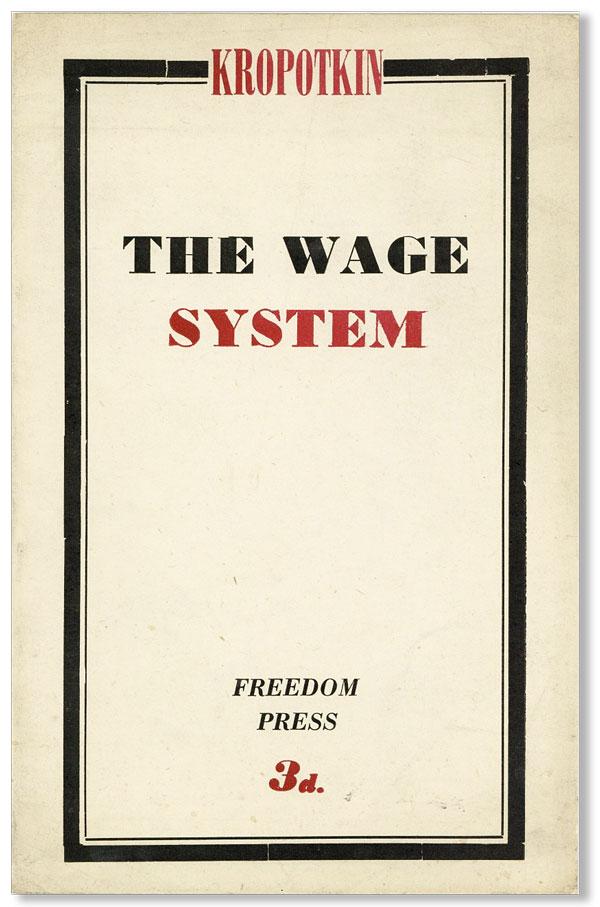
To return to more firmly anarchist territory, strike action and mutual aid are related concepts. Though we no longer have the confidence today that Peter Kropotkin once had in science, his view of mutual aid as a factor of evolution by which organisms cooperated against their environment to survive has a clear resonance in workplace militancy and the strike.
Britain’s, and the world’s, economy has not remained the same. Industries have changed. But whilst platform capitalism may offer new challenges, the exploitation of the worker by the boss remains the fundamental dynamic of lived experience for many under capitalism. Every day is a war. Our forebears understood that. So do we. And just as they believed in their capacity to self-organise against all odds, we can too.