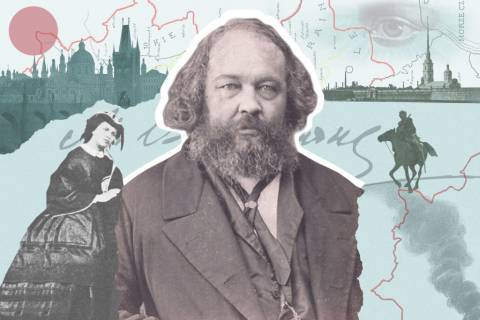
Marking 150 years since the death of the great revolutionary, whose vision of anarchism remains more relevant than ever
~ Nikolay Gerasimov ~
The political and cultural birth of Russian anarchism occurred at the turn of the 20th century, when Kropotkin and his associates began publishing theoretical works in Russian in exile. It was then, decades after his death (150 years ago today), that the legacy of Mikhail Bakunin began to be actively reinterpreted. His works were suddenly discovered to contain philosophical irrationalism, mysticism, and a theomachist pathos. As a result, a huge diversity of currents emerged within Russian anarchism, something not seen in Europe or the United States: mystical anarchism, anarcho-biocosmism, and Christian anarchism, which combined Bakunin’s radicalism with Tolstoy’s critique of the state and civilisation.
Bakunin diverged throughout his life. There was Bakunin the romantic, fascinated by classical German philosophy. There was Bakunin the proponent of the natural-scientific method. There was Bakunin the socialist. And finally, there was Bakunin the revolutionary anarchist. All of these qualities coexisted within one person, but they were revealed at different stages of his biography. To trace these transformations in detail, one must study his correspondence in depth. But the main thing remains unchanged: for him, there were no boundaries between his inner world and the outer universe, and he knew how to transform all his experiences into action.
Bakunin’s key idea is that power is not localised, but dissolved into all institutions: social, economic, and spiritual. The state, capital, and the producers of cultural norms form a single system of oppression. Today, we see that transnational corporations and states may conflict, but ultimately they are always allies. Therefore, pitting them against each other—for example, considering corporations “progressive” and the state “reactionary”—is fundamentally wrong. Bakunin’s comprehensive, integrative view is more relevant today than ever.
Bakunin’s critique of representation also attacks the modern blind faith in technology and artificial intelligence. For Bakunin, delegating human freedom to any abstract agent — be it scientists, politicians, the clergy, or AI algorithms — is monstrous. Because the entire digital system of control is in the hands of a narrow social group defending its financial and political interests. Freedom is possible only through the direct self-organisation of society. Similarly, today’s politicians and media personalities often speak on behalf of the oppressed, while defending exclusively their own interests.
As for the man: Bakunin, as we would say today, had very poor personal boundaries. He abruptly intruded into other people’s personal relationships, even when he wasn’t asked to. A striking example is his sisters. Bakunin actively advised them, expressed outrage at their choices, and sometimes significantly influenced their decisions about marriage and their personal lives. He behaved similarly with his friends.
Bakunin was interested in absolutely everything, simultaneously. On the one hand, he endlessly reflected on his own feelings, thoughts, and suffering; on the other, he was equally deeply affected by political events and assessed the wisdom of those in his inner circle.
As for his personal suffering, it may have been similar to that of Emma Goldman, who also professed free love. For Bakunin, this was not a petty, everyday drama. His suffering served as an endless source of creative work and was easily converted into constructive, revolutionary energy.
Modern nationalists sometimes try to portray Bakunin as a like-minded figure who fought against universalism for the sake of Slavic freedom. But this is fundamentally wrong. Bakunin believed that the world should develop according to the principle of federal or, ideally, confederative structures. Yes, at the first stage, linguistic groups and ethnic groups must free themselves from imperial shackles. But he never called for the creation of separate nation-states based on ethnicity. On the contrary, it was an attempt to unite diverse peoples in a way that would avoid the emergence of both new empires and closed nation-states.
Nor was Bakunin a banal atheist. He radically opposed formal, superficial atheism, when a person simply declares that God doesn’t exist and dismisses the subject. One of his manuscripts, dedicated to the “divine ghost,” is precisely about this: to seriously consider the absence of God, one must delve deeply into religious literature and reflect.
In Bakunin’s philosophy, the political and religious are intimately intertwined. It was crucial for him to uncover the governing function of the sacred within the political system and to emancipate and extract this sacred from the shackles of power. Bakunin fundamentally hated rigid schemes, formulas, and closed structures. He understood that the sacred, when confined to the state system, inevitably degenerates into an instrument of violence.
Therefore, from Bakunin’s perspective, the simple destruction of state institutions will not bring freedom unless there is a simultaneous liberation and rethinking of the sacred itself. This is why some modern Christian anarchists refer to Bakunin as an atheist who, in fact, attempted to “liberate God” from the power of formal structures.
Paradoxically, while remaining radical, Bakunin opened the door to the future “liberation theology” (where Christ is conceptualised as a revolutionary liberator) and Christian anarchism. Bakunin argued that the sacred, locked within the walls of the historical church (specifically, the church as an institution, not the mystical Body of Christ), inevitably perishes, turning into a dry, lifeless formula. Bakunin himself, however, was the herald of a vital, overflowing life.
Edited machine translation. Image: Lika Sochkina