A hundred yeas since the publication of The Organisational Platform of the General Union of the Libertarian Communists, we offer two opposing views of its value
The best way to organise for promoting anarcho-communism
~ Ilan Shalif ~
When I uploaded my book “Emotions in Everyday Life and Their Maintenance” to the Internet in 1991, I discovered on the host site that there are not only lifestyle anarchists but also communist anarchists. Among the notable texts I translated for the website I built were “Social Anarchism or Lifestyle Anarchism” and “The Organisational Platform of the General Union of Anarchists”.
The Platform is an organisational concept of communist anarchists, developed as a lesson from the failure of the anarchist movement in the October Revolution. In my opinion, the failure of the 1917 revolution, which allowed the Bolsheviks to take control of the revolution, stemmed from the fact that the anarchists, who were more numerous, were not organised enough. Still, I am amazed at the few successes and insights that Nestor Makhno extracted from the 1917-1921 revolution.
In my opinion, this is the best way for anarchist activists to organise themselves, for whom the promotion of the idea of anarcho-communism is the centre of their existence.
I did not delve into the differences between the groups in the current platformist/especifist tendencies that developed around the website anarkismo.net of which I was one of the initiators.
In my opinion, the idea of unity and responsibility among the partners in organising anarcho-communist activists is undisputed. Anarchists who are interested in a different form of organisation, theory, strategy, and mutual responsibility would be better off organising separately.
Hyper-organisationalism leads to bureaucracy and hierarchy
~ Jay Arachnid ~
Roundly condemned by most anarchists when initially published, The Platform was an attempt to out-organise the Bolsheviks without a centralised party structure. Its tenets were ideological and tactical unity, collective responsibility to the organisation, and a formal membership with an executive committee (all looking suspiciously like a quasi-militarist formation). The document itself resulted in no General Union in the years immediately following its publication, and the ideas promoted in it were abandoned soon after Arshinov (known to be the primary author) went back to the Bolshevism of his earlier years and voluntarily returned to the Soviet Union in 1930.
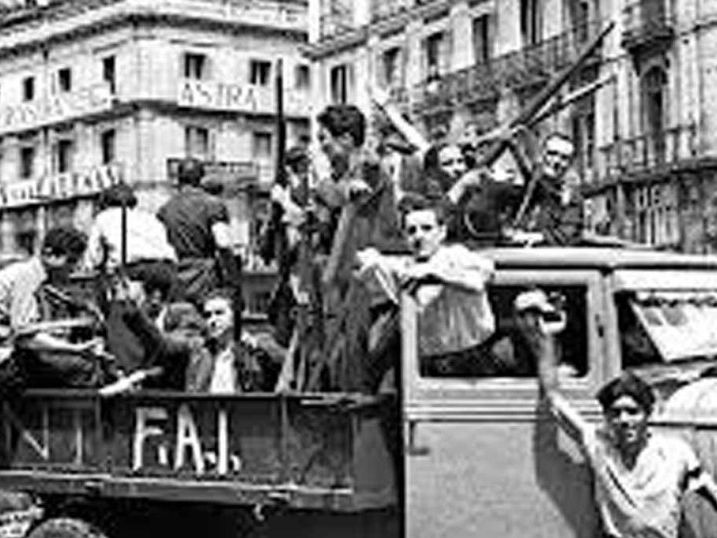
It is also clear and obvious from all internal documents and discussions that the Platform never figured into the structure or culture of the Spanish FAI. Indeed, Juan Gomez Casas states unambiguously in his comprehensive history that “I must point out that the issues raised in The Platform made hardly any impression on anarchism in Spain” (Anarchist Organisation: The History of the FAI, p. 105).
For six decades The Platform languished in well-deserved obscurity, a curio of a particular time and place.
Until the late 1990s. NEFAC (North Eastern Federation of Anarchist Communists) was founded in 2000 because, according to one participant, “the late 1990s was a depressing time for anarchists in North America.” This, despite the proliferation of micropower radio, infoshops, collective housing, community gardens, cafés, small publishers, and other forms of semi-permanent as well as enduring infrastructure. What the neo-platformists wanted, however, was a formal membership organisation for “class struggle anarchists” so that they could intervene as a caucus of disciplined militants in the heroic struggles of the American proletariat. Their interventions often looked like not much more than handing out leaflets at informational pickets. Needless to say, their numbers did not swell.
Black Rose/Rosa Negra (BRRN) is the longest running neo-platformist group in North America, and like other such groups, they fabricated a non-existent “global anarchist tradition of platformism.” In their self-congratulatory history the hyperlink in that quote takes the curious reader to an individual’s analysis of NEFAC written in 2005, in which the author laments that the F is no longer appropriate because NEFAC is in fact a network rather than a federation. Other than the fact that NEFAC was Black Rose’s immediate precursor, what this particular essay has to do with the alleged global anarchist tradition of platformism remains a mystery.
BRRN has never publicly come to terms with “a massive wave of resignations beginning in late 2019, 59 in total, with two-thirds taking place in the fall of 2020. Those who left were disproportionally women, queer, trans, non-binary, and/or POC”. It is significant that fifty-nine people could represent a “massive” faction of the overall membership. Sadly, those who wrote this document failed to notice the inherently bureaucratic and hierarchical cliquishness of the organisational structure, preferring to blame patriarchy and sexism for individual male shortcomings. And just as nothing beyond an empty promise of a response came from BRRN loyalists, neither has anything been heard subsequently from the authors of Every Rose.
Some Latin American groups have since then adopted a hybrid form of neo-platformism called “especifismo”. But as far as North America is concerned, hyper-organisational anarchist groups have displayed sketchy historical claims; inflated self-importance; inevitable resignations and splits (including denunciations from former members); organisational dead-ends; no discernible impact on the diverse projects of other anarchists or the wider public: this is the legacy of The Platform of 1926 and those who sought to revive it beginning in the late 1990s.