Report exposes Israeli higher education’s collaboration with military and arms manufacturers
~ Nissi Peli ~
Israel’s deliberate and thorough destruction of Gaza’s higher education system is one of the grave cases of scholasticide in modern times. Like other aspects of the genocide in Gaza, it raises questions of institutional accountability and complicity for Israeli society. One aspect of this complicity is the widespread collaboration between institutions of higher education in Israel and the country’s security establishment, with the military at its core.
A report I have authored for New Profile, now available in English, reveals extensive, active, and institutionalised military-academic collaboration across a wide array of domains. Academic institutions in Israel cooperate with the military and the Ministry of Defence in the training of soldiers for various military roles through at least 57 unique study programs. These programs typically involve a combination of academic study and military training, preparing troops for various military roles, including weapons development, cyber warfare, combat command, and intelligence.
In response to a formal request for information, the Ministry of Defence stated that these programs generated nearly 270 million NIS (about 70 million GBP) for participating academic institutions over a three year period. Academic institutions also actively assist the military in recruiting youth into these programs by advertising them and hosting on-campus conferences and special events with military and academic personnel.
One such program is “Havatzalot”, which is described by the military as “the flagship program of the Intelligence Corps”. The program operated at the University of Haifa between 2005 and 2019, later moved to the Hebrew University of Jerusalem, and is now set to transfer to Tel Aviv University. Program participants live on campus in what effectively functions as a de facto military compound, secured and monitored by the soldiers themselves.
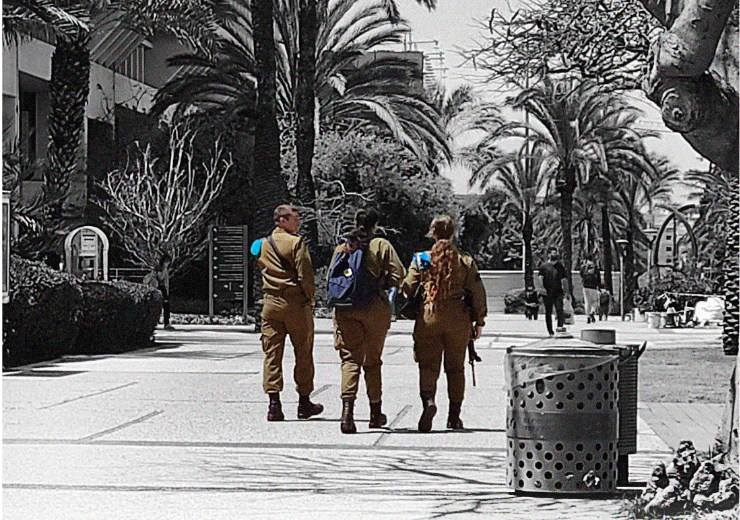
Two former participants interviewed for the report described academic conditions tailored to the military’s needs, including the recognition of more than 20 academic credits for intelligence training. They also reported that the constant monitoring of the compound meant that soldier-students actively monitored their fellow students. Participants are also required to wear military uniforms on campus, a practice the interviewees attributed to the military’s attempt to distance them from Palestinian peers and constantly reinforce their identity as soldiers, reminding them that their presence in academia is for the army’s sake.
Another example is the “Erez” program, launched at Tel Aviv University in 2023 and described by the Ministry of Defence as an “Elite track for combat command”. Each cohort includes approximately 100 soldier-students, who subsequently continue to a career service of at least four years as combat officers in the Israeli military.
Collaboration in research and development projects of weapons and military technology is also extensive. Here, academic institutions partner directly with the Ministry of Defence, with state security and intelligence agencies, and with companies in the military industry. For example, the Hebrew University disclosed financial research engagements with state-owned arms company Rafael amounting to over 3 million NIS (about 762 thousand GBP) over a period of three years. It also acknowledged research collaborations with Israel’s General Security Service (Shin Bet), without disclosing their nature. Other universities also confirmed extensive research ties with the security establishment while withholding specific information about their exact scope and objectives.
The past two and a half years have further proved to many that only sustained external international pressure on the Israeli government, its economy, and its institutions has the potential to meaningfully challenge Israel’s systematic military aggression and occupation and generate structural change.
Recognising academic complicity requires accountability, including reparative measures. Rehabilitation should, at the very least, begin with the support of Israeli and international academia in the material rebuilding of Palestinian higher education in Gaza, alongside a clear and uncompromising position against the targeting of academic institutions and scholars under any circumstances. This also entails solidarity with academic institutions in the West Bank and with Palestinian scholars and students in Israeli academic institutions.
At this dangerous and violent moment, academia has the potential, if it chooses, to articulate and demonstrate a different political horizon. The collaborative and creative nature of scholarship can serve as a lighthouse in a volatile world. But this would require reconstructing academia as an institution that is financially and morally independent, accountable to its peers, and committed to resisting militarisation and commodification.