Terrorism charges without legal basis, hunger strike, and new threats at sea: repression expands as international mobilisation grows
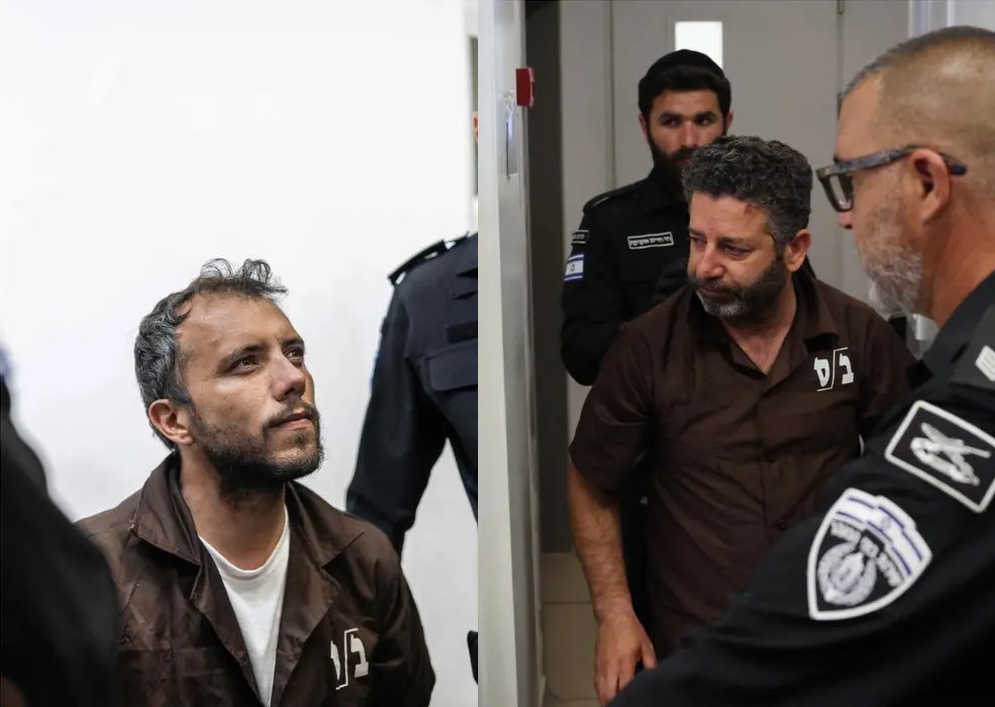
The Ashkelon court’s decision marks a clear shift: what began as an illegal hijacking in international waters is now being transformed into judicial detention. Saif Abukeshek and Thiago Ávila, the two Global Sumud Flotilla activists hijacked by the Israeli navy between April 29 and 30 near Greece, appeared before a judge who decided to extend their detention until Sunday, upholding the prosecution’s charges in their entirety.
The charges are serious and, at the same time, without any discernible basis: “aiding the enemy in war,” “belonging to a terrorist organisation,” and “being in contact with foreign agents.” Standard charges, already used in similar contexts, are applied here to two civil activists intercepted outside any Israeli jurisdiction while participating in a humanitarian mission.
This is the crux of the matter: the shift from a violation of international law to its judicial legitimacy. The court’s decision does not address a lawful arrest, but a hijacking that occurred over a thousand kilometres from Gaza, in the Mediterranean, on civilian vessels. Yet it transforms it into a criminal proceeding, normalising the anomaly.
The lawyers from the human rights organisation Adalah, who are defending the two activists, state it unambiguously: extending their detention under these conditions amounts to judicial validation of the state’s illegality.
Meanwhile, Abukeshek and Ávila continue the hunger strike they began immediately after their arrest. For days, they have been drinking only water. It is an extreme form of protest against the conditions of detention and against a proceeding they perceive—and appear to lack—legitimacy. Both reported mistreatment and beatings while in custody, placing their case within a context already marked by testimonies of systematic violence during the boarding and the hours that followed.
But the story isn’t ending in the courtroom. Meanwhile, tensions are rising at sea. According to the latest reports from the Global Sumud Flotilla, Israeli forces are attempting to intercept four more vessels off the coast of Greece. US aircraft and drones are flying over the area. Reports speak of vessels being monitored by helicopters and low-flying drones, with naval units operating without lights. The risk is clear: new boardings, new hijackings, a repeat of the operation that affected the first mission.
This is no longer an isolated incident. It is part of a broader pattern of repression of civilian initiatives aimed at breaking the siege on Gaza. These aren’t public order operations, but actions aimed at discouraging, intimidating, and preventing any concrete impact from being made on international solidarity.
In Crete, where many of the released activists gathered after 40 hours of detention, this is now clear. On the beach of Ierapetra, a meeting was held between those who remained on anchored boats and those hosted on land to redefine strategies and objectives. First, a collective embrace—the realisation of having survived—then the political discussion.
Because the mission has not stopped.
The testimonies circulating among activists speak of exhaustion, pain, anger. But also of determination. The belief that what happened failed to stop the movement, but on the contrary, strengthened it. The organisers are clear: the hijackings, designed to intimidate, have had the opposite effect.
Meanwhile, political reactions are also multiplying, albeit still fragmented. A delegation of MEPs – including Benedetta Scuderi, Cecilia Strada, Cristina Guarda, and Mimmo Lucano – publicly denounced the incident, describing it as an attack on a peaceful civilian mission and calling for the immediate release of the two activists.
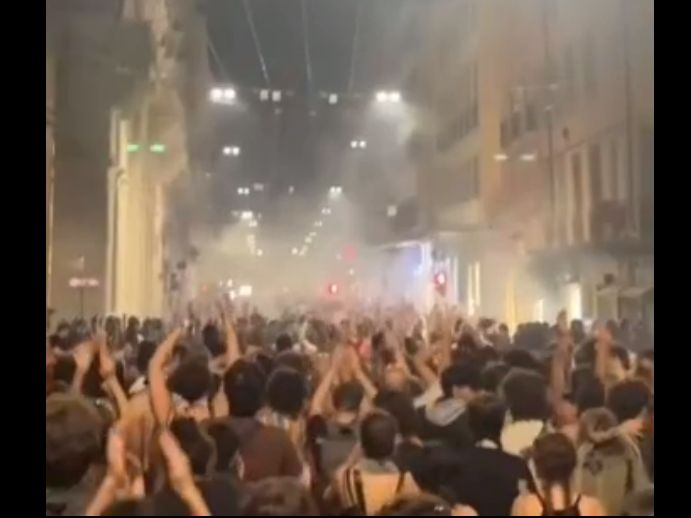
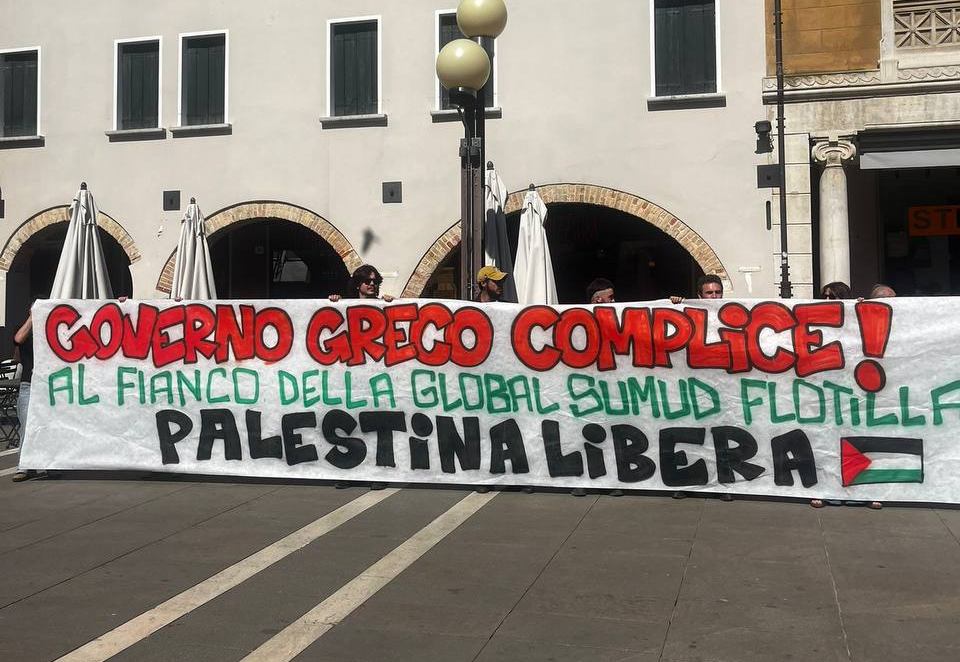
In Italy, mobilisation is growing. Solidarity initiatives are multiplying. Discussions are underway regarding the possibility of a general strike for Palestine and the release of prisoners. The Italian delegation of the Global Sumud Flotilla has called on Italian unions to promote inter-union dialogue to call a new united general strike for Palestine, the release of the two detained Flotilla activists and all Palestinian political prisoners. The Flotilla emphasises the need for a collective mobilisation demanding that Italy and the EU respect international law, condemn Israeli violations, release illegally hijacked activists, and adopt concrete measures such as sanctions, embargoes, and the termination of all agreements with Israel.
In parallel, the Global Sumud Flotilla is already preparing for the next step: an international assembly in Marmaris, Turkey, on 9-10 May, followed by a press conference on 11 May. The objective is clear: to reorganise the mission, strengthen international coordination, and redefine the strategy.
This is a turning point.
Because the story of Abukeshek and Ávila is no longer just an individual issue. It has become a political and legal issue that calls into question fundamental principles: freedom of navigation, the prohibition of hijacking in international waters, the right not to be subjected to arbitrary detention and inhumane treatment.
And above all, it highlights another element: the fragility—or lack thereof—of an adequate institutional response.
While the Israeli court extends the detention, while the charges multiply, while new vessels risk being intercepted, European institutions remain, at best, cautious. And this caution, in such a context, risks turning into a political vacuum.
A vacuum that allows the same pattern to continue: intercept, seize, detain, accuse. This is why the court’s decision is not just a judicial act. It is a signal. It indicates that the chosen path is one of continuation, not closure. Of normalisation, not exception.
And at this point, the question no longer concerns Israel alone. It also concerns those who, faced with all this, continue to fail to intervene. Because every additional day of detention, every unproven accusation, every vessel at risk of being intercepted, isn’t just a fact. It’s a consolidated precedent.
Machine translation. Photos: Itamar Greenberg, Global Project