Governments are gearing up to define any popular protest as violent and legitimise institutional repression
~ Tiziano Antonelli, Umanità Nova ~
The internal war that governments wage against the exploited and working classes manifests itself primarily through repression against political forces seeking change in social organisation and against mass movements expressing social discontent with specific situations and government actions.
Current democratic states are experiencing growing authoritarianism. Along with the focus of political power on increasingly restricted elites and the slowdown of capitalist accumulation, the compass that guides government action between force and consensus is shifting toward increasingly oppressive authoritarianism.
The defence of “legitimately constituted” governments and their decisions, as well as the defence of fundamental political, constitutional, economic, and social structures and traditional views on family, religion, and morality, are the justifications for a renewed fight against terrorism.
The 2006 UN General Assembly resolution stated that “acts, methods and practices of terrorism in all their forms and manifestations are activities aimed at the destruction of human rights, fundamental freedoms and democracy, which threaten the territorial integrity and security of States and destabilise legitimately constituted governments, and that the international community should take the necessary measures to strengthen cooperation in order to combat and combat terrorism.”
The European Union, in Directive (EU) 2017/541 of the European Parliament and of the Council of 15 March 2017, defined terrorist acts as “intentional acts […] if and to the extent that they are committed with a specific terrorist aim, namely seriously intimidating the population, unduly compelling a public authority or an international organisation to perform or abstain from performing any act, or seriously destabilising or destroying the fundamental political, constitutional, economic or social structures of a country or an international organisation. The threat to commit such intentional acts should also be considered a terrorist offence where it is established, on the basis of objective circumstances, that such a threat was made with such a terrorist aim.” The Directive, however, went on to state that “acts aimed […] at compelling a public authority to perform or abstain from performing an act, which are not included in the exhaustive list of serious crimes, are not considered to be terrorist offences.”
In the Memorandum of September 25, 2025, implementing the previous executive order of September 22, US President Donald Trump states that “common motives and recurring indices unite this pattern of violent and terrorist activity under the umbrella of self-styled ‘anti-fascism.'” These movements portray core American principles (e.g., support for law enforcement and border control) as ‘fascist’ to justify and encourage acts of violent revolution. This ‘anti-fascist’ lie has become the rallying cry used by domestic terrorists to wage a violent assault on America’s democratic institutions, constitutional rights, and fundamental freedoms. The common threads animating this violent conduct include anti-Americanism, anti-capitalism, and anti-Christianity; support for the overthrow of the United States government; extremism on migration, race, and gender; and hostility toward those with traditional American views on family, religion, and morality.”
The anarchist movement has always maintained that governments are the brutal, violent, and arbitrary domination of the few over the masses. They are also an instrument designed to ensure the dominance and privilege of those who have monopolised all the means of production and use them to keep the masses subjugated and make them work for them. Governments are nothing other than the community of rulers, that is, those who have a monopoly on violence and use it to maintain current economic and social conditions.
The ideological apparatus used to combat “political violence” and “terrorism” confirms this cornerstone of anarchism. The documents cited above reveal a brutally conservative approach, aimed precisely at tenaciously preserving the current social order: an approach that ignores the emerging needs of society that require new forms of political and economic organisation. These new forms destroy the old privileges that the legal system and regulations protect. Tension between society and the political system is therefore inevitable, and the more violent the governments’ resistance to the new, the more violent the clash will be. And these measures do not smell good; they reek of sacristy and reaction.
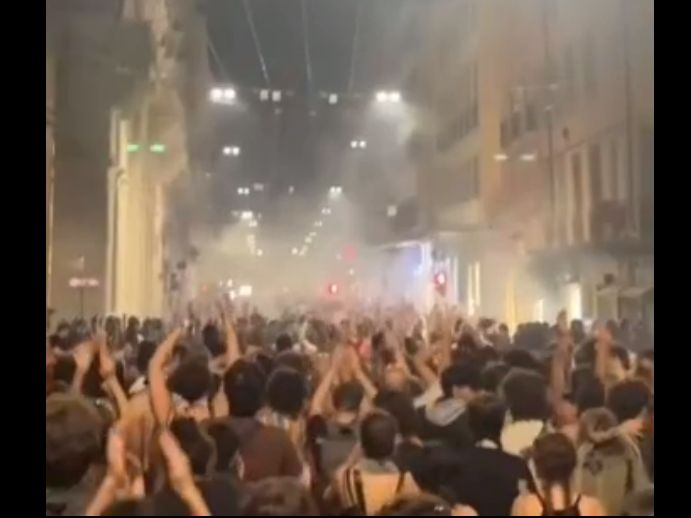
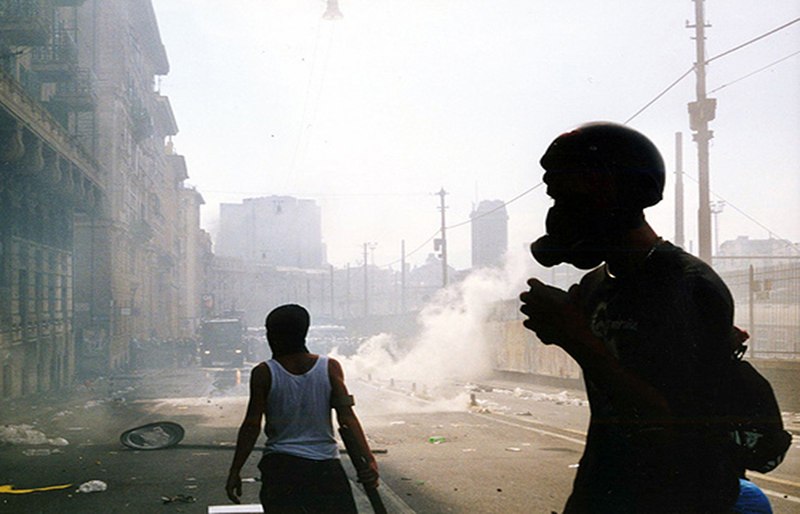
In the aforementioned documents from governments and supranational organisations, the behaviour targeted, in addition to actual terrorist acts, is popular pressure to force governments to change their policies. This is clearly evident from the UN resolution and the US administration’s executive order. As for the European Union, legislation distinguishes between terrorist acts and acts of opposition, but this distinction is lost in communication to the media. In other words, governments are gearing up to define any popular protest as violent and legitimise institutional repression.
In reality, it is precisely government policies — through environmental devastation, increased poverty, and the persecution of the most vulnerable — that are causing the rise in violence in society.
The anarchist movement has no ideology to impose on society, no model to rigidly apply once it has seized power. It is the most conscious expression of society’s spontaneous movement toward the continuous improvement of living conditions and social relations. Obstructing this movement, in the name of conservatism, in the name of tradition, demonstrates the falsity of the democratic narrative.
Direct action from below and self-organisation are the strategies of anarchism. Criminalising them is equivalent to depriving the anarchist movement of the tools indispensable to the realisation of its ideal. The anarchist ideal aims to change the way of life in society, to establish relationships of love and solidarity among people, to achieve full material, moral, and intellectual development, not for a given social class, but for all people—and this cannot be imposed by force, but can arise from the progressive growth of collective consciousness and be achieved with the agreement of society.
The participation governments call for is not that of free debate, free association, or direct action for improvement; the participation they intend is, at best, limited to the ballot box and demonstrations that merely celebrate the existing state of affairs.
We must therefore change the narrative: this is not simply a contest between the forces of law and order and opposing factions, in which victory falls to one or the other. We must reaffirm that societal change can only be halted temporarily; at that point, the gap between the level of civilisation reached by the masses and the law, which always lags behind, could only be bridged with one leap: insurrection. It is up to the anarchist movement to strengthen among the exploited classes the conviction that, to truly and definitively improve their condition, they must change society and rid themselves of all instruments of oppression: police, prisons, magistrates, presidents, ministers, deputies, etc., once and for all.
Anarchist, antagonistic, communist, and grassroots organisations are all the same enemy in the eyes of the oppressors. This is why we must strengthen the bonds of solidarity between the various components, spread good practices of horizontal organisation, and counteract authoritarian, top-down, and collaborationist practices.
It will be tough, but we will make it.
Machine translation