His arguments are no less salient in the face of contemporary threats
~ Søren Hough ~
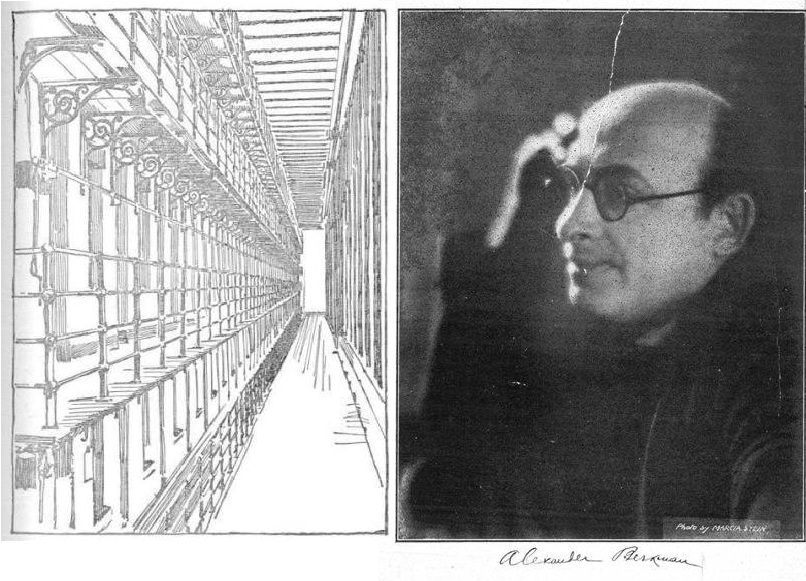
We often think of Alexander Berkman as one of the preeminent anarchist communist thinkers of his time. After all, he did write Now and After: The ABC of Communist Anarchism, a valiant attempt to lay out in concrete terms what anarchy might look like in practice. But Berkman was also a deep thinker about prison and police abolition: not as an addendum to his anarchism, but as a natural extension.
Following an attempted assassination, he saw prison from the inside for nearly two decades. His life in incarceration helped shape Berkman’s politics while forcing him to consider his own relationships. For example, as he catalogues in Prison Memoirs of an Anarchist, prison was an opportunity to explore his sexuality: “I remember the first time he kissed me. … He put both hands between the bars, and pressed his lips to mine. Aleck, I tell you, never in my life had I experienced such bliss as at that moment.” It was also where he formed a delightfully charming relationship with a little bird: “It was only a little sparrow, but never before in my life did I hear such sweet melody.”
Yet these moments were mere flashes of connection in what was otherwise, as he called it upon his release, “a hell where the fires of the law’s vengeance burn with a thousand hungry tongues; a hell where the hot flames of persecution burn into your very soul; a hell where the brimstone of brutal humiliation stifles the very breath of life; it is a hell where man’s inhumanity to man turns the milk of human kindness into the gall of hate, despair and revenge.”
This dalliance with hell put Berkman in a position to critique the very structure of prisons and police themselves. As he laid out in 1913, prisons and police are a symptom and tool of economic injustice.
“It is starvation that fills our prisons,” he said. “It is our wrong and unjust economic conditions that are the source of fully nine-tenths of all crime. And as to the other tenth, — though a crime may not be against property, it may spring from misery and rage and depression produced by our perverted social conditions.”
Modern prison abolitionists like Mariame Kaba and others have taken this argument further, arguing that the prison-industrial complex is inextricably rooted in racial and gender oppression.
We are facing an unprecedented level of surveillance the likes of which the State of Berkman’s time could only dream of. Take as one glaring example British Transport Police who are trailing facial recognition systems at stations across London. Or how about Ring cameras, which seem to adorn more and more homes across the US and UK, and their open collaboration with police companies. Never mind that these catch-all systems like these don’t work even as they violate people’s basic rights. Now the Metropolitan Police fight to integrate Palantir’s AI systems into its infrastructure — Palantir UK is run by none other than Oswald Mosley’s own grandson, by the way — in a mark of even closer alignment of AI and police powers.
In America, this is already a present reality. ICE works with Palantir-based systems to help racially profile migrants, detain them in nightmarish conditions, and disappear them to the CECOT “mega-jail” in El Salvador where they endure “systematic torture.”
We live in an era of extreme capital wealth, unprecedented inequality, and relentless austerity. There is very little those of us not born into wealth can do to transcend our class boundaries. On the contrary, many individuals end up homeless, as recent trends confirm. That state of hopelessness and proximity to wealth leaves crime as one of the only options available — and with that, an excuse for the ruling classes to use the police to fill its prisons.
Berkman’s arguments about the purpose of prisons and police are no less salient in the face of these mutated threats. But even when facing incarceration and violence at the hand of the State, as anarchists are all around the world, it is important to bear in mind the other reason for these systems: to crush dissent, stifle ideas, and alienate us from our peers. From Berkman, we can learn that these are not inevitabilities, and that repression can strengthen our resolve.
“The sentence of twenty two years that the bloodhounds of the law imposed upon me, the living death of my prison existence, and all those special persecutions that I had to suffer on account of being an anarchist — all these have failed of their purpose: they have failed to kill me, and they have not succeeded in breaking my spirit, and I am here tonight to throw my defiance into the teeth of the accursed enemy, defying the beast of capital, its handmaid the law, and the whole brood of their filthy hirelings to do their worst: and here tonight I want to declare as publicly as I can that I am an anarchist, my undying hatred toward all tyrants and oppressors of mankind, and my eternal, active enmity toward the assassins of justice and liberty.”