Why does praxis feel so dreary – and what can be done about it?
~ SoraLX ~
Much has been made of exhortations to enact the revolutionary spirit through joy and creativity. From the oft mis-attributed, “If I can’t dance, I don’t want to be part of your revolution” ( a paraphrasing of Emma Goldman’s skewering of the dour attitudes of her fellow anarchists) to the art-forward approach of the Situationist International, radical movements have long held art and the creative spirit as primary vehicles for revolutionary change.
Why then, does praxis itself often feel so dreary – and what can be done about it? Norman Nawrocki may have the answer.
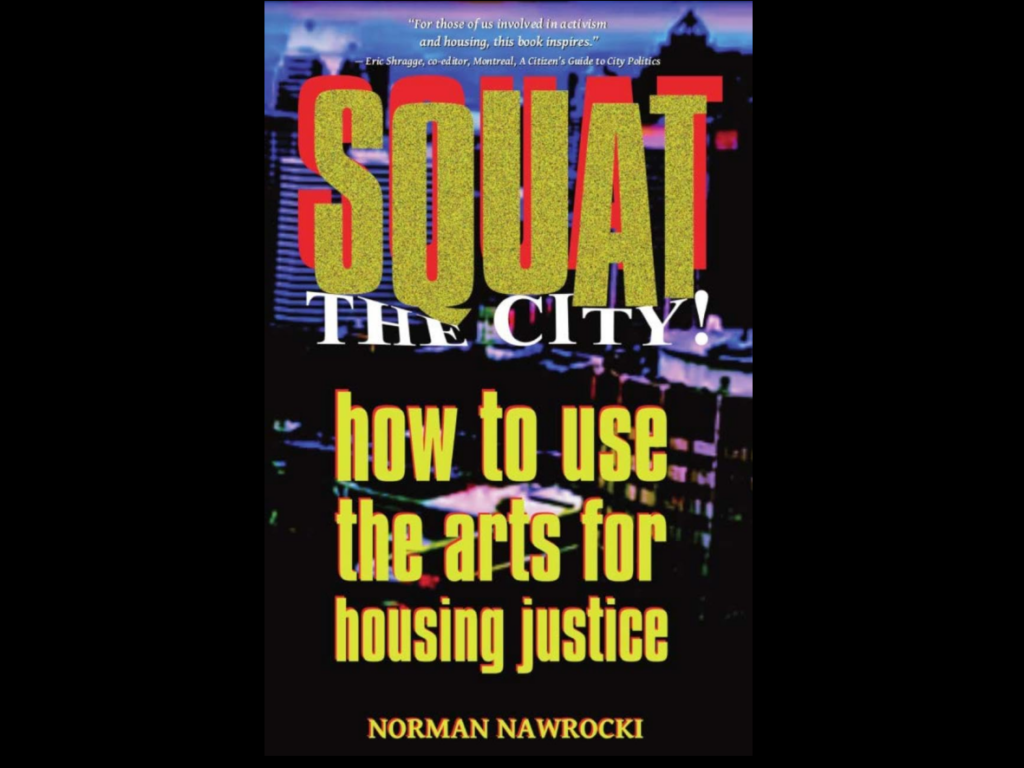
In his most recent book, Nawrocki summarises decades of spirited, fun, and creative activism around housing rights in a rapidly gentrifying Montreal. The book itself acts as a kind of compendium. He weaves first-person accounts from his own long history of engagement with radical projects with their related primary source materials in the form of photographs, visual art, music, and plays. Part history, part memoir, part call to arms (or arts), and part organisers’ handbook, Squat the City! is a truly unique document that captures resistance past and present and instructs on how to sustain and enliven our movements through the lens of creativity.
Nawrocki begins with a call to artists and musicians to engage with their communities and offer their creativity in service of larger social actions. What follows is a quirky pastiche of song lyrics, essays, visual art, documentary history, and texts from dramatic productions. Squat The City! does something unusual by placing primacy on the actual work produced by creative resistance, and in doing so signals that creative work is a central part of the movement for housing rights, and indeed all resistance movements.
The text situates art, activism, and the social milieu birthing their particular expression outside the confines of the traditional narrative which holds that these things are inherently transient. Instead, Nawrocki contextualises them firmly within a larger socio-historical trajectory. No longer is the play performed only once at a housing protest reduced to a moment in time (now long past), but rather is explored as an action with real consequence for the resistance movement which engendered its creation. The raucous retelling of creative protest actions belies the seriousness of Nawrocki’s mission here: to make artist and viewer alike understand the long-lasting impact that creative expression can have.
There are a number of pieces in the book related to specific tenants’ fight for the Overdale housing project. While Montreal housing struggles may not be familiar to the non-Canadian reader, the description of the destruction wrought on regular people’s lives and homes in the service of “development” will be familiar to almost everyone. Nawrocki clearly illustrates the effect that both the planned displacement of tenants and their incredible resistance had within the Overdale community and wider Montreal. Knowing little about the subject myself, I was overjoyed to find that the Overdale resistance Nawrocki describes inspired similar actions across Montreal and that collectively these actions had a meaningful impact which persists to this day.
Nawrocki has carefully recorded much of his artistic output. Performances by his band, Rhythm Activism, community cabarets, song lyrics, housing-focused plays and dramas are all given space within Squat The City!. Many of these endeavours share a slightly hokey sincerity and often an overtly didactic form. It is exactly this willingness to be uncool that is the book’s strength and the heart of its message. Nawrocki takes art as a popular form seriously, and credits it with the ability to enact change and further the aims of any movement. At the centre of the book, philosophically and physically, is Nawrocki’s essay on accessibility. He describes his goal of making work that anyone “can engage with. That has meaning for them. That is understandable and accessible… So that they might then be encouraged or inspired to think about, and actually join, the movement for housing justice.” Stylistically, his creations take their cues from well-worn agitprop tropes of decades past – and yet they cannot be said to be passé. Nawrocki documents clearly the meaningful effect these actions had on audiences as well as participants. Indeed, there are clear echoes of this particular Nawrockian posture in much protest activism today. The social media friendly, humorous, and visually charming figure of the Portland Frog comes to mind – a gleeful riff on an American childhood icon (Kermit) put into service as a tool of resistance.
Throughout Squat The City! Nawrocki displays a level of optimism about the potential of art to transform which seems the truest expression of the “joy as an act of resistance” mode. His optimism is infectious.
Norman Nawrocki, Squat The City! How to Use the Arts for Housing Justice (Kersplebedeb, 2025), 251pp.