Investigation of fatal 2010 arson revived as fresh prosecutions re-centre ‘law and order’ politics
~ Blade Runner ~
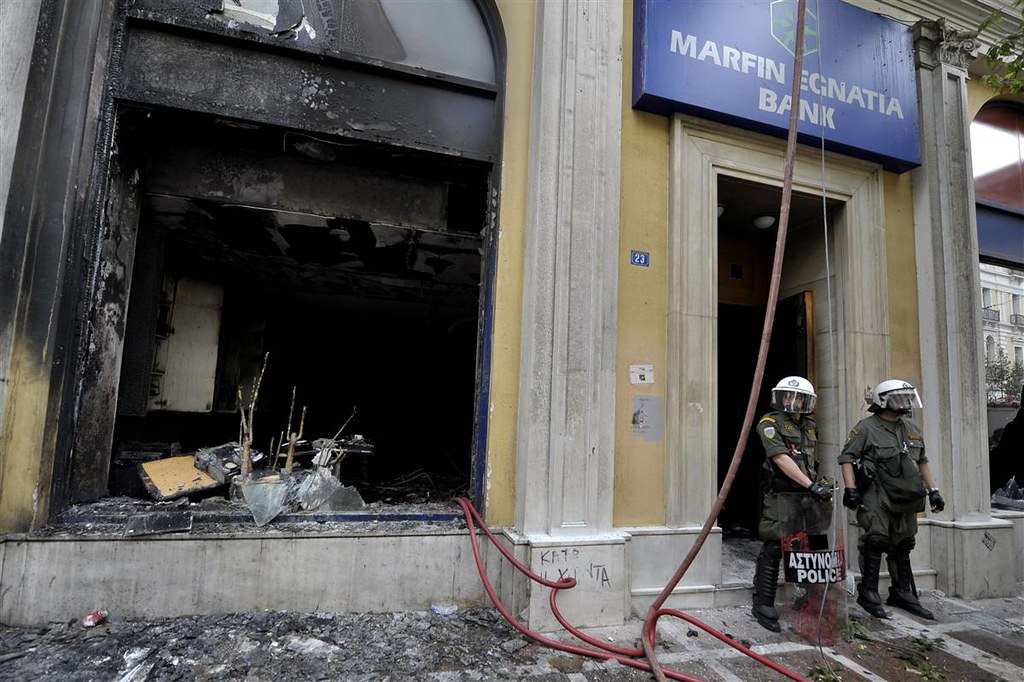
Sixteen years after the Marfin bank fire of 5 May 2010, arrest warrants have been issued for three people—one of them reportedly living in Brighton—accused of carrying out the fatal arson attack. The attack took place during one of the largest demonstrations against the first austerity memorandum at the onset of Greece’s debt crisis. Unknown assailants threw petrol bombs at the Marfin Bank branch on Stadiou Street in central Athens, trapping employees inside the burning building. Three workers, including a pregnant woman, were killed in what remains one of the darkest and most traumatic episodes in the history of Greece’s anti-austerity movement.
Greek authorities and the mainstream media have presented the arrests as a major breakthrough in a case that has remained unsolved for more than fifteen years. Three bank officials were themselves convicted in 2013 and received suspended prison sentences for failing to implement adequate fire safety measures at the branch. It was also widely reported that local staff had warned management against opening the branch on the day of the general strike, but employees were nevertheless instructed to report for work.
According to multiple reports, the case was revived after an anonymous email identified the alleged perpetrators. Investigators subsequently re-examined old case files, compared evidence from other investigations and used AI to reprocess photographs and video footage from the original inquiry. The latest development evokes a sense of déjà vu, recalling earlier attempts to solve the Marfin case, including the 2011 prosecution of three anarchists and the 2020 investigation sparked by an anonymously delivered USB stick—neither of which resulted in convictions for the killings.
The reopening of the case comes as the New Democracy government faces sustained political pressure over the Tempi rail disaster, the OPEKEPE agricultural subsidy scandal and the Predator surveillance affair. It also follows the fatal firebomb attack that killed Vagia Nestora, the mother of a New Democracy politician, an event after which the government explicitly returned law and order to the centre of its political agenda. The Marfin arrests therefore arrive at a moment when public debate is once again focused on security, terrorism and political violence.
The following letter by anarchist Giorgos P., who was himself prosecuted and ultimately cleared in the original Marfin investigation, argues that the latest arrests revive a familiar pattern of politically motivated prosecutions aimed at criminalising a broader political movement.
Fifteen years on, the architects of the frame-up are looking for new victims
In April 2011, I—then just twenty years old—and two other comrades found ourselves charged with three counts of murder and twenty-six counts of attempted murder over the Marfin bank fire.
The trigger was a badly written, misspelled and anonymous note—the Security Police weren’t using emails back then—which named us as the perpetrators with absolute certainty. Conveniently enough, the note also included our telephone numbers, home addresses and details of our vehicles.
Once the Security Police had declared us guilty, the media quickly followed. Fed by selective police leaks, they “identified” us in photographs and video footage, in items of clothing and pieces of equipment.
Three years passed before both N. and I were finally cleared by the Judicial Council. It took five years before Thodoris S. was unanimously acquitted by the Mixed Jury Court.
Five years spent trying to prove we weren’t elephants. Five years of collective political struggle to defeat a frame-up. As for those who orchestrated it—and the willing parrots who echoed their lies—silence.
Fifteen years later, much remains the same
The same political superior, Michalis Chrysochoidis, is still following, fifteen years later, the same script that has defined his forty-year career of political decline: law and order for television audiences, impunity for trigger-happy and rapist cops, prosecutions and imprisonment for political opponents.
The same police correspondents continue to make front-page headlines by serving up the same reheated police leaks to an eager audience.
The very same repressive machinery—and its lackeys—remain in place, still fantasising, in 2026, about political offences and certificates of political loyalty. They still want to rewrite history to suit themselves—but, as always… with the same spelling mistakes.
Fifteen years later, much has changed
The memorandum era that began in Greece in 2010 has now entered the final stage of its inevitable decline.
A country heading towards elections with ministers, journalists and opposition politicians all placed under surveillance by the National Intelligence Service, operating under the authority of the Prime Minister, and all vulnerable to blackmail by the Israeli intelligence services. A Constitution hollowed out. Young people dying on trains, from police bullets, or while trying to earn a living.
It was against this pervasive decay that the mass working-class and social movement of 2006–2012 fought. Though it was never vindicated, its strength, intensity and directly democratic character still haunt a state incapable of producing either material improvements or genuine democratic consent.
In the three comrades now facing prosecution, it is that very radical and hopeful movement that is once again being put on trial in an act of political revenge.
It is our duty to stand by their side. To defeat this frame-up once again.
Informers, step back. Comrades, step forward!
Giorgos P.
Photo: Joanna on Flickr