An ancient obligation to protect is animating the mass protests against the Jared Kushner’s destructive resort
~ Joel Sucher ~
I’ve said it before and I’ll say it again: I love Albanians. Tough, rough, and guided by a code of honour that most of the world has never heard of and wouldn’t know how to pronounce. That code is called Besa — an ancient Albanian principle, rooted in something older than Christianity or Islam, older than the Ottoman Empire, older than anything the West can claim to have taught the Balkans. Besa means, roughly, keeping your word. Protecting those who need protection. Even at cost to yourself.
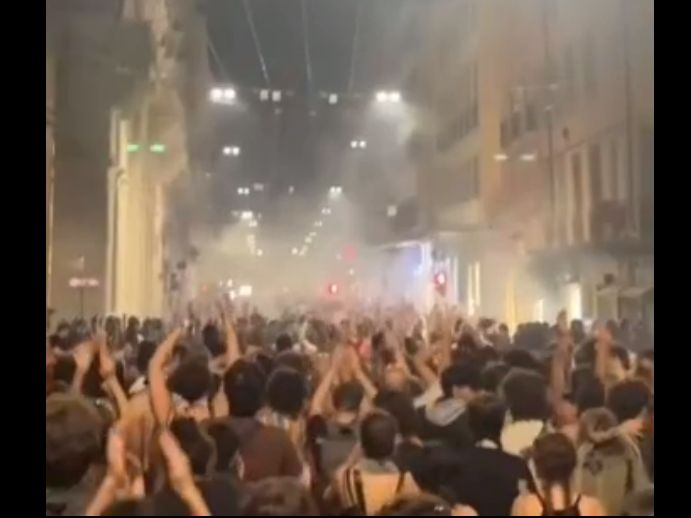
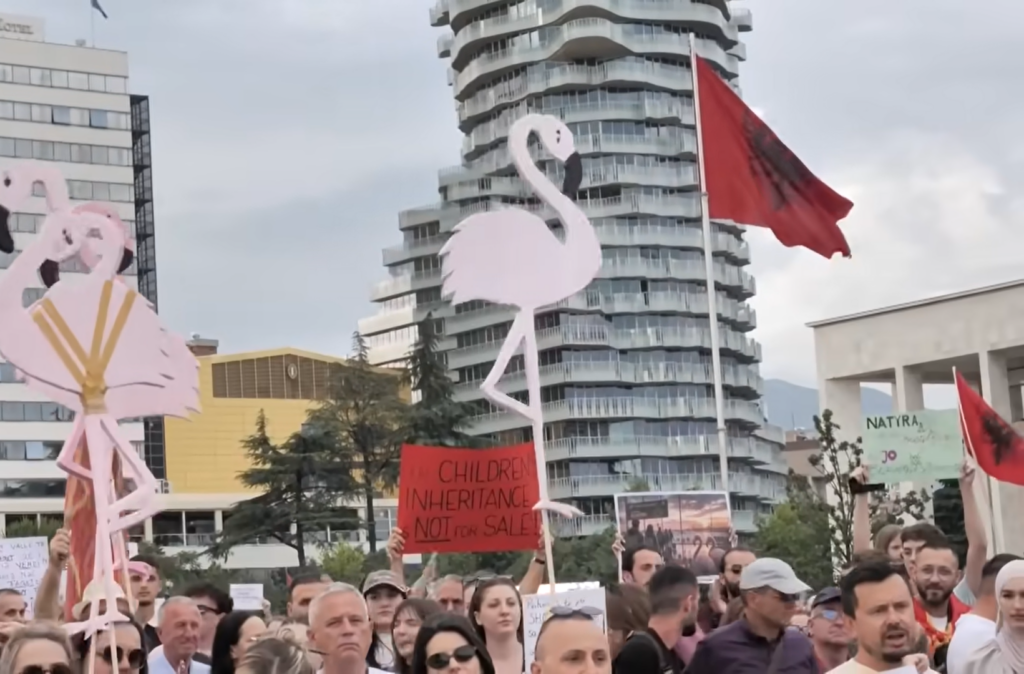
Which is why what’s happening right now along Albania’s Adriatic coast — the mass protests, the flamingo flags, the crowds filling the streets of Tirana night after night — doesn’t surprise me in the slightest.
The immediate spark is a 4-billion dollar luxury resort project, backed by Jared Kushner’s Affinity Partners and linked to Ivanka Trump, planned for Sazan Island and the protected coastal wetlands of Zvërnec — an ecologically precious stretch that happens to be home to flamingos, sea turtles, and nesting seals. The Albanian parliament quietly removed the ban on construction in protected areas back in 2024, laying the legal groundwork for what critics now describe as a sweetheart deal with powerful foreign investors and politically connected domestic interests. Albania’s special anti-corruption prosecutor has opened an investigation into how the land was acquired and sold.
When bulldozers appeared on the beach and private security guards started roughing up local residents and environmental activists, Albanians did what Albanians do: They showed up.
What began as regional resistance in the villages of Zvërnec and Nartë has mushroomed into a national movement, with thousands carrying inflatable pink flamingos — symbol of the threatened wetlands — and banners reading “Albania Is Not For Sale.” Solidarity demonstrations have been scheduled from Vlora to Milan, London, New York, and Toronto. Albanian anarchists have gotten in on the act too, replacing the eagle on the Albanian flag with a flamingo — a gesture that manages to be simultaneously irreverent and pointed. The movement has been dubbed the Flamingo Revolution, and its decentralized leadership and Gen Z aesthetics have drawn comparisons to other youth-driven protest movements internationally.
Prime Minister Edi Rama has responded by calling it a “hybrid war.” That’s the tell. When a politician reaches for that phrase, it usually means the protests are working.
But to understand why Albanians respond this way to perceived injustice — why this small, mountainous nation of 2.6 million produces people who simply will not be pushed around — you have to go back further than this resort deal. Much further.
During the Nazi occupation beginning in 1943, the Albanian population refused to comply with orders to turn over lists of Jews living within the country’s borders. Governmental agencies provided Jewish families with false documentation, allowing them to blend into the general population. This was not a minor act of passive resistance. This was systematic, deliberate, and dangerous defiance of the Nazi killing machine. Albania ended World War II as the only European country with more Jews than it had at the start — the only Nazi-occupied nation that can make that claim.
Besa — that ancient obligation of protection — was the animating principle behind this extraordinary act.
I’ve known Albanian Americans in the New York metropolitan area for decades. Some of them were not exactly choirboys. In 2004, the Albanian Rudaj Organization — “The Corporation,” as its members called it — was labelled the sixth crime family in New York City, alongside the five traditional Italian-American families. Operating out of the Bronx, Queens, and Westchester County — my own backyard — they were considered by the FBI to be more ruthless and harder to infiltrate than the Italian families they displaced and, occasionally, humiliated. I’ll leave the moral accounting to others. What I’ll say is this: even in that world, the code held. You didn’t betray your own. You honoured your word. You didn’t make a deal and then sell out the people who trusted you.
Which brings us back to Zvërnec, and to Jared Kushner’s bulldozers on a protected beach.
Jared Kushner – buoyed by his relationship to Trump, Inc. — navigated the labyrinthine real estate politics of Manhattan, and ham-handedly tried to do the same by pretending to put his brand on events going down in the Middle East. With a great deal of pretence and pretensions he went out with Ivanka on a quest for new challenges.
They found one, on a beautiful Albanian island, where they disembarked from a yacht, swam ashore, hiked to the top barefoot, and were — her word — “captivated.” In the world they inhabit, captivation plus capital equals acquisition. You see it, you want it, you buy it. What they apparently failed to account for is that this particular island sits off the coast of a country where the code runs older and deeper than any investment prospectus. You don’t get to just buy Albania. The Nazis tried to break it. Enver Hoxha spent forty years trying to seal it off from the world. Neither succeeded. A son-in-law with a chequebook doesn’t change the odds.