Interview with a member of Dago Melawan, a collective promoting autonomous networks, education and economic independence
In August last year, an uprising in Indonesia saw widespread clashes with police and harsh repression, followed by a wave of arrests. These were part of a series of what is often characterised as “GenZ” protests, starting in Bangladesh and including in Nepal, Madagascar, and Kenya. To catch up on the situation today, we sent questions to a member of Dago Melawan, a collective promoting autonomous networks, education and economic independence.
How were the protests in Indonesia organised, and how did they escalate so quickly? Would you see the protests as a victory?
I see an organised pattern—this is different from 2020, when the massive Omnibus Law protests were sparked by labour movements and NGOs. The August protests were sparked by live broadcasts from the TikTok app, which were organised and spread to several locations—and broadcast traffic quickly increased due to the possible use of “viewing bots.” Indeed, on the one hand, many organic initiatives from the people and structured organisations participated in mobilising the masses. This became a follow-up wave after the “Dark Indonesia” tagline/campaign was amplified by the online mass base on platform X.
But on the ground, when riots erupted in various locations and large-scale mobilisations were formed, there were two elite camps battling each other, particularly within the police and military—and attempting to exploit the mass mobilisation. Why? Because security measures for mass demonstrations were less stringent than usual by the police and military, they acted defensively. This became a kind of attempt to increase bargaining power with the new Indonesian president, who was closer to the military.
But this situation did not last long—when the elites united and found a compromise. Their brutality was repeated, especially when a motorcycle taxi driver (the late Affan) was run over by an armoured vehicle and died. Anger boiled over—protests, including arson, and riots broke out everywhere. Unfortunately, due to the lack of an adequate information coordination network structure to quickly share analyses of the situation on the ground between cities, several network analyses that should have been shared and complemented each other—to calculate the risks—did not materialise.
One analysis predicted that the enemy would use these protests to repel and remap the fragmented network. Finally, what we feared happened: they began arresting individuals, first the anarchist faction, then the left-wing network, and many ordinary citizens were used as shock therapy for the rest of the population.
Now the movement in Indonesia has become a fugitive again, and to this day, our comrades are still focused on assisting the political prisoners who have not yet been released!
Yes, we are beginning to reflect on this—that at least a more organised coordination structure is needed, regardless of differences in ideology, strategy, and tactics. But of course, this step must be disciplined; everyone must agree that physical and digital security must be tightened! Many are still acting carelessly in this regard.
Is our latest action a victory? For me, yes. Winning has sparked and trained Generation Z to see how liberal democracy works and that the electoral system is just nonsense. I believe that in a decade or two, a revolutionary generation will grow better and more organised than ours; the seeds of this are already visible now.
Earlier, in 2019 there were large Black Bloc protests in Indonesia which is how many people in the west may have first encountered anarchism in the country. Could you describe the moment that was and the development of anarchism in Indonesia since then?
In Jakarta, since the 2019 anarchist hunt, Westerners have begun to recognise the Black Bloc tradition. But one thing is certain: anarchism is growing here, rooted in the failure of labour unions to update their analysis. They are trapped in the statist nature of wage struggles, and have failed to renew themselves through visual design, as the majority still work in the industrial sector, not the creative sector. Furthermore, anarchist literature is easier to find and more accessible to young people, especially through the anarcho-punk and hip-hop scenes.
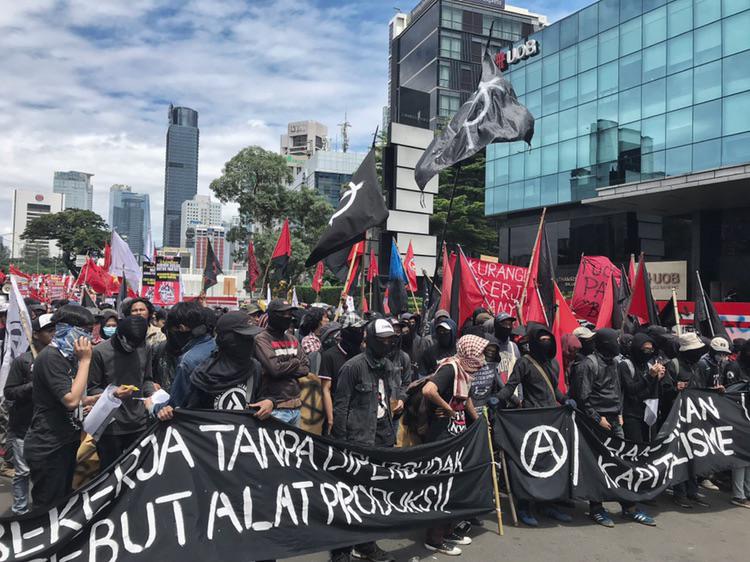
What’s unique here is that the Black Bloc isn’t solely comprised of anarchists or anti-authoritarians in the definition of anti-state. Some simply hate the regime, the military, and the police, but aren’t anti-state—they participate because they want to channel their desire to gather together without boundaries, which is difficult for left-wing groups, and to fight together on the streets. This is what makes us unique, because our masses are rooted in red-letter student organisations, coffee vendors, t-shirt screen-printers, the unemployed, artists, and others. What’s interesting in 2019 was that the number of people in Jakarta doubled to threefold, while in Bandung it could increase three to fivefold. Similar figures were seen in other cities like Malang, Yogyakarta, and Surabaya—a significant jump from 2017 and 2018.
But 2019 also marked the end of the peak of the anarchist movement, or more precisely, anarchists as a group adopting anarchist tactics, who are quite organised with loose networks or free associations. However, the end of these organisational ties wasn’t due to the state’s destruction—rather, we realised that our day-to-day political battles were far from adequate. Covid-19 deepened this analysis. Before Covid-19, there were street battles against the Omnibus Law, which would endanger workers’ conditions; some took the initiative to form Street Paramedics and tear gas self-defence units, and these spread to almost all protest hotspots. But again, they were generally poorly organised—and patchwork in nature, only active as tactical groups responding when anger escalated.
In 2021, we chose to discuss further and begin building a more specific organisational structure by adopting municipalism and dual organisation. As I explained above, the theoretical impasse began to be synthesised and recontextualised within our homeland. Others chose to enter the workforce and disappear, you know? Before fighting the system, fighting capitalist modernity turned out to be more difficult. That’s an important point I learned… why do we always start from scratch?
Where then did your group emerge from? What is your purpose, and how are you organised?
Historically, we are rooted in youth groups from diverse backgrounds, connected in several cities through literacy movements and the activation of street library spaces. However, in late 2015 (but actually, it started long before that, around 2010), we came together because of momentum after one of our libraries was closed down by state officials, and the suppression of left-wing books intensified. During our gathering, we began sharing stories about the slogan “workers are one, we are one,” but in reality, differences between factions were never resolved. From there, we began to build a loose inter-city coordination structure and create a learning space to gather shared knowledge for those who hold anti-fascist and anti-authoritarian values. This is a kind of new wave—from a small, reflective and self-critical millennial generation.
In my own context in Jakarta, since 2018, we have begun paving the way to resolve the debates of our time that we never experienced: the Bakunin-Marx split and the betrayal of the Soviet Union. Instead of endless theoretical debates, we began studying together about organisational critiques of decision-making, critiques of vanguard parties, blind vanguardism and power struggles, and how to view the state if infrastructure isn’t truly built. We also discussed the anarchist lifestyle, which tends to be indisciplined and merely a lifestyle—much like Bookchin’s critique.
We are now in a formal organisational context, tied to labour unions for learning and continually updating theory and practice. However, our identities are generally dual. I spend more time organising the Paguyuban Lintas Kampung (Cross-Village Community), municipal cells of urban communities from diverse backgrounds: Vespa communities, gangsters, cyclists, supporters, and Islamic study groups—a federation of youth associations (still small-scale, 100-200 people if we gather them) focused on rehabilitating social relations damaged by capitalist modernity. This collective (federation) was founded in 2021; this year we will celebrate half a decade of our association.
Our collective goal focuses on three main pillars: socio-cultural rehabilitation—democratising everyday social reproduction and rediscovering the identity of their homeland and culture; economics—by encouraging people to build a sense of community within a family, no longer ignoring those suffering or struggling to eat, and, ultimately, encouraging them to start independent businesses; and finally, politics—building an organisation that serves as a tool for liberating public education and further struggle.
In recent years, we have also been building another people’s assembly, comprising several urban poor villages and a movement against gentrification in North Jakarta. We have taken on a non-litigation role—public education—and are working to build people’s cooperatives (workers’ control—economic democracy) to support the organisation. Meanwhile, our comrades from the red organisation (FPPI—Indonesian Youth Struggle Front) have taken on a role in litigation (law) and knowledge on how to fight for and defend rights—this is another aspect of our intersection with the red organisation (left).
Specifically on repression, how is it that you have organised against the surveillance and imprisonment of anarchists by the state? How has it affected the movement and how you organise?
After the waves of arrests in 2019 (May Day) and 2020 (the Job Creation Law), we, especially in Jakarta, began to reflect, critique, and deeply self-criticise our methods of movement and the egoism of labelling or tactics (Black Bloc and direct action) as an end in itself—as I mentioned.
Then, we began to gradually shed the symbolic identity of the round A and syndicalism, especially when dealing with people outside of school. We began to move away from organising among intellectuals (students) and shifted more seriously to youth, the urban poor, environmental movements, and labuor unions.
We did this to minimise the label of anarchist, which the authorities indiscriminately used to stifle popular movements and organisations. Ultimately, this strategy was more effective, allowing us to move freely. However, there will certainly be criticism among us—will this depoliticise the people for revolutionary symbols? This depends on the point of struggle, for some organised cells, especially youth. They are still informed about the symbols and the risks they face by using them—there’s a kind of slogan among us: choose to use symbols to shorten our lives? Or prioritise values and practices over symbolic validation?
Finally, our strategy regarding the debate over symbols: from 2021 to today, all the people’s organisations that have joined us have created their own symbols that reflect where we all come from. People are not forced to carry black or red-and-black flags to emphasise their dogmatic ideological identity. Their identity is that of a people’s organisation, and their paradigm is one they themselves have developed as a tool for analysis and resistance.
We must not only fight alienation in the workplace, but also in capitalist society! Why have we been so easily identified? Because we have failed to identify with the people. We have become a separate class from them.
Today, is anarchism present across Indonesia or concentrated in certain areas? What areas of struggle (student/ youth movements, labour movements, movements against gentrification etc.) is anarchist organising/ though most present and why?
Anarchists have actually spread to almost every region, both small and large cities, in Indonesia. But generally, the most popular and vanguardist movements—inspiration for struggle strategies and tactics—are still centralised on the island of Java, for example, in Bandung, which is now the centre of repression and the confinement of political prisoners suspected of being anarchists after the August protests.
Today’s anarchist movement focuses more on the urban poor. Why? Because this is a long-term struggle and organisation, its associations are more likely to endure, and when spatial planning is successfully organised, these can become autonomous zones—not only for the self-defence of people facing displacement due to gentrification, but also as safe spaces for anarchist organisations and others.
Anarchist ideology remains a mainstream, very popular, and youth-oriented ideology in Indonesia. However, in Indonesia, few have declared themselves as specifically anarchist organisations because anarchist values are not purely the foundation of the struggle.
In the past, we focused on student movements and controlled and built many spatial spaces as meeting points and learning points. Unfortunately, today, student movements can no longer be expected to return. The percentage of finding militants from the education industry (universities) is increasingly difficult—this is different from the objective conditions of a decade ago. Because today’s students are strangled by increasingly unreasonable tuition fees, worsening family financial conditions, and college assignments that increasingly resemble tasks in a factory/office. Even in some cities, it is starting to be quite difficult to organise discussions of people’s movements as lively as before—I suspect this is the effect of technological acceleration during the Covid-19 pandemic that makes our bodies comfortable.
Machine translation