The spying was part of a covert, illegal national anti-radical program initiated by the FBI
~ Peter Werbe ~
“To be GOVERNED is to be watched, inspected, spied upon, . . .”
Thus begins Pierre-Joseph Proudhon’s famous quote defining the function of the political state. The surveillance states already in formation in Britain and the U.S. are nothing new. Only its technology and its capacity for totality. But this is a key consideration. No more escaping across the county line or hiding out in the hills. Everywhere and anywhere today is a social panopticon.
In earlier times of political opposition to the rulers, the names of rebels would be written in ink in a large ledger and later, on 3X5 cards, following reports from observers, undercover agents, and provocateurs. This was often sufficient to keep track of those who threatened the rule of capital and the state. Enough to often fill prisons and dungeons with those who refused their duty as loyal servants of the system.
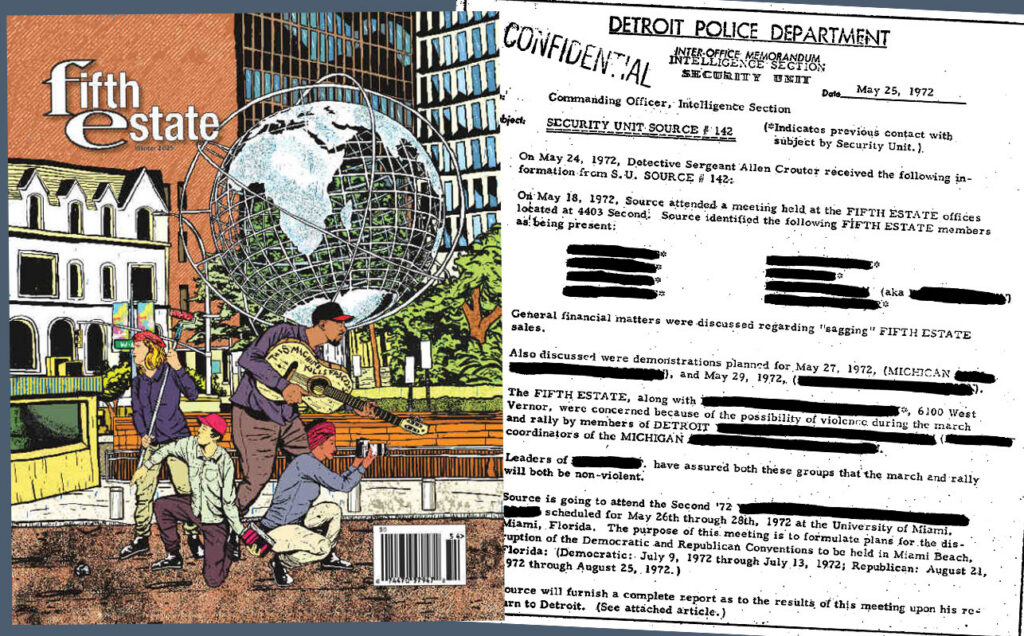
From almost the beginning of publishing a radical newspaper in 1965, the Fifth Estate in Detroit, the police apparatuses of the city, state, and secret police (the FBI) created a file for the fledgling publication. Cops back then were particularly stupid, seemingly only less so today as now there are demands for college degrees, training, and they are aided by sophisticated technology. But, modern cops are from a long lineage of infiltration and spying that began intensely following World War I with the rise of communist movements after the success of one of them in Russia.
The staff of the Fifth Estate had no idea their paper had come under scrutiny because of its advocacy of civil rights, opposition to the Vietnam war, and legalisation of marijuana. And, it was a voice not without power. The Detroit tabloid was one of 500 so-called underground radical publications that began between 1965-1970. These regularly appearing publications had a combined circulation of four million all of which condemned the American system, its wars, and its empire.
In the mid-1970s, lawsuits were brought against the Michigan state and local police forces as well as the FBI by civil liberties groups demanding that the accumulated files, many harkening back to the 1920s, be distributed to the groups and individuals who were spied upon, and that the surveillance be ended. The Fifth Estate received files of its activities from the Michigan State Police, the Detroit Police, and the FBI. One astute infiltrator from the federal police reported that “The Fifth Estate supports the cause of revolution everywhere.” Neither the staff then, nor the current one objected to the description, to the point where the sentence often appears on appeals for subscriptions.
This spying, and worse, was not unique to one city and state, but part of a covert, illegal national anti-radical program initiated by the FBI labelled COINTELPRO, for Counter Intelligence Program. It was active between 1956 and 1971 in information gathering, name collection, encouraging illegal acts, infiltrating, and disrupting a wide range of organisations and individuals from the Black Panther Party to Martin Luther King, Jr. to the American Indian Movement to the American Communist Party. The damage done in terms of disruption and even deaths gives testimony to what lengths the rulers will go to when their absolute rule is challenged.
However, sometimes there is unexpected blowback. In 1968, persons unknown (actually, I know, but ain’t telling) bombed a secret CIA office in the college town of Ann Arbor, Michigan. Suspicion fell on activists of the anti-racist White Panther Party headquartered in Detroit, directly above the Fifth Estate offices. Warrantless wiretaps were set up by the FBI on both the Panthers and the newspaper offices’ phone with the hope of overhearing incriminating evidence.
The U.S. indicted three White Panthers, including counter-cultural activist, John Sinclair, on charges of conspiracy to destroy government property including one of the three specifically for the CIA bombing. In pre-trial motions, the defence asked for the disclosure of all electronic surveillance by the government. The case eventually wound up in the United States Supreme Court which ruled unanimously in 1974 that the taps were illegal. The indictments were quashed as the government refused to reveal the extent of its spying. Some taps lasted over a year and monitored over 900 calls.
The court decision led to the dismissal of dozens of other cases the government had brought against activists, but its most dramatic result was the unravelling of U.S. President Richard M. Nixon ending in his resignation in 1974. Fearing that the court would rule against the government’s warrantless wiretaps, members of Nixon’s re-election campaign, two days before the final court ruling, were instructed to secretly remove listening devices they had installed in the headquarters of the Democratic Party at the Watergate Complex in the nation’s capital. The burglars were apprehended and the act traced back to Nixon which began the process whereby he willingly left office. He was granted a pardon by his predecessor before charges could be laid against him.
Following the Supreme Court decision, all federal electronic surveillance had to be approved through a special judicial body. Many cities and state governments disbanded their so-called Red Squads that had harassed radicals for decades in a seeming victory for civil liberties and the rule of law.
Are the days of infiltrators, provocateurs, and secret surveillance just history from half a century ago? It’s hard to believe that the cops have given up keeping tabs on radicals in Britain and its former colonies. In a world of electronic communication and ubiquitous cameras, spying is that much easier for the authorities and much less traceable.
One of the results of a Big Brotherish atmosphere in which radical work for change is perhaps no different than a hundred or more years ago is the feeling that our every move is being monitored by repressive forces that can easily give rise to a sense of powerlessness or paranoia.
There isn’t a single piece of advice to give here other than what has always gotten us through the activity we do to rid the world of an oppressive and unjust system: Continue on as we have, be vigilant, extend solidarity, and have confidence that as the generations before us have maintained our struggle even in the face of ruthless governments, we will never stop until a vision of a world without states and capitalism has been won.
Peter Werbe is a long-time member of the Fifth Estate magazine. He is the author of a novel, Summer on Fire: A Detroit Novel, and a collection of essays, Eat the Rich and Other Interesting Ideas.
This article first appeared in the Winter 2025/26 issue of Freedom Journal