Thirty-six years on, Freedom revisits the 1990 Poll Tax riots and considers their legacy
~ punkacademic ~
For folks of a certain age (me), the Poll Tax riots of 1990 were something of a political coming-of-age. Not that I was there of course. My youthful ten year-old self was far away in the fastness of his Liverpool back bedroom, alternating between playing video games and worrying about Everton (neither of these things has changed).
But the image of ‘clashes’ (as they were often euphemistically described by the media) between ‘police and protestors’ burned itself into my young mind, just as the threat of nuclear annihilation had done through the cheerful NUCLEAR BALANCE OF TERROR poster on my bedroom wall, courtesy of the Quest science magazine.
Whereas the fear of nuclear annihilation just mundanely weaved itself into lifelong nightmares, the lesson of the Poll Tax riots – which took longer to digest – was rather more positive.
Governments can fear their peoples. We were often told this, of course, but only at a ‘minimum safe distance’; it was OK and indeed right and proper for collapsing Soviet satellite states to fear their peoples, as glorious capitalism was about to bring them to the materialistic millennium. But until the Poll Tax riots, I hadn’t realised they could fear the people here, too.
I was too young really to remember what was at stake in the Miners’ Strike of 1984-85, and Liverpool wasn’t in the heart of a coalfield, though solidarity was real, and buckets were passed round in the fish and chip restaurant Mum took me to for a treat, and I always remembered the sticker I got.
But in 1990 I knew, unequivocally, that the Poll Tax and Margaret Thatcher were both Bad, if not why. I know now the why was quite simple – the Poll Tax, or ‘Community Charge’ as it was misleadingly described – was the latest in a long series of injustices visited on the public by a neoliberal government hell-bent on savaging what remained of community in Britain.
The Poll Tax was a flat, per capita, tax intended to fund local government. Instead of the system of ‘rates’ which preceded it, there was no link to property value and as such it meant a real-terms transfer of wealth from the rich to the poor, as was characteristic of the Thatcher governments.
A mass non-payment campaign took hold, and numerous people went to jail rather than pay it. The Poll Tax is often described by historians as the Rubicon which, when crossed, paved the way for Thatcher’s demise.
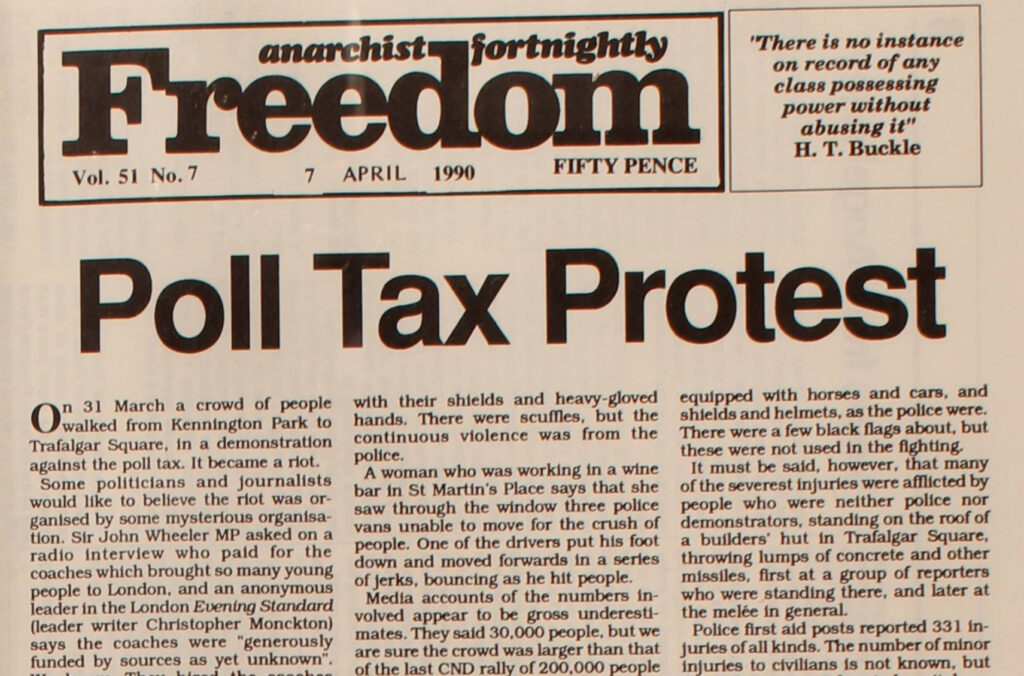
In the article reproduced here – Freedom’s front page of the week after the Trafalgar Square riot on 31st March 1990 – a familiar story is told of police violence and provocation, of conspiracy theories from government MPs and the demonisation of political opposition.
But an essential truth is contained in the last sentence; the riots represented a ‘spontaneous demonstration of the resentment of the poor’. Months later, Thatcher was gone, the Poll Tax was scrapped, and change happened, even in the limited context of state-bound politics.
Thirty-six years on, protest has been heavily criminalised, not least by ‘human rights lawyer’ Sir Keir Starmer. The media’s response to large-scale demonstrations in London is, wherever possible, simply to ignore them.
But spontaneity then, as now, is by its nature unpredictable. The criminalisation of protest is by definition reactive; the government still fears the people, even if in melancholic moments we sometimes allow ourselves to believe our efforts are futile.
They are not. There was no secret anarchist conspiracy in 1990, whatever the Tories would have liked to think. The truth was both more anarchist and more prosaic – people spontaneously revolted against an injustice perpetrated by the state which violated their moral sensibilities.
Such breaches of the ‘moral economy’ (as Marxist historian E. P. Thompson described it) have resulted in revolt – from bread riots in the eighteenth century, to the Poll Tax riots, and on to the student uprisings of 2010-2011 and beyond.
Despite the best efforts of today’s tech-bros and the past’s capitalists to kill empathy, they have failed. And just as a small boy in Liverpool awakened to political possibility decades ago at the sight of a spontaneous act against injustice, so too have the young of today.
It is they who, in their consistent emphasis of hope over despair on causes from Palestine to the environment, continue to offer a determined resistance to the necropolitics of Britain’s zombie state.
—-
Freedom, vol. 51 no 7, 7th April 1990
Poll Tax Protest
ON 31 March a crowd of people walked from Kennington Park to Trafalgar Square, in a demonstration against the poll tax. It became a riot.
Some politicians and journalists would like to believe the riot was organised by some mysterious organisation. Sir John Wheeler MP asked on a radio interview who paid for the coaches which brought so many young people to London, and an anonymous leader in the London Evening Standard (leader writer Christopher Monckton) says the coaches were “generously funded by sources as yet unknown”. We know. They hired the coaches themselves.
All our investigations indicate that nobody organised it.
A comrade at the rear of the procession tells us that after they passed the Houses of Parliament, demonstrators were diverted up Northumberland Avenue. At the Trafalgar Square end of Northumberland Avenue there was a joyful party of people on builders’ scaffolding, banging rhythmically in unison.
He saw missiles being thrown in Trafalgar Square, then suddenly a body of police ran across the end of Northumberland Avenue to block it. People sat down and there was a stand off, then gradually the police moved people back. This was scary, because missiles were being thrown from the rear of the demonstrators. The police were able to make more progress when smoke was visible in the square, and they shouted “Fire engines coming through!”. Not true, but the demonstrators cleared a path.
Our young comrade had not been involved in violence from the police before, and was surprised about how they smiled as they attacked. The most frightening thing was the way the police used their batons like blunt swords to stab demonstrators in the guts, and hit people at close quarters with their shields and heavy-gloved hands. There were scuffles, but the continuous violence was from the police.
A woman who was working in a wine bar in St Martin’s Place says that she saw through the window three police vans unable to move for the crush of people. One of the drivers put his foot down and moved forwards in a series of jerks, bouncing as he hit people.
Media accounts of the numbers involved appear to be gross underestimates. They said 30,000 people, but we are sure the crowd was larger than that of the last CND rally of 200,000 people or more. Perhaps the police, numbering about 10,000, felt themselves grossly outnumbered.
As the march moved peacefully along Whitehall to Trafalgar Square, a group of about 200 marchers staged a sit-down protest at the end of Downing Street, and refused to move when asked to do so by police and stewards.
Most of the marchers continued to walk past the sitters-down, until a squad of riot police fanned out across the road, blocking it. Pushing and shoving then started between police and demonstrators, which quickly escalated as the police struggled to show that they were the boss, and others were equally keen to show that they did not like police bossing them.
As a spokesperson for the organisers of the march put it, “the police inflamed a smouldering situation”. Unable to separate rioters and peaceful demonstrators they attacked the crowd as a whole, driving cars at small children and their mothers, attacking everyone. A television team, seeking to interview an injured demonstrator in hospital, interviewed instead an injured theatre-goer, struck on the head by a police truncheon as he was leaving the theatre.
Some of the demonstrators attacked the police using poles which had been carrying placards as weapons, and would no doubt have liked to be equipped with horses and cars, and shields and helmets, as the police were. There were a few black flags about, but these were not used in the fighting.
It must be said, however, that many of the severest injuries were afflicted by people who were neither police nor demonstrators, standing on the roof of a builders’ hut in Trafalgar Square, throwing lumps of concrete and other missiles, first at a group of reporters who were standing there, and later at the melée in general.
Police first aid posts reported 331 injuries of all kinds. The number of minor injuries to civilians is not known, but 76 civilians were taken to hospital.
After the square was cleared there was an attack by demonstrators in the surrounding streets, not against people but against property. Banks, building societies, the tourist offices of various countries, department stores, jewellers, and a fast food shop had their windows smashed. Cars were over-turned. But apart from a stray brick through the window of Book for a Change, places which provide a more general service were intact.
This was an attack on ostentatious wealth, a spontaneous demonstration of the resentment of the poor.