Indonesian alternative football has developed its own identity, but the influence of the experience of self-organised clubs in England is palpable
~ Yann Dey-Helle, Dialectik Football ~
The rejection of modern football is also gaining ground in Asia. The entry point is undoubtedly Indonesia, where, for several years now, an alternative football scene has been taking shape. Let’s explore some of these clubs that are striving to advance their democratic and anti-fascist counter-model.
In the archipelago, several dozen self-organised clubs reject the commercialisation of football and the corruption of its governing bodies. They include clubs like FC Rainfall, Riverside Forest, Port City Wanderers, Tribun Kultur FC, Stonegate Rovers, and Kalibrug FC. They readily show their support for social, environmental, and feminist struggles. They raise funds for striking workers and children with cancer. Some also mobilised to help victims of the recent floods in Sumatra.
The popular uprising of summer 2025 against worsening living conditions highlighted the commitment of these clubs. Most of them present themselves as spaces of resistance against the regime and the Indonesian Football Federation (PSSI). In Indonesian football, as in Europe, the commercial and security excesses of modern football have given rise to an opposition. Modest but determined, this movement has seen real growth since the early 2020s.
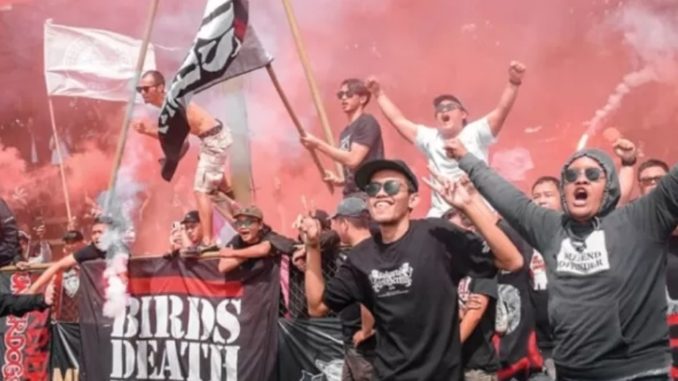
Behind many of these projects are fans expressing a level of disgust that has reached its breaking point. Riverside Forest, for example, was created by members of the Bobotoh, the supporters of Persib Bandung, a near-hegemonic institution in West Java. A large community of supporters, led by the Birds Death Brigade, surrounds Riverside Forest. Their counterpart is the Deer Troops, who support and animate FC Rainfall, based in Bogor.
At the root of it all is a profound disgust with modern football.
While protests from traditional supporter groups also exist, they sometimes encounter contradictions, particularly in their relationship with club owners. As in many parts of the world, rivalries play a significant role in Indonesia. To such an extent, according to some critics, that they neglect addressing the “football-business complex that commodifies passion and demonises the fans.”
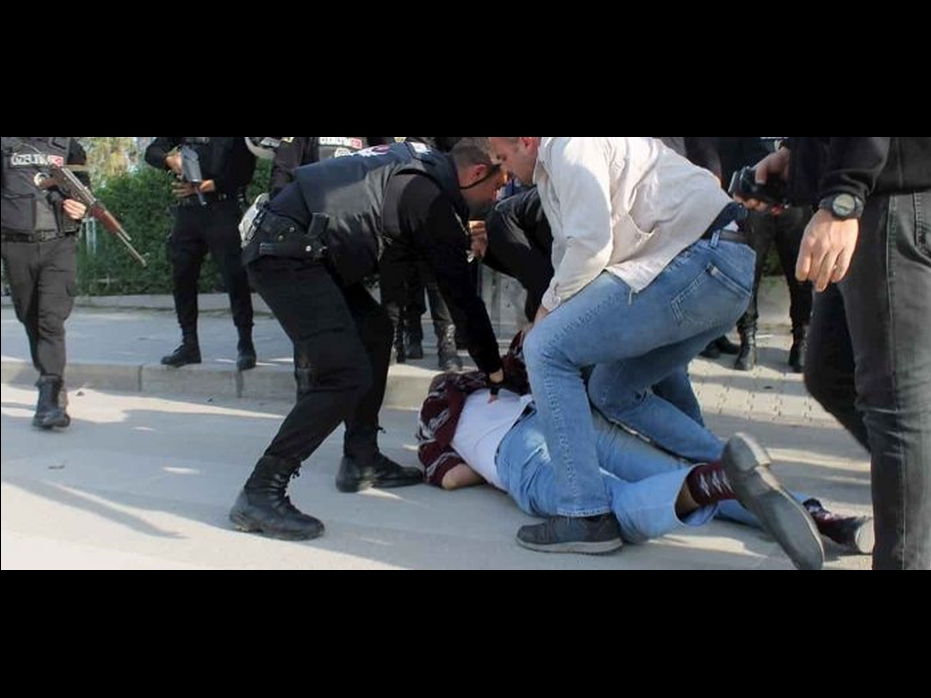
The Indonesian football scene is also deeply affected by the tragedy that occurred on October 1, 2022, at Kanjuruhan Stadium in Malang. At the end of a match between Arema FC and Persebaya, 135 people died following a brutal police intervention and the use of tear gas. This event, which shocked and outraged many fans, further damaged the already tarnished image of the PSSI (Popular Security and Sports Industry), which largely shirks its responsibilities.
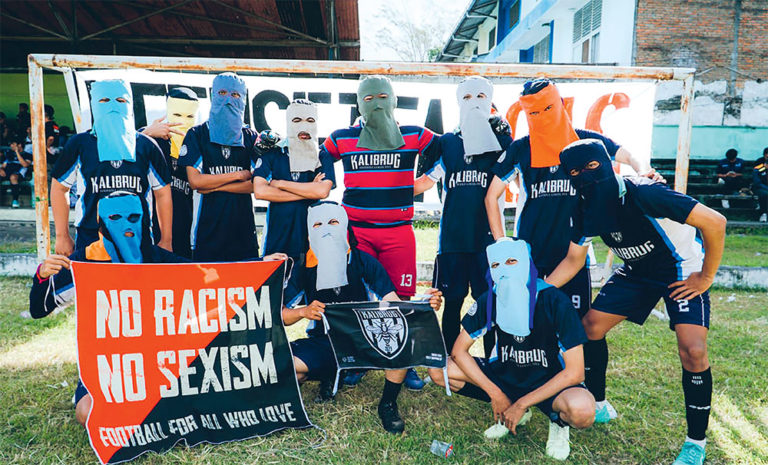
The Kalib rug FC Team
The way the state and governing bodies handled everything was a trigger, or perhaps an accelerator, for some supporters, in their desire to break with the dominant football model embodied by this federation that “abuses its power, practices corruption, and tolerates police brutality.” This is particularly true of FC Kalibrug, a team from Purbalingga. Its name is formed from two Bahasa words: “kali,” meaning “river,” and “brug,” meaning “bridge.” “It represents our hope of connecting communities, groups, and individuals.” The philosophy of FC Rainfall—founded in 2023—also offers a response to ritual and institutional violence. The club promotes a football centred on friendship and solidarity, hence its motto, “Football Friendship Forever.” It has naturally forged ties with FC Kalibrug despite the 390-kilometer distance.
Faced with this feeling of dispossession, the invention of a local counter-model had become essential. It’s even a matter of survival, according to the members of Stonegate Rovers: “By building a club from the ground up, we are reclaiming what was stolen from us: a football that speaks the language of the workers, the neighbourhoods, and the anti-fascist resistance.” Indonesian alternative football has developed its own identity, but the influence of the experience of self-organised clubs in England is palpable.
“The ‘fan-owned’ model, where decisions are made by the supporters themselves, as the true owners of the club, is, for us, the ideal form of a football club,” explains Shamroog, a member of Riverside Forest. He readily cites the examples of Exeter City, FC United, and Clapton CFC. The name of the East London club comes up frequently in discussions. FC Kalibrug also makes no secret of seeing Clapton as “a source of inspiration.”
For its part, Stonegate Rovers – which experienced a period of hiatus – has adopted the label “protest club,” while maintaining a different approach than its Manchester-based counterpart, FC United. “Here, the problems aren’t just the commercialization and the price of matches; it’s also the security apparatus controlling public space, the scarcity of autonomous spaces, and the crowd management by the police and bureaucracy.” For the club based in Garut, the scope of protest extends beyond football.
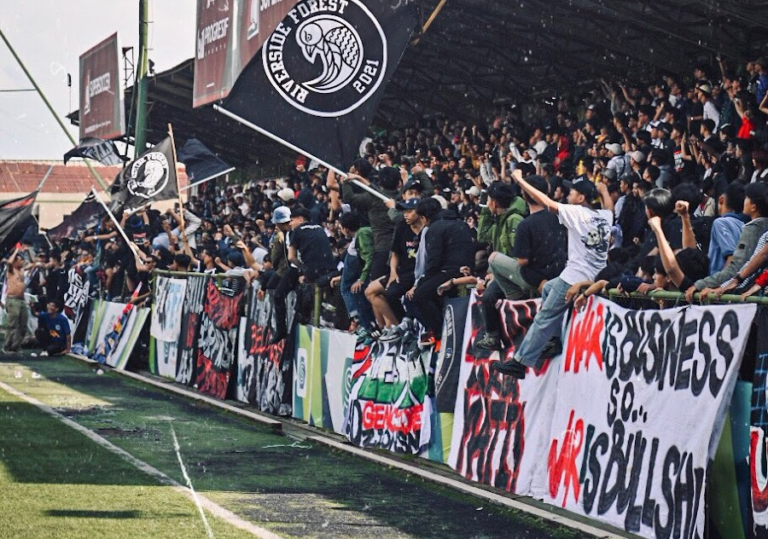
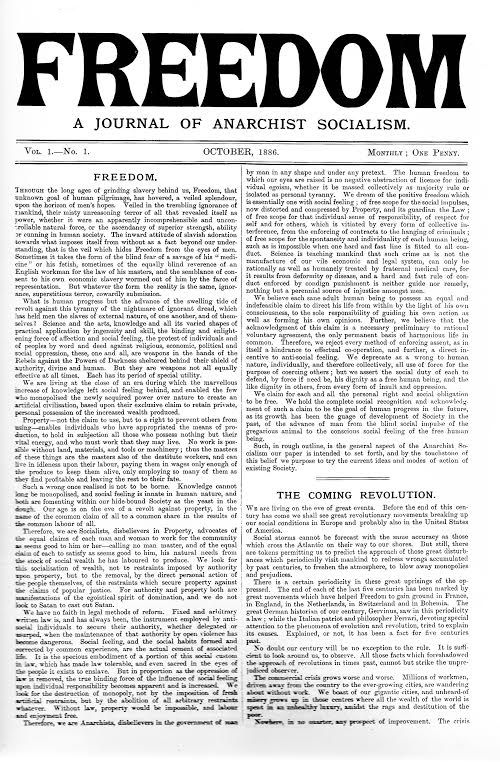
“Many of us became politically engaged through community kitchens, anti-fascist concerts, and clashes with the regime’s police. For us, football has never been apolitical,” adds a member of Stonegate Rovers. As he explained to us, his team claims to be as much a product of the legacy of Bakunin or Emma Goldman as it is of the Samin, the peasant communities of Java who fought against Dutch colonial rule at the end of the 19th century.
With very rare exceptions like Riverside Forest, affiliated with the PSSI, the Indonesian movement is characterised by a deliberate break with official governing bodies and competitions. Instead, they have their own schedule, punctuated by friendly matches like the Underground City Series. Organized by FC Rainfall, this traveling tournament—which landed in Purbalingga in 2024 and then in Yoguakarta the following year—strengthens ties between different alternative projects and structures the network.
This movement is called “punk football.” English influence is certainly a factor. But in Indonesia, it is also characterized by the close connection between these clubs and the punk scene. Their collaborations sometimes serve to produce merchandise for self-financing purposes. Between a DIY (“Do It Yourself”) ethos and a strong rejection of authority, Indonesian alternative football is steeped in punk counterculture, of which Bandung is a hub. More broadly, it works to build autonomous practices and spaces. Clubs support the struggles of the urban working class and those of peasant communities victimized by the land-grabbing bourgeoisie.
It was also in the wake of the punk movement that libertarian ideas experienced a resurgence in popularity after the end of Suharto’s dictatorship. The anti-communist climate of that era has not disappeared and, indirectly, affects anarchists involved in recent uprisings. Marxist opinions remain officially illegal, and members of alternative clubs expose themselves through their activism. Around stadiums or in the streets, they vigorously denounce state repression.
Machine translation