Fourteen years of worker control in Brazil’s only occupied factory
~ Matheus Fonseca ~
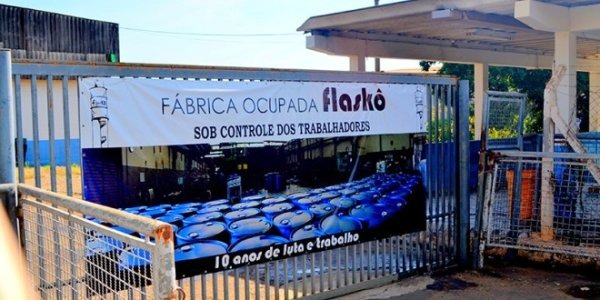
The Flaskô plastic barrel factory was the only workplace in Brazilian history to be controlled entirely by its workers. After years of exploitation and mistreatment, the workers of Sumaré, São Paulo, restarted production in 2003, after the company’s owners abandoned the factory. The machines provided both jobs and resources for the workers’ village, and could not be left behind.
But the Brazilian state would not allow them full control. The machinery was tied up in massive debts left by the former bosses, and the courts placed heavy lawsuits on the property. The workers could not pay.
Flaskô’s final days came with the 2017 boycott, when the electricity supply was cut off, making production impossible. Although the site is still under workers’ control, it no longer produces barrels. A legal battle over ownership drags on.
Despite this tragic ending, the experience was a spark in the debate on workers’ liberation and self-management. Even under crushing debt, Flaskô became a better workplace: shorter hours, higher wages, stronger safety measures, and wages guaranteed. Decisions were taken collectively in workers’ assemblies, and production continued for fourteen years.
Coverage in the mainstream press was scarce and skewed. Brazil’s media landscape is dominated by liberal or right-wing outlets, tied to state subsidies, tax reliefs, and religious groups—hardly sympathetic to workers’ struggles.
“The routine in an occupied factory I find, in particular, very interesting. We do only six hours per day, we do not have the boss and its whip. We work all pleased.” —Osvaldo da Costa Neto, Flaskô worker
Occupation in Brazil is harsh, dirty, and dangerous. The Flaskô workers faced not only state repression, but also threats from mercenaries and militias. They deserve enormous respect for their courage and determination. Yet they fought almost alone, with only minor support from a small militant group, in one of the most dangerous metropolitan areas in Brazil. Perhaps the occupation could have spread, ignited wider revolt, or inspired further takeovers—but instead it was isolated, and finally crushed. In truth, the project was doomed from the start: it was born into a neoliberal order hostile to industrial development and workers’ emancipation.
Flaskô was not unique. The Movimento das Fábricas Ocupadas (Movement of Occupied Factories), which led the takeover, also occupied Cipla and Interfibra in Joinville, Santa Catarina, at the same time. Both were ultimately seized by police. These struggles showed that reclaiming the means of production demands deeper organisation and broader participation. But Brazil’s trade union structures, dominated by state bureaucracy and lobbyists, actively condemned the takeovers and stifled solidarity.
The MFO occupations bear a family resemblance to the Paris Commune and the CNT-FAI in Catalonia. Though not anarchist, they revealed much of what libertarian socialism means in practice: the building of a workers’ village, a school, and a cultural centre, alongside dignified labour conditions won in the teeth of hostility.
Yet anarchists, both in Brazil and internationally, spoke little about these experiences—a serious failure of our movement. The criminalised status of anarchism in Brazil is no excuse. We need to bring anarcho-syndicalist ideas back into the centre of the struggle, stronger and louder, against the state-controlled unions and the liberal discourse that dominates the workplace, in farms and in factories.