The champion of ‘Der Einzige’, who died 170 years ago, has frenemies across the political spectrum
~ Elke Van dermijnsbrugge ~
Max Stirner, who died on 26 June 1856, would have turned 220 this year — a more than august age which is luckily only reserved for thought, not body, at least for now. Stirner has frenemies across the political spectrum and continues to be adopted, appropriated, and (mis)used: from libertarians to feminists to nihilists: anarchists, fascists as well as communists. Notoriously, Karl Marx and Friedrich Engels devoted a chapter to Stirner, sarcastically titled ‘Saint Max’ in their book The German Ideology, wherein they tried to convince Stirner to become a communist. Yet, Stirner always remained Stirner: unique, and for this reason his practical philosophy deserves not only recovering and redeeming, but also celebrating. Stirner’s thought offers useful guidance on how to live an ethical life today; how to resist and transgress oppression and statism.
Stirner was part of the Young Hegelians, a Berlin-based group of radical intellectuals arguing for social change, active in the early nineteenth century. Berlin at the time was in full expansion: a beacon of enlightenment and growing industrialisation within the increasingly powerful Kingdom of Prussia. Stirner resented all of the above. He problematised the prevailing dominance of a rational, dualistic, enlightened, humanistic worldview, and accused liberalism and rationalism of being deeply religious, whereby God was now replaced by the Human and everything human and rational was sacred. He opposed all ideologies, dogmas and meta-narratives and therefore has been regularly portrayed as the first poststructuralist.
His publication ‘Der Einzige und sein Eigentum’ (1844) gave him his name and fame. The book briefly got taken out of circulation shortly after publication, because it was considered dangerous. Yet, very quickly it became available again, deemed too crazy to actually cause any harm. The first translation of his book in English by Steven T. Byington appeared in 1907 and was titled The Ego and His Own. This translation, still a major reference today, gave Stirner the international reputation of ‘the philosopher of egoism’. It is partly because of the choice of the English words ‘ego’ and ‘egoism’ that there is widespread misunderstanding of his work.
The only way to be considered a legitimate citizen and to be recognised by the state, argues Stiner, is to be a rational, Christian, ‘modern’ human being. This homogenised, generalised and abstract view of human beings forms the fundamental legal pillar of the liberal state, written into human rights and notions of freedom. Stirner warns us that universal abstract terms such as ‘rights’ and ‘freedom’ – ‘spooks’ as he calls them – are hollow and meaningless, and completely obfuscate the difference between individuals and communities, flattening their diversity and singularity.
Our absolute belief in the state as a protector of our rights and freedom also means that we have collectively surrendered our individual freedom. We are owned by the state. When states determine what we consider to be a human right and what it means to be free, they can then take away those rights and freedoms at any given point. This raises a number of questions: Who is free? Who has rights? Who decides what freedom means and which rights should be claimed? Stirner’s critique of the nineteenth century liberal state could equally be applied to the present-day all-encompassing power of multinationals such as Amazon, Google and Apple and, with that, the far reaching power of the ‘free market’. How free are we really? And do we really have no choice but to surrender?
Global politics is still governed by the type of human being Stirner so vehemently critiqued, now with intensified levels of state surveillance and control and increasing hostility towards those who do not fit the narrowly defined ‘modern human’. The many who do not fit this profile are at constant risk of being deliberately silenced and criminalised. Governments criminalise or delegitimise large numbers of citizens (‘the outsiders’, e.g. ethnic minorities, refugees, feminists, queers, …), often justified under the umbrella of ‘national safety’ (for ‘the insiders’). The outsiders constantly need to fight for their voices to be heard and their existence to be recognised and legitimised. Often these oppressed groups are forced to develop a strong, homogenised, abstract identity as a legal pathway into being legitimised by the state or any other oppressive institution, a process we refer to as ‘identity politics’. The creation of these strong identities is an understandable reaction to oppression, but to Stirner it is just the adoption of another spook. What would he suggest instead?
For Stirner, the abolition of states and more generally, oppressive authorities, and the dismissal of their all-encompassing power starts from individuals who – together – no longer wish to replace one power (the state) with another (the identity), but who wish to abolish the notion of being governed altogether. Stirner’s answer is a return to the micro-political level of our communities. He saw a voluntary coming together of people, based on principles of openness, diversity, multiplicity and contingency as a reclaiming of individual freedom through collective responsibility by forming affinity groups, or what he called a ‘Union of Egoists’.
These unions are committed to question and revisit their own principles, values and actions at any given moment and to reinvent themselves, articulating their own purposes and creating their freedom from within. A Union of Egoists is an experimental practice of forming alliances, of bridging individual and collective freedom, approaching existence as an ongoing negotiation, rooted in a shared creative responsibility. Critics of Stirner tend to accuse him of being nihilistic and lacking ethics, yet what could be more purposeful than arguing for a collective ethical responsibility that acknowledges uniqueness and singularity?
Many of our day-to-day relationships with fellow humans, animals and inanimate objects are affinity-based: we have affinity with our pets, with the houses and buildings in our neighbourhoods, with weather patterns, with colleagues, with those who are engaging in similar activities to ours (sewing, gardening, painting, cooking), close by as well as far away. These are voluntary relationships, free floating and ever changing alliances that have the potential to form a strong micro-political force against dogma, statism and oppression.
If freedom is one aspect of our existence we all so deeply value, why are we putting this in the hands of the 1%? What is this freedom we are waiting for when we can create it ourselves, right here and now? Recognising our ability to shape-shift and to come together in respectful disagreement, difference and delight is a step towards un-seeing the state. Or, to quote Stirner: ‘We are perfect altogether! For we are, every moment, all that we can be; and we never need be more’.
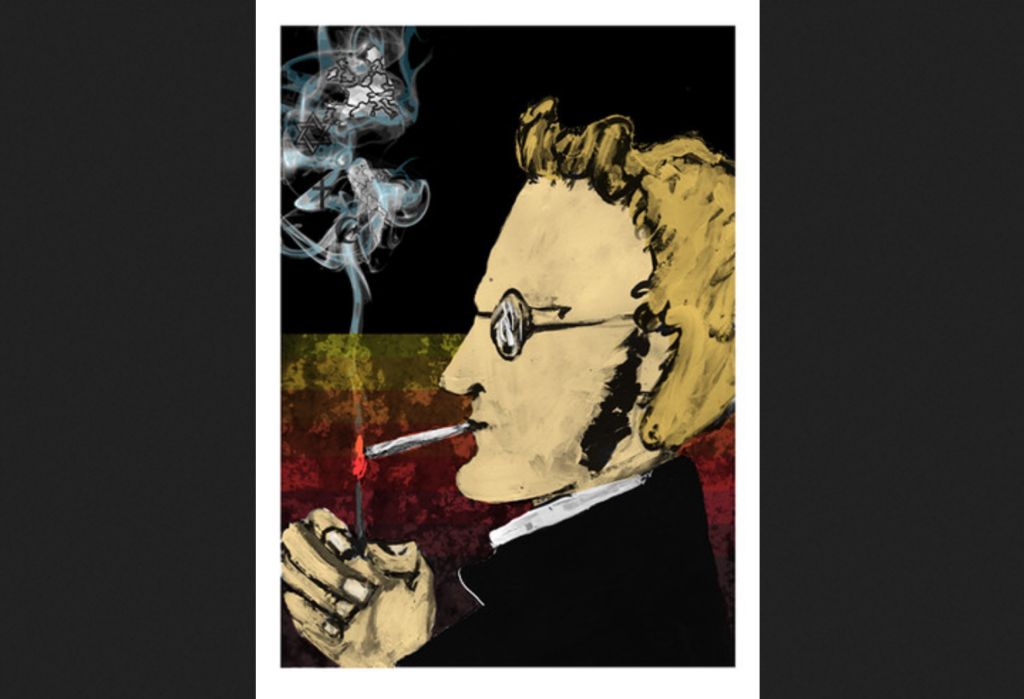
Top image: Frederico Penteado