The incredible story of a skull — and a Berlin landmark that survived Nazism and the Cold War
~ Maurice Schuhman ~
In 2006, in response to my enquiry, the Senate of Berlin extended the honorary status of Max Stirner’s grave in Berlin for another 25 years. The Department for Cultural Affairs informed me it had supported this decision, “as Max Stirner is an internationally recognised figure, and his philosophy continues to be discussed and to exert influence to this day”.
The curious story of this grave has rarely been told from start to finish.
On 26 June 1856, Johann Caspar Schmitt, better known as Max Stirner, died in Berlin at the age of just under fifty. His circle of friends – foremost among them the Young Hegelian Ludwig Buhl – raised money to provide the impoverished philosopher and anarchist with a dignified burial. However, the funds collected proved insufficient. Instead, Stirner was interred in a pauper’s grave, that is, a mass grave, at Sophien Cemetery II, and was in danger of being forgotten.
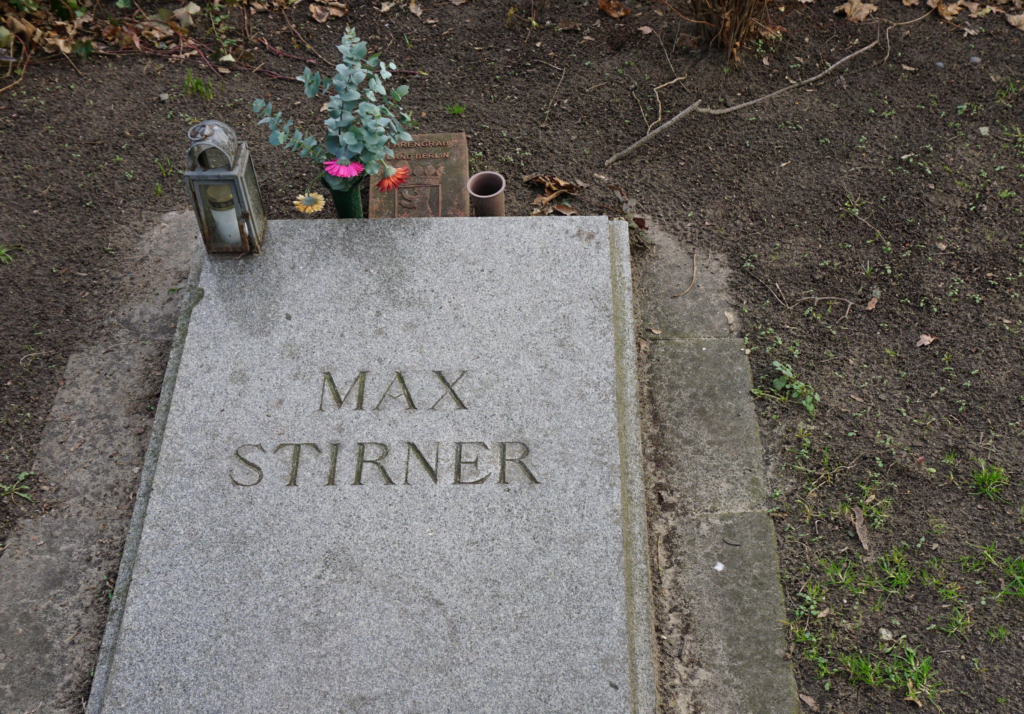
Stirner’s biographer, John Henry Mackay, in his enthusiasm later raised money for a simple granite slab bearing Stirner’s name. This was installed on 7 July 1892 and remains there to this day. Mackay also bribed a gravedigger to exhume Stirner’s skull – very much in the tradition of Johann Wolfgang von Goethe, who kept the skull of his friend Friedrich Schiller on his desk as inspiration for his own work. In any case, the gravedigger procured a skull for him, which has since been passed from one Stirner scholar to another – without it ever having been verified whether it could indeed be authentic.
When Berlin was reorganised under Nazism to make way for the projected capital “Germania”, many graves were relocated, and it was decided – in this instance by Hitler’s chief architect Albert Speer himself – which graves were to be preserved. Remarkably, Stirner’s grave appeared on the list of those deemed worthy of preservation. The reasons for this have unfortunately been lost, leaving us only to speculate.
During the National Socialist period, Stirner was not a banned thinker, but neither was he particularly popular. Between 1933 and 1945, only two scholarly works on him were produced: the doctoral theses of Kurt Mautz (1936) and Wilhelm Cuypers (1937). Both are relatively free of ideology and largely apolitical for their time.
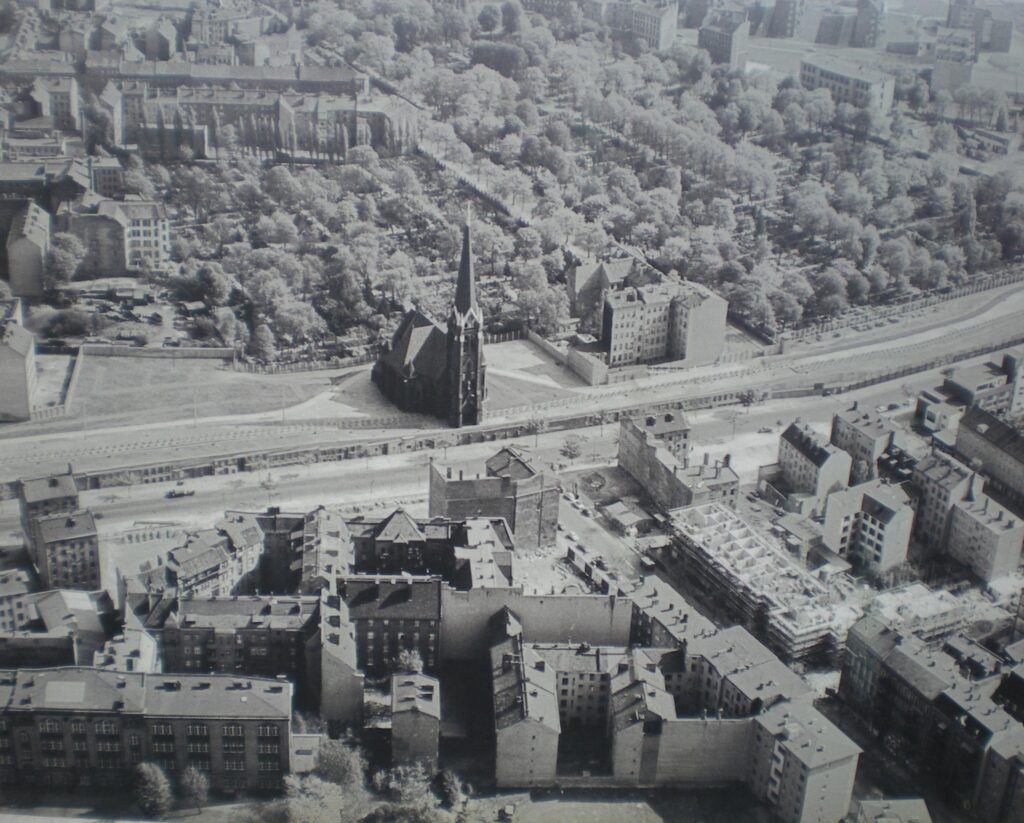
Following liberation, the Soviet authorities gave a kind of honorary designation to the Stirner’s grave, now located in East Berlin. The Sophien Cemetery lay very close to the inner-German border, in a restricted no-man’s-land on the East German side. It was an accessible area, though officially entry was prohibited. Many Stirner scholars nevertheless defied this ban and, during visits to East Berlin, paid reverent visits to the grave.
In the course of Berlin’s reunification, a conservative Berlin city Senate led by the CDU officially designated the grave an honorary site. This status is granted for 25 years at a time and includes municipal funding for the maintenance of the grave. German-Jewish anarchist Erich Mühsam, who was murdered by the Nazis, also has an honorary grave in Berlin.
Photos: Yvonne Schwarz, Semiramis Photoart; Wikimedia commons