How an iconic director became AI’s newest pitchman — and why it matters
~ Joel Sucher ~
The industry verdict came in fast and it wasn’t pretty. When Martin Scorsese announced earlier this month that he had signed on as partner and adviser to Black Forest Labs — a German AI startup whose image-generation tool, FLUX, he’s been using to storyboard his next film — the blowback from the filmmaking community was swift, pointed, and came from every direction.
The Art Directors Guild, IATSE Local 800, issued a formal denunciation. “Mr. Scorsese,” their statement began, landing like a subpoena, “the business is not in flux.” The guild accused him of “turning his back on the human artists who throughout his career have helped him create his most memorable works” and called the endorsement “a betrayal of the collaborative nature of cinema.” Concept artist Karla Ortiz — whose credits run from Rogue One to Black Panther, and who’s testified before the Senate on AI and intellectual property — wrote that Scorsese “throws every single storyboard artist he’s ever worked with under the bus, as he demolishes their livelihoods with models that are likely trained on those storyboard artists’ same works.”
His peers weighed in too. Steven Spielberg, in his new film Disclosure Day, made a point of announcing that no AI was used — opting for human-led work rather than algorithmic generation. And Guillermo del Toro, accepting the BFI Fellowship in Hollywood this same week, didn’t just decline AI — he indicted it. “We are on the verge of image illiteracy,” del Toro warned the assembled crowd — which included Leonardo DiCaprio. DiCaprio, it should be noted, is set to star in Scorsese’s AI-storyboarded What Happens at Night. Del Toro called artificial intelligence a form of “natural stupidity” and invoked something close to a moral absolute.
Three directors of the same generation and stature. One signed with the AI startup. Two sounded the alarm.
All of which raises a question for those of us who knew Scorsese when he was just a greasy-haired kid slamming the clutch of a Moviola on the 9th floor of NYU’s East Building: What happened to the guy who taught us that cinema was a moral act?
This current kerfuffle takes me back to my student tenure at NYU Film School — 1969-1971 — and listening to young Martin Scorsese wax poetic about cinema history. As a young teaching instructor he worked with the tools available at the time including the iconic edit machine, the upright Moviola. I remember him standing in one of the editing cubicles discussing cut points while slamming the clutch to advance or reverse the 16mm celluloid, as if trying to beat a confession out of it. It was an instrument — all gears, rubber belts and sprockets — through which his cinematic intelligence flowed and we all believed in the idea, best expressed by Jean Luc Godard, that “cinema is truth 24 frames-per-second”
Flash forward to 2026, and in the promotional video recorded for Black Forest Labs Scorsese uses FLUX to storyboard a scene, then pivots to discuss the famous Goodfellas Steadicam shot tracking Henry Hill through the Copacabana and suggests that with a tool like this, you could have worked it out “much much quicker” and saved production time and wear on the crew.
I know that shot. Pacific Street Films was on the Goodfellas set, in 1989, producing Martin Scorsese Directs, for the Public Broadcasting Service. We watched several scenes – numerous rehearsals and all – choreographed in real time and the collaboration between real people whose collective efforts resulted in a movie that remains a cinematic masterpiece.
Recent criticisms didn’t shy away from the underlying economics either: generative AI produces its “cinematic intelligence” by ingesting large swaths of copyrighted work, likely scraped from the internet without consent, credit, compensation or transparency. In other words, the tool Scorsese calls “creatively freeing” was built by picking the pockets of the very artists he’s now proposing to replace.
Then there’s the money trail. The connection to Black Forest Labs was brokered through BroadLight Capital, an investment firm co-founded by his longtime manager Rick Yorn, who is also an investor in the company. So when Marty evangelizes about FLUX conveying “cinematic intelligence,” it’s worth noting that his manager is financially positioned to benefit from every director who follows his lead. That’s not a footnote.
So, what gets lost when the tool stops being physical; when film through sprockets becomes prompts through servers? At the Taormina Film Festival last year Scorsese told an audience, “Whatever new tool comes along, learn to use it,” while adding the caveat: “The thing is that it’s gotta be human, the heart’s gotta be there.”
The heart, I’d argue, has been craftily removed from the filmmaking process and replaced with a substitute that responds to the need of an industry intent on making as much moolah as possible; humans be damned.
Scorsese once taught us that cinema was a moral act. Many folks in the filmmaking community are asking him to remember that.
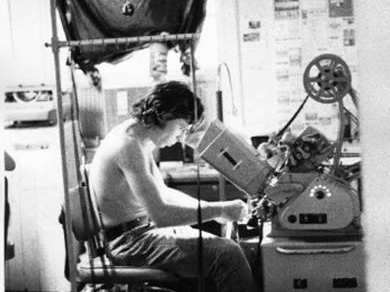
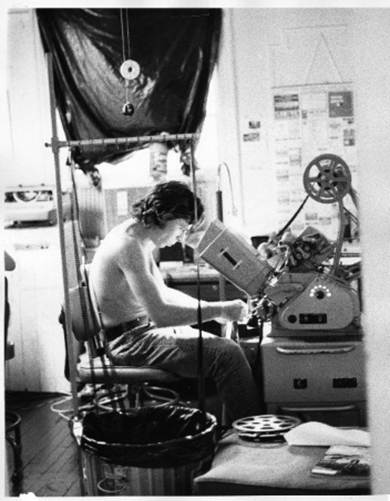
Image: Pacific Street Films co-principal Steven Fischler, 1970. Courtesy of the author