Is this the beginning of a counteroffensive in the streets against the new right-wing wave in Latin America?
~ Sindicalismo.org ~
The workers’, peasants’, and popular rebellion in Bolivia against the government of Rodrigo Paz is unfolding within a convulsive regional context marked by both the hegemonic decline of the United States and its renewed imperialist attempts to advance into Latin America. In this context, Paz in Bolivia, Milei in Argentina, and Kast in Chile—three facets of the same imperialist offensive—are experiencing accelerating crises. The strategic question of how to defeat the pro-imperialist right wing is becoming increasingly concrete.
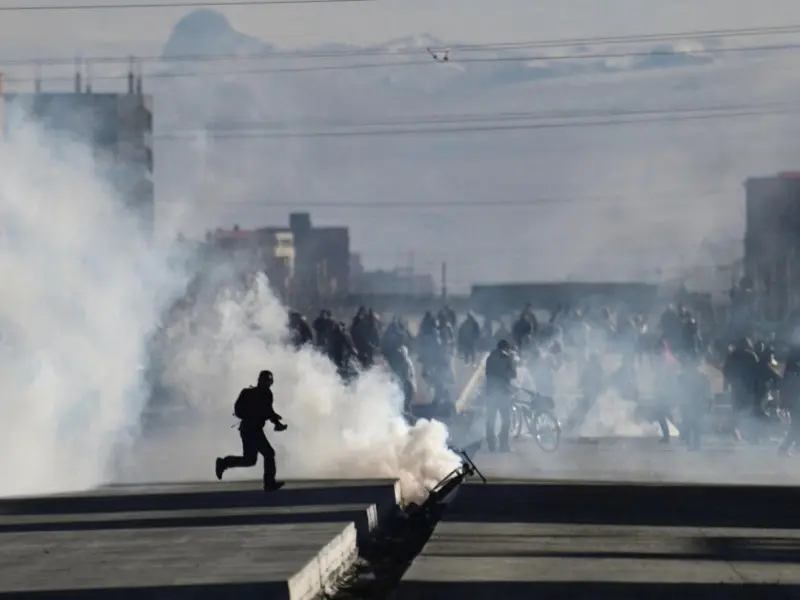
What is at stake in Bolivia these weeks is whether we are witnessing the beginning of a counteroffensive in the streets against the new right-wing wave in Latin America. President Rodrigo Paz has been in power for just over six months and is already facing a rebellion that has been brewing since the beginning of the year, despite the betrayals of the bureaucracy and the repression. Between December and January, there were three weeks of blockades and mobilisations. Now we are facing a workers’, peasants’, and popular rebellion. On May 16, the government attempted to subdue the protests with brutal repression that left four dead. The result was the opposite: the following day, road blockades increased, and the next Monday, a massive march descended from El Alto to La Paz with the slogan “Out with Paz.” Another day of mobilisations and blockades took place on Friday the 22nd. The following Saturday, the government tried to break the blockades, but this operation, dubbed “white flags,” failed completely thanks to the resistance. On May 24, nearly 60 blockades were reported throughout the country. On Monday the 25th, another day of mobilisation took place from El Alto to La Paz, the largest in recent weeks, incorporating new sectors into the conflict.
The Paz government’s plan increases fuel prices, attacks education and healthcare while lowering taxes for large corporations, seeks to encroach upon peasant and indigenous lands, plunder lithium and common resources, and deepen the country’s subjugation to the IMF and imperialism. It’s no surprise that the Trump administration has come out in full force to support Paz, Netanyahu was also present, and Milei even sent Hercules transport planes to the Bolivian government. This support is explained by the fact that what’s happening in Bolivia presents a prospect of defeating the pro-imperialist right-wing governments in the streets. Amid the intensified offensive of imperialism in the region, US imperialism sees the danger that the Bolivian rebellion could take down one of its pawns. This must also be interpreted in the context of the dispute with China. It’s an attempt to reaffirm geopolitical control of what they consider their backyard. And Bolivia is a strategic area: it forms part of the Lithium Triangle along with Chile and Argentina.
With his new National Security Strategy, Trump launched his own Monroe Doctrine of “America for the Americans.” He advanced on Venezuela, where he established a quasi-protectorate with the help of Delcy Rodríguez. Now he’s again putting extreme pressure on the Cuban people, where a more direct attack is very possible. On May 20th, a two-pronged operation took place: Raúl Castro was indicted for murder in connection with the downing of two small planes in 1996, and the aircraft carrier USS Nimitz was deployed to the Caribbean. Trump is weakened by his defeats against Iran and faces significant criticism at home: his approval rating is at a low 35%, according to the latest Reuters-Ipsos poll. The decline of US hegemony is accelerating, and this very fact is driving it toward more aggressive interventions against the peoples of the region. A defeat of the Paz government in the streets would, in this context, be a severe blow to the ruling classes at the regional level and to the plans of US imperialism.
The Bolivian rebellion, still unfolding, exposes a series of crucial issues for those of us fighting against the pro-imperialist right wing in the region. First, it shows that direct action is the only language these governments understand. These governments cannot be defeated by asking them to respect the democracy they themselves violate as soon as they take office in order to implement their pro-imperialist plans, but rather through direct action. While there were declarations, statements, and “dialogues,” Paz pressed ahead with his austerity plan; when the blockades and mobilisations began, which repression was unable to quell, the Paz government entered a profound crisis.
Secondly, self-organisation demonstrates that it is the only alternative to the demobilisation promoted by bureaucracies. Bolivia shows trends in this direction: thanks to self-organisation, expressed essentially in blockades—maintained by self-organised committees—the struggle continues despite the manoeuvres of the COB (Bolivian Workers’ Center) and government repression. The development of these forms of self-organisation into higher forms of coordination is what can articulate forces to impose a united front, leading to the massification of the struggle and the realisation of a general strike to force the resignation of Paz and all the coup plotters.
Third, the Bolivian process also demonstrates that direct action and self-organisation constantly clash with attempts at betrayal by the bureaucracies, highlighting the importance of a strong revolutionary party that resolutely confronts the bureaucracy so that the movement does not become dependent on the bureaucracy’s will and the energy deployed by the masses is not trapped in the cycle of mobilisation and institutionalisation. In other words, it underscores the importance of a political organisation that consistently fights for the independent emergence of a workers’, peasants’, and popular bloc that takes control of the situation.
The Bolivian rebellion is not an isolated episode; it is a laboratory where the strategic questions facing the entire region are being tested. If Paz falls, if the general strike becomes effective, if the blockade committees manage to transcend the bureaucratic apparatus and organise themselves into a national coordination, the impact on Milei, Kast, and the rest of the right wing in the region will be unavoidable. What is at stake in Bolivia, and increasingly throughout the region, is the possibility of changing the course of history. That is the strategic horizon, and the task of the revolutionary left is to rise to the challenge.
Machine translation