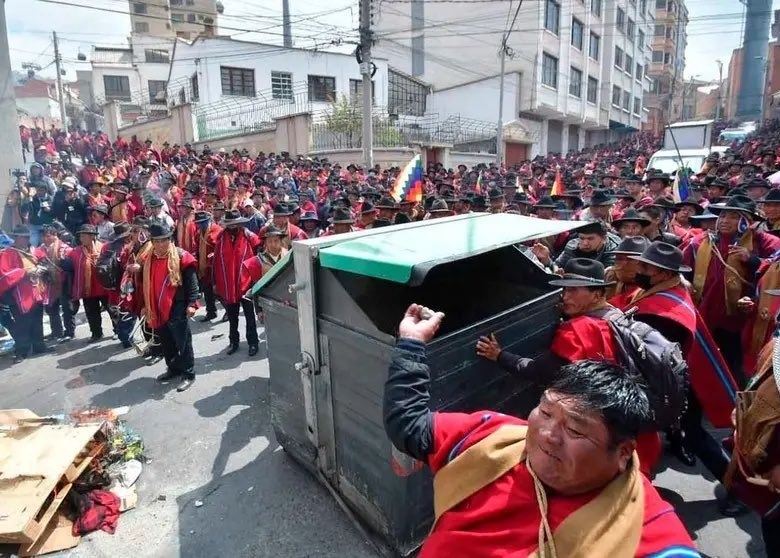
Bolivia’s political crisis enters its third week as a broad coalition of anti-government protesters block dozens of roads
~ Gabriel Fonten ~
After six months in power, Bolivia’s government now faces broad opposition and calls for president Rodrigo Paz’s removal. For the past weeks the country has had waves of protests, blockades and mobilisations by peasants, mining unions, teacher unions, transport unions and the indigenous population as well as supporters of the former president Evo Morales.
The protests began in reaction to Law 1720, promulgated on 10 April, which authorised the National Institute of Agrarian Reform (INRA) to combine and reclassify small rural properties as larger estates if sold by their owners. The law, which also allows these small properties to be used as collateral for loans, has been opposed by indigenous and peasant organisations. They see the marketisation of these properties as benefiting business and agro-industrial sectors interested in expanding the land market. This triggered a march by hundreds of indigenous people from the towns of Beni and Pando towards the capital of La Paz. The march, which would grow to include thousands of people over its 100km, would become one of the main sources of pressure on the government.
Since then, the protests have escalated to a general strike including other demands linked to the economic crisis, fuel shortages, and political discontent with the government of Rodrigo Paz. Workers in the transport sector and rural producers have protested against the poor quality of the fuel imported by the government. Mining unions have joined protests in the capital and attempted to storm the presidential palace using dynamite explosives in clashes with the police. Supporters of the former president and leader of the Movement for Socialism Party, Evo Morales, occupied the Chimoré airport for days in response to the government issuing a warrant for his arrest.
Under the pressure, the government has repealed Law 1720 and attempted to make deals with protesting unions. However, peasant resistance has continued in recent days with dozens of blockades recorded on strategic routes that connect the capital of La Paz with Cochabamba, Oruro and border crossings to Chile and Peru. According to official reports and local media, more than 60 bridges remained blocked in different provinces, generating shortages of food, fuel and medicines, in addition to millions in economic losses.
After weeks of blockades, protests and clashes with the police, there have been over 100 arrests and mass use of tear gas in and around the capital.