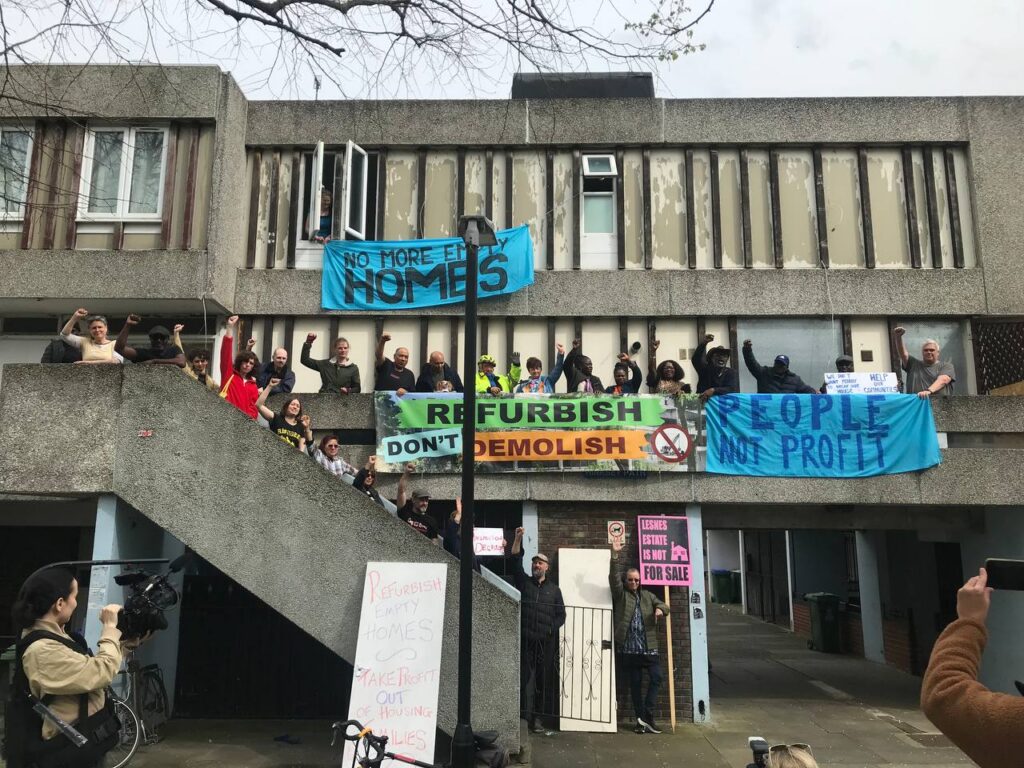
Squatters joined residents in Thamesmead to confront the exclusionary vision of London as a property portfolio
~ Jamie Ludd and Persons Unknown ~
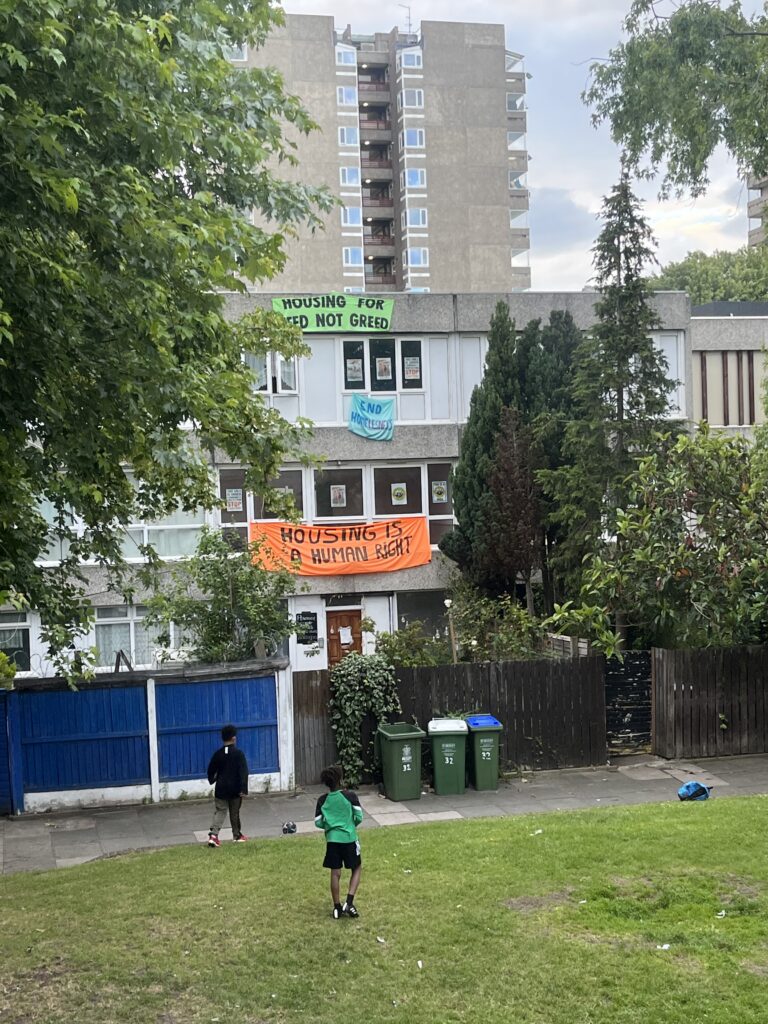
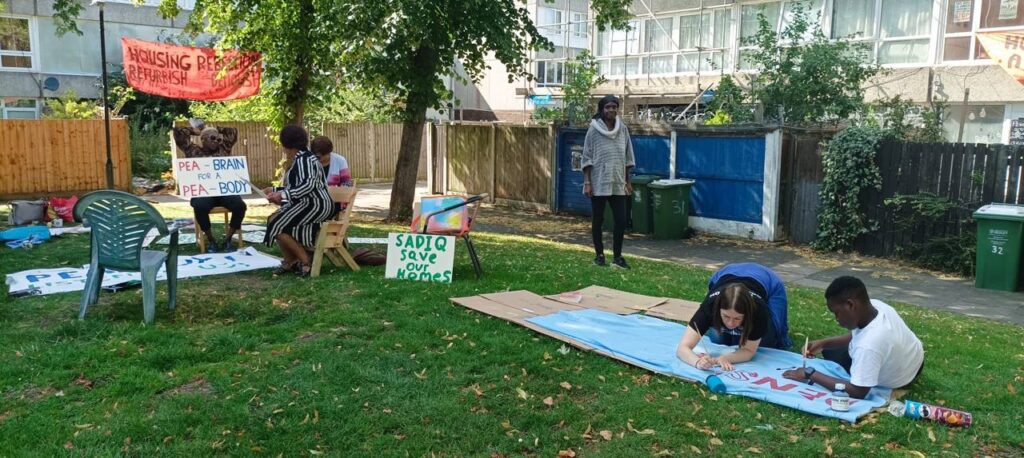
On 14 April at 10:05 am, the thud of a battering ram signalled the end of a squat lasting 715 days, one of more than twenty houses occupied in support of residents fighting against the demolition of the Lesnes Estate in Thamesmead. The spaces hosted assemblies, exhibitions, film screenings, design workshops, talks, dinner parties and mediation – shared with antagonism, inspiration, the banal, affection, disillusionment, hope and refuge.
Breaking their way into three houses, a forum for collective social exchanges was to be rendered void. Negotiation was terminated by the roar of an angle grinder, as was our attention towards a court case for repossession on 20 April.
High court bailiffs and a protest removal squad, flanked by the Metropolitan Police, violently enforced the law, a warrant crumpled by a fist and our repeatedly refused demands to see the writ – simultaneously obscuring and clarifying what the law is. A monopoly of violence above all.
Police officers stood on guard with their backs to black-clad contractors as they devastated the generous architecture of a once emboldened municipal socialist London; the shatter of glass and ceramic pierces the tense air fragmenting sinks, toilets and windows. Criminal damage, reserved to prosecute those who repair, readapt and re-appropriate empty buildings is displaced by lawful destruction. The modernist design of the houses provides rich conditions for intervention; three separate buildings accessible by a single door connected by walkways exposed the confusion of bailiffs in their mixed interpretations of where the repossession order extended to, eventually shoving and assaulting their way into the second repossessed house.
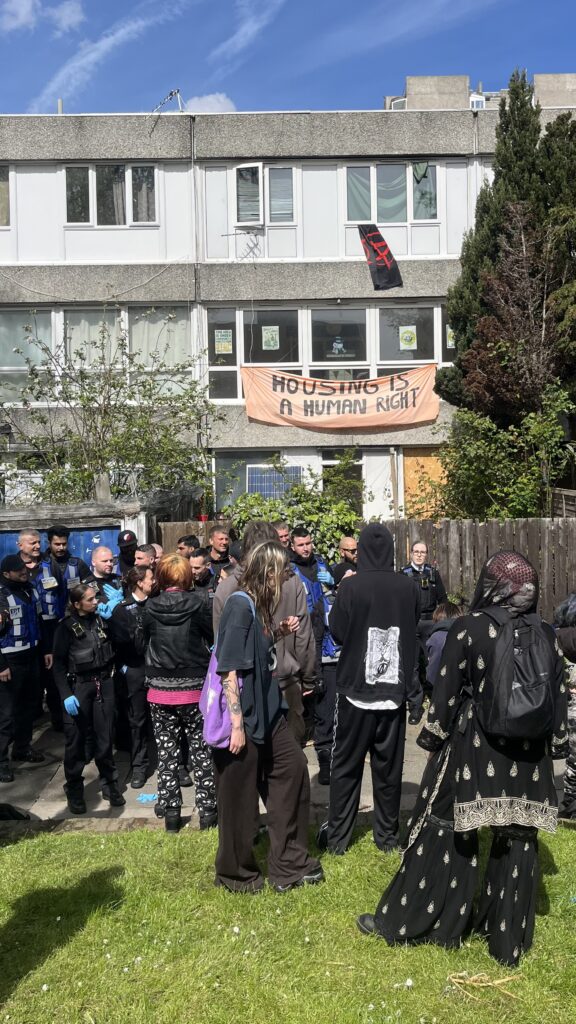
In response, an impromptu barbecue accompanied by a sound-speaker established our presence in the consolidated courtyard between the evicted houses, a stage to heckle and jeer bailiffs, forming a line of defence as bailiffs and police suddenly approached the third house to lay waste to. Bailiffs attacked protestors as police oversaw to make sure that any retaliation would result in arrest.The rationale for eviction? The terraforming of Thamesmead, erasing the built legacy of the welfare state to establish a landscape amicable for the urbanisation of capital.
The financialisation of housing will create an environment providing a third less affordable housing with three times the density. Even this bleak description concedes to a contentious definition of affordable, and of the 1,950 properties intended to supersede the 596 of the Lesnes Estate only 61 will be for social rent – what many people consider genuinely affordable – that on average redevelopment increases by over £80 per week, as even this provision capitulates to market logic.
Constructed between 1967 and 1970, initially economically attainable for a broad range of society, gradual erosion of this quality has been conducted via right-to-buy introduced by the 1980 Housing Act and the complete privatisation of the Lesnes Estate after the abolition of the Greater London Council in 1986. Ownership changed hands until the housing association Peabody acquired vast control in 2014, and have since advanced a regime of dispossession and demolition behind a façade of social benevolence. Offers to Lesnes Estate residents of £245,000 for a three- or four-bed home, enforceable through compulsory purchase order, juxtaposes the price of £570,000 for a two-bedroom flat overlooking the estate, advertised at international real estate events – a diverse property portfolio achieved amongst small talk, complimentary canapés and champagne top-ups at the five-star Mandarin Oriental in Hong Kong.
The estate must also be understood as a fragment of a greater injustice – a conservative estimate is that at least 135,658 households since 1997 have been or are expected to be displaced by the demolition of social housing in the capital. Physically and economically dispossessed, many are outcast to the periphery of London or removed from the city entirely- severed from proximity to friends and family.
Already an urban periphery, Thamesmead is the expansion of a process that has already afflicted a myriad of inner-city council estates. Additionally, estate demolition puts additional strain on extensive waiting lists for social housing, condemning many to a seemingly endless itinerant life in temporary accommodation.
Not to be understated is the racial discrimination inherent in the destruction of social housing, understood by those who inherited London’s architectural legacy of the welfare state. In 2011 48% of London’s black households lived in social housing, in comparison to 21% of White British households, and at the Lesnes Estate, asymmetry is also shown in statistics; 43% of residents are black, and 63% are from a minority ethnic background, compared to 12% of the greater local borough of Bexley being black and 36% minority ethnic.
The history of racialised exclusion from the welfare state, privileging a white working class with wider accessibility simultaneous with the mass disinvestment of social housing, is bookended at Thamesmead by Peabody. Established in 1862 to alleviate the living conditions of London’s working class, the initiative was financed by the wealth of George Peabody, an American financier who pursued a career in which he profited in many ways from the labours and lives of enslaved African people.
Decades of disinvestment plagued Thamesmead, now the arrival of the Elizabeth Line has rapidly opened the area to capital accumulation. Augmented unevenly, creating a sharp contrast between the resigned Keynesian ideal of mass social housing and the destructive neoliberal re-imagination, the struggle at the Lesnes Estate is a confrontation between an open and exclusionary vision of London.
Alongside a judicial review by the residents in opposition to the demolition, resistance will continue to be found within the homes and in the courtyards of the Lesnes Estate.