“We Are Against A Police State”, it declared in 2014: Black, block letters on a white sheet, with no logo
~ Emily Channell-Justice ~
There is a story about a banner that I like to tell when I talk about Ukraine’s Euromaidan protests. These mass mobilisations took place across Ukraine, starting in November 2013 and culminating in February 2014, when riot police and snipers killed at least 100 protesters in Ukraine’s capital city of Kyiv. I was in Ukraine at that time for my dissertation fieldwork, which, before the protests broke out, focused on independent, leftist student activism around higher education.
The protests initially began because then-president Viktor Yanukovych refused to take actions that would allow Ukraine to sign an Association Agreement with the European Union, seen by many as the first key step in Ukraine’s future accession. Immediately, calls for people to gather in Kyiv’s main square, Maidan Nezalezhnosti, or Independence Square, brought hundreds of people out to the rainy protest.
The activists I worked with were at first optimistic. They were critical of Ukraine’s EU accession, because they understood that Ukraine’s potential position in the EU would be at the bottom of an economic and political hierarchy. Yet they also understood that it was essential for Ukraine to claim its own future direction in order to get out from under the thumb of Russian claims to brotherhood and unity. Many of these activists decided that it would be essential to participate in the protests so that this Euro-critical perspective could be circulated.
However, when I went to one of the small gatherings in the early days of protest with a leftist activist friend, we discovered that the protests were then dominated by people who represented institutional political voices, and that right-wing, nationalistic rhetoric would dominate the language of the protests. We left the square disappointed.
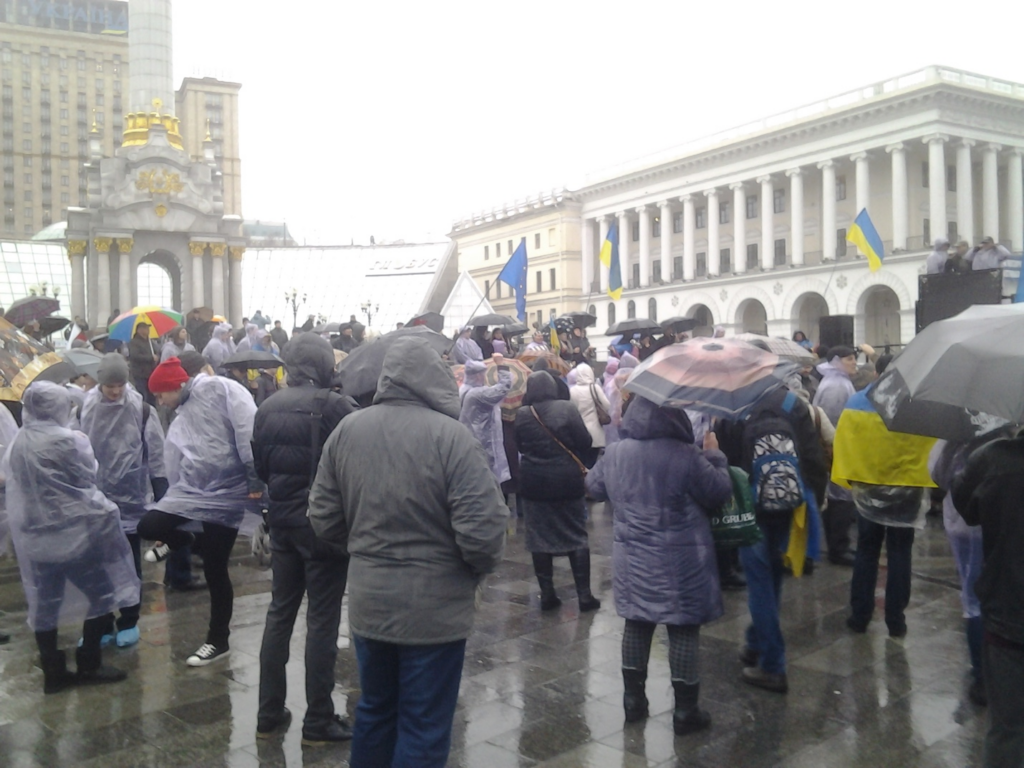
Despite this disappointment, leftists decided to continue to participate as the protests grew, carrying banners promoting free transport and free education, feminist and anti-homophobia posters, and using slogans that provided an alternative to the nationalist phrases that had dominated thus far. Sometimes they were met with violence, especially when other protesters saw their feminist language. Other times, these same banners and posters brought protesters into conversations that might not have been possible in other circumstances.
Ultimately, it was the right decision to continue to participate. On the night of November 30, 2013, riot police (Berkut) beat and arrested student protesters who had camped out on Independence Square, allegedly to clear the square so a holiday market could be installed. These police represented the Ukrainian state, which by now was understood to be abandoning its citizens by using violence against them. Where the protests had previously promoted Europeanisation, now, they were fighting against a state that no longer had their best interests in mind.
Leftists were positioned to provide the language the protesters needed to criticise these state actions against peaceful protesters. On December 8, as part of a massive gathering around the Maidan, leftists staged an intervention with banners, criticising state actors and the co-optation of the state by oligarchs. Whereas previously, leftist interventions had resulted in violence against activists, now, this anti-state language was precisely what the protests needed.
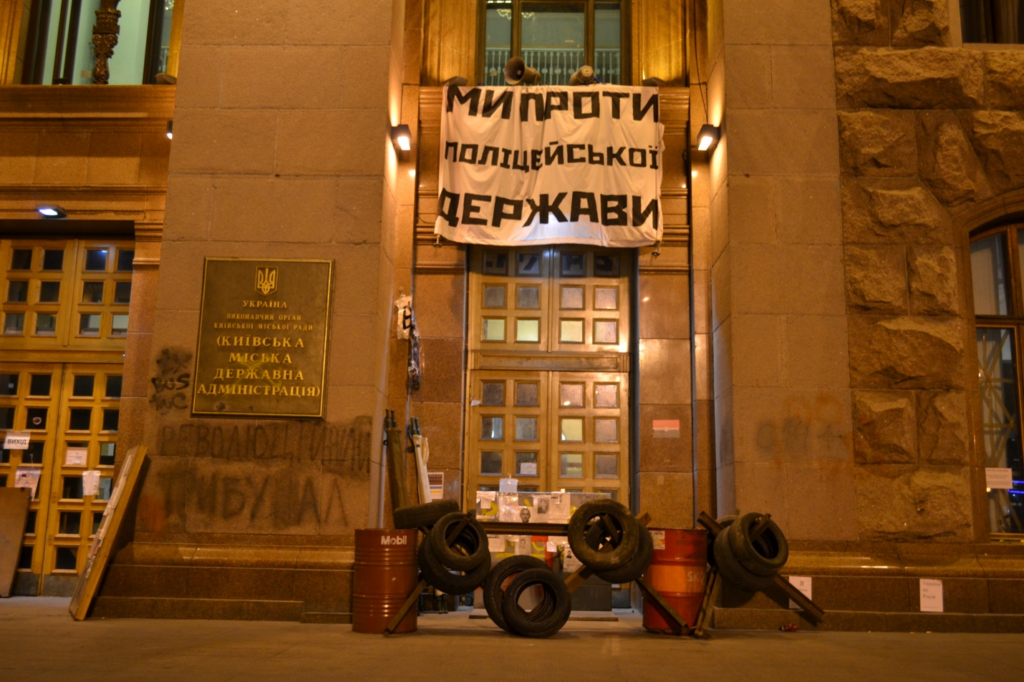
The banner at the core of this story was almost nondescript. It read МИ ПРОТИ ПОЛІЦЕЙСЬКОЇ ДЕРЖАВИ—We Are Against a Police State. Black, block letters on a white sheet, with no logos or any identifying symbols. The banner was first dropped somewhere along the protest route in downtown Kyiv, but it ended up in the occupied Kyiv City Administration Building, taken over by protesters in early December 2013 and used as a headquarters for protesters to rest and eat in between their time outside in the freezing protest camp.
During my research, I photographed this banner twice, once during my single visit inside the occupied City Administration Building in mid-December, where I saw the banner hanging inside the main room, alongside opposition party flags. I photographed it again in March 2014, after the mass violence that resulted in protesters’ deaths and Yanukovych’s flight from Kyiv. This time, it was hanging outside the building, which would remain occupied throughout the spring.
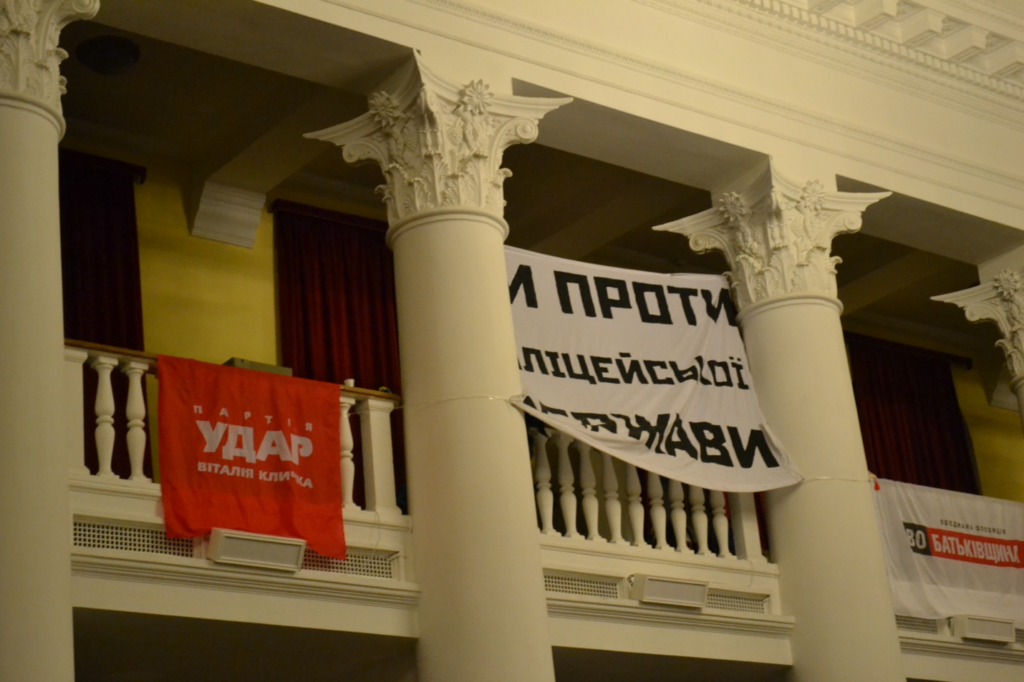
Even at the time of the protests, the banner’s movements struck me as significant. After their early experiences with violence at the hands of other protesters, leftist activists actively discussed how best to participate in these protests so as not to be considered provocateurs intentionally trying to cause violence. I attended various meetings in which activists from different leftist perspectives debated the phrases that should go on these banners in order to best present their critique without inviting violence on those holding or hanging a banner.
To me, the fact that a banner made by leftist activists ended up in what was called the “Revolutionary Headquarters” of the protests was emblematic of the success of this approach. By removing explicit references to existing leftist groups or even overtly leftist terminology, the banner was effortlessly incorporated into the language of the main body of protesters. The language of “the state” targeted the entire institution of government in Ukraine at that time, rather than focusing on standing against one political figure (or for another, opposing one). In particular, the phrasing of the “police state” called out the violence of the police against peaceful protesters and the state for its sanctioning of this violence.
Over the course of the winter, leftist activists continued to participate in the protests through self-organised initiatives—when something needed to be done, and someone was able to do it, they simply did it. This was especially effective in the incorporation of higher education institutions into the protests. Because the activists I worked with had such extensive experience in mobilising students at universities across Kyiv, this became a key area of leftist organising. The activists I worked with helped organised a strike, followed by the occupation of the Ministry of Education building in the wake of violence that took place in February 2014.
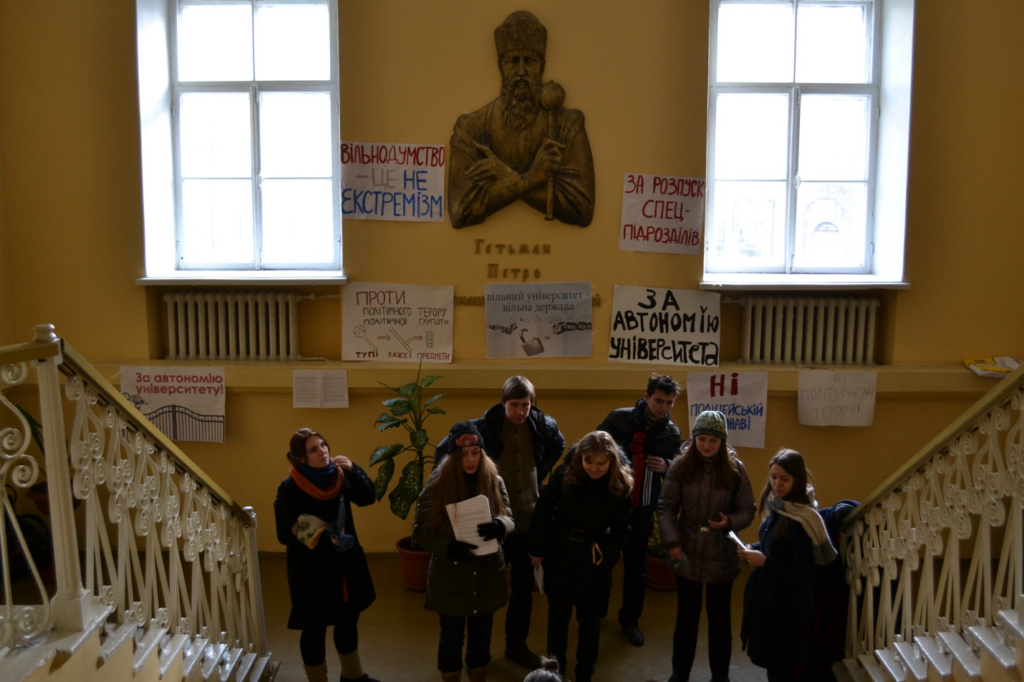
Measuring the influence of leftist activists among the thousands of protesters who took part in these mobilisations is impossible. Indeed, after my return from Kyiv in July 2014, I was faced with many people who had watched the protests from afar and simply did not believe that leftists participated at all. This is in part because these activists actively decided not to include leftist slogans or symbols on their banners and signs after their early experiences of violence. At a conference in the autumn of 2014, a colleague presented research she had undertaken during the same period, illustrating her text with a photo of the We Are Against a Police State banner that she’d taken in the occupied City Administration Building. She had no idea it came from a small group of radical leftists.
In the immediate aftermath of the protests, many of the activists I had worked with felt burnt out and didn’t know where they fit in the post-Maidan political makeup of Ukraine. As a political movement, leftists from different perspectives could not agree on whether they should find a unified anti-war position after the illegal annexation of Crimea and the outbreak of Russian-backed separatist violence in Eastern Ukraine. Several people who participated in my research volunteered to serve on the Ukrainian side, citing their experience of self-organisation during the protests: something needed to be done, and they could do it. In their view, they weren’t supporting the Ukrainian state, but rather their fellow citizens. If they did not take action, no one would.
This was the sentiment that motivated leftists to participate in the protests on Maidan, and it is this same sentiment that led to many of them mobilising after Russia’s full-scale invasion in 2022. This time, mobilisation includes those who are on the front lines, but also those many activists who have developed essential networks of aid to frontline and displaced communities. Leftists have been an essential voice in Ukraine’s diverse community of supporters, during the Maidan protests and now, even as the story about their banner shows that their presence and contribution may not always be obvious.
Postscript
More than ten years after the protests took place, I presented some reflections from my research to a group of leftists in Berlin. The audience included one activist who I met during this fieldwork who had moved to Berlin in the years following the protests, who added even more context to the story about the banner.
According to this activist, the person who contributed the banner was a man named Denis Levyn, who I’d met a few times before the protests began. Levyn was involved in a workers’ rights group called Borot’ba (Struggle), described to me at that time as a Stalinist organisation (the activists who I worked with during my research would later officially break with Borot’ba). After experiencing violence at the hands of far-right actors, Levyn eventually condemned the protests. Following the end of the protests and the separatist takeovers that began in the spring of 2014, Levyn moved to Donetsk and remained there, as evidenced by interviews with international socialist and communist organisations.
Several people in Berlin informed me that Levyn was mobilised into the Russian Army after the full-scale invasion in 2022 and was killed fighting in Ukraine. I have not yet found evidence confirming these claims.