The Chilean anarchist prisoner talks about her situation, views on patriarchy and speciesism, and anti-prison politics
~ La Zarzamora ~
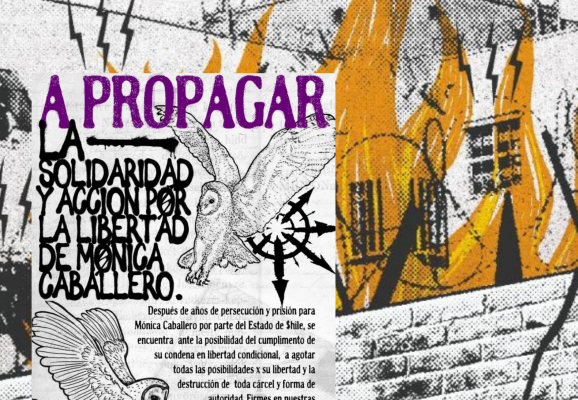
La Zarazamora: We know that the prison guards continue to reject your applications for parole, ignoring the fact that you meet all the requirements. Could you elaborate on this and also tell us about your current prison situation?
Mónica Caballero: Regarding parole, let me explain what it entails. Parole is a benefit granted by a commission of the Court of Appeals. It consists of a different way of serving a sentence outside of prison, where you are on the street, but subject to permanent monitoring by the prison guards. The requirements for granting parole are both objective and subjective.
The objective requirements are: 1) Having served the minimum sentence. This varies depending on the crime; in my case, it is having served half of the sentence, which I have already done. 2) Maintain very good conduct in the last four bimesters (8 months prior to application). On this, I have more than 10 bimesters of very good conduct!
The subjective requirement is: Possessing a favourable report issued by the technical staff of the Gendarmerie. This is the requirement on which the denial of the parole was based.
Let me explain…The report prepared by the specialists focuses on an interview in which they attempt to measure the risk of recidivism, which is observed based on deficiencies they in the areas of family support, employment, use of free time, peer identification, and criminal involvement. Once the areas in which there are risk factors for recidivism are identified, an intervention plan is developed, which aims at social reintegration.
According to the report and the parole review board, I was denied parole because I have a pro-crime attitude, a moderate level of criminal involvement, and a high risk of recidivism. This situation stems from the logic that if the factors that led me to commit crimes haven’t changed significantly, it’s assumed I could reoffend. Specifically, if my beliefs led me to commit crimes, and I don’t change them or repent, it’s very likely I’ll never be granted parole. In that sense, I would remain in prison, more for my beliefs than for other factors. It’s no secret that I’m an anarchist and that I try to act accordingly. I know the costs that my position brings (and has brought!).
Even so, taking all these factors into account, I will fight within the legal system and demand that they comply with their own rules, since their own regulations state that actions, not ideas, are punishable. If the denial of the parole is maintained based on these arguments, it would be applying, or rather revealing, unjust treatment. I have been in the same situation for some years now; I have been in the Santiago Penitentiary Center for Women (CPF) for about two years in a segregation module with 15 to 20 other inmates. I have been studying online for a few years now, and I have already passed my fifth (and final!) year. If all goes well, next year I should begin my professional internship. This whole issue of university studies is very important, not only on a personal level, but also for any prisoner who wants to study a university degree (that is not practical). Generally, the police say that higher education is not accessible, and those who want to pursue it face numerous obstacles. But in reality, if I could do it, anyone could try; it’s difficult, but not impossible.
This is more or less my current prison situation, but I don’t know if the new government has considered anything different… For now, I have no choice but to be prepared for any move the repressive apparatus of power might make.
For some years now, we have been witnessing an intensification and even an internationalisation of prison isolation methods. What do you think about this, and how have you seen this latest stage from prison?
During the years I was imprisoned in Spain, I was kept in first-degree isolation units as part of the FIES (Fichero de Internos de Especial Seguimiento), which was very different from what I had experienced in Chile. In the Iberian Peninsula, I witnessed exhaustive control and punishment within the prison system, and I always believed it wouldn’t be long before something similar was established in Chile. Fortunately, I was wrong, and the prison model hasn’t yet changed radically… but everything suggests that it will.
There are many theories about what’s to come within the prison system under this right-wing government. I don’t expect anything good; in fact, I expect the worst, and that’s called Article 41 bis, or the “Italian model.” Inside the prison, the possible changes are viewed with great fear, at least within my limited communication with the female prison population. The worst is expected.
Right now, we have several comrades in prison around the world. Comrades like Pola Roupa, Mariana M., Daniele Klette, among others. At this time, they face a prison-like system that is particularly harsh, with exemplary punishments against those who attack from the anarchist and anti-authoritarian perspective. In Greece, our comrade Mariana is still recovering, with all that this implies, in prison. She is going through this while also having experienced such a serious accident alongside our comrade Ximitiris. We see once again how wounded comrades must face confinement with intense media and repressive pressure, without adequate medical care, and with all the restrictions that prevent any living being from recovering. What do you think about their situation?
Little by little, I’ve managed to learn about the situation of our comrades imprisoned in other places, especially Marianna. Upon learning of her case, I inevitably recalled Luciano Pitronello‘s imprisonment.
When Luciano entered prison, he was still badly injured from the accident that nearly cost him his life, but he possessed incredible inner strength. He managed to stand firm and defend himself against attacks from guards and other inmates. I greatly admired his resilience… well, I still admire him, even though he’s no longer here. Entering prison makes you feel truly vulnerable. In my case, I even felt like my body didn’t belong to me and that they could do anything to it. I overcame that feeling by standing firm in my beliefs and staying strong (both physically and emotionally), a situation that might have been very different if I hadn’t been healthy or if I had been injured.
In this scenario, solidarity is vital, because if any comrade is in prison, living with a condition that makes them more vulnerable or puts them in greater danger by being in the clutches of the powerful, you can never let them be or feel alone! While I have said on more than one occasion that without solidarity we cannot do much in general, for those who are wounded or ill, it can be a matter of life or death.
Patriarchal domination and its everyday expressions have been addressed in various writings of yours. One recent and very significant one was the letter you sent as part of the commemorative event for 8 March, the anarchist anti-prison movement, in which you shared your perspective and experience regarding the existence of patriarchy as seen from within the prison. We would like to know how you observe and experience the historical progress of the anti-patriarchal struggle as a fundamental part of the anarchist struggle in this territory, both before your incarceration and now that you are incarcerated?
Regarding the anti-patriarchal struggle, I don’t know if I can say that “we have made progress, but I can say that within anti-authoritarian spaces (at least those with which I feel most aligned), clear positions have been established that, among the many chains that we must break, there is the hetero-patriarchal system. That doesn’t mean I don’t reproduce sexist, misogynistic, transphobic, etc. attitudes among us. In other words, what I mean to say is that yes, the different approaches and practices of what we understand as the anti-patriarchal struggle have developed and intensified, but there is still much to be done.
On this matter, in my own experience, it has gone through various processes, which I try to address through learning and refining. Before my incarceration, I had ups and downs with feminist/anarcha-feminist individuals and collectives. At some point, I clashed with people who understood feminism as a kind of hatred of men, believing that any “macho” is a potential aggressor, a sort of biological determinism. At other times, I had the pleasure of coordinating with others who view feminism or the anti-patriarchal struggle from the perspective that gender is a social construct that must be abolished, and that, as people who identify with the female gender, we experience a different kind of patriarchal violence than men.
Inside the prison, the violence that women have experienced is evident everywhere: in their behaviour, life stories, etc., and within the prison, there is also a great deal of patriarchal violence. It is difficult to confront this situation, since there is a normalisation of violence at both the domestic and institutional levels. For my part, within the small spaces of autonomy that the prison provides, I have given short talks about gender violence. In general, the inmates welcomed the initiative very well. By interacting with women from other backgrounds, I have realised that it is truly crucial to make sexism visible and confront it.
We know you’re vegan and that you oppose the human authority that oppresses other species. Regarding this, tell us a little about your political decision to stop eating meat and to show solidarity with other species, regardless of your context. We know about your friendship with the cat Mantequilla and other acts of care and support that you’ve carried out while in prison. Can you tell us more about this?
For me, anti-speciesism is a logical consequence of being anti-authoritarian, and I understand that this goes beyond a diet. If I maintain a vegan diet, it’s because I’m incredibly fortunate to have a wonderful group of companions who provide me with the necessary food. I know I’m privileged because of it, so if any of my fellow inmates can’t maintain a diet that’s at least free of meat products, whether because they lack a support network or because the prison system doesn’t allow it, it would never occur to me to question them.
It wasn’t easy to get my vegan diet “validated” by the prison authorities. It was achieved thanks to the persistence of both my fellow inmates and myself. This was despite the fact that I haven’t consumed meat products for over 20 years.
It amuses me greatly that you mention Mantequilla, my friend is already famous. He’s one of the most hardened creatures I’ve ever met. It took a lot of effort to gain his trust, since he’s suffered a lot of mistreatment at the hands of some of the inmates. This prison is somewhat atypical; it has a very old structure with buildings scattered throughout the grounds, which has created conditions for animals like cats, mice, and various types of birds and insects to live there. This comes with conflicts in “sharing” the space with the human inmates and the guards.
As in all places where there are humans, they try to subdue/dominate other species, and here there’s nothing very different. But little by little, in daily life, a kind of balance has been maintained… it’s difficult, and many conflicts arise among the inmates.
I think the key moment to turn things around and gain some more empathy from the inmates was when I brought in a baby pigeon. In the cell block, almost all of them ended up liking the little pigeon, except for Mantequilla.
How do you think anti-prison networks should be structured to generate concrete support for our comrades in prison?
Maintaining anti-prison networks in the medium and long term is and has been a major problem for those of us both inside and outside of prison. Over the years, I’ve come to understand that for prisoners serving long sentences (it’s difficult for me to frame it this way, since comparing my 12 years in prison with my co-defendant’s 86 seems incredibly disproportionate), our solidarity networks are experiencing strain both economically and emotionally. I understand that this occurs because certain responsibilities and tasks fall on the same people for extended periods, and they don’t receive the necessary support.
These kinds of situations can arise from many factors, among which I believe the most significant is the lack of commitment and responsibility on the part of people who see confronting the capitalist system/domination as a passing fad or “a youthful pastime”.
Machine translation