The Anarchist Studies Network organised three sessions at the Political Studies Association Conference 2026
~ ASN Co-convenors ~
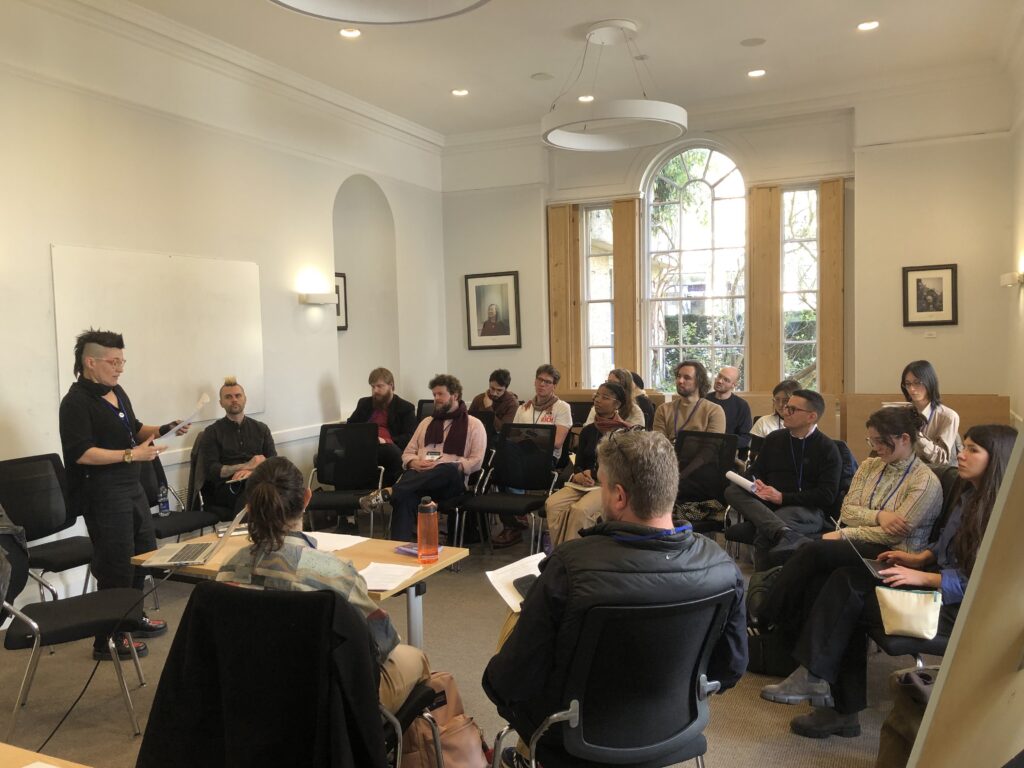
The Anarchist Studies Network (ASN) organised its most significant platform to date at the Political Studies Association (PSA) conference in Oxford at the end of March. One of forty-eight active ‘interest groups’ within the PSA, the ASN exists “to coordinate and promote the investigation of anarchism as social and political praxis”.
For this year’s conference we organised three distinct sessions, representing diverse political perspectives and practical arguments. A roundtable on the contemporary relevance of anarchist thought as chaired by Shane Little with the participation of Laurence Davis, Rhiannon Firth, Jim Donaghey and Freedom’s own Jon Bigger. The first panel featured talks by Elke Van dermijnsbrugge on “Max Stirner, identity politics and multispecies co-existence”; by Rhiannon Firth titled “Eat the Rich: Prefiguring ecological and social recomposition through mutual aid and cooperative food movements”, and by James Willis titled “World-making and feral mysticisms: Resistance as Via Negativa Politica”.
The second panel featured talks by Ray Di Marco Campbell titled “Anarchism in-action: Community cuts, meals, and connection”; by Matti Eskelinen titled “Property, not Liberty! Untangling Anarchism and Libertarianism from Propertarianism”; and by Ivan de Oliveira on the “Alianza Libertaria Argentina: context and creation of an anarchist political organisation in the 1920’s”
While operating within academic settings constitutes a multitude practical and ethical challenges, the positions many of us hold within educational settings afford us highly privileged environments within which we can integrate, embed, and align our anarchist perspectives in our practices. Just as the ASN platform at the PSA conference permitted those unfamiliar with, intrigued by, or outright hostile to anarchist and anarchist-adjacent approaches to engage in our hosted spaces, our status within these organisations, at times, facilitates access to institutional funding, teaching environments where we can expose our learners to radical ideas beyond the conventional academic curriculums for our respective fields, and opportunities to engage diverse audiences in critical discourse.
None of us entered these institutions with any illusions about what they represent (profiteering from fee-paying students, qualifications serving as barriers to entering the types of work our learners want to do, etc.). Rather, we’re striving to strengthen our own networks so that, in our dedicated spaces (whether at the PSA, our own conferences, or other events), we can continue to promote solidarity, partnerships, and collaboration within a culture that often promotes and even values the polar opposite.
In addition to our upcoming conference in Manchester, we’ve coordinated a two-day programme of activities for early career academics (researchers, educators, and other roles within the academy) which will run for two-day immediately prior to the conference (Monday 24th August – Tuesday 25th August 2026). Anarchademics, Unite! is open to postgraduate students at Masters and Doctoral level, ‘whose research engages with anarchism and who are considering a future in academia or beyond’ and though particularly eager to support colleagues who experience additional barriers to entering or establishing themselves within academia – including but not limited to ideology, class, race and ethnic belonging, religion, gender, sexuality, residency status, disability, and any manner of intersections – all interested parties are encouraged to a submit an Expression of Interest. The sessions will explore radical pedagogies, research funding bids, syllabus creations, academic publishing, and further related issues.
To improve accessibility to the workshops, the network have committed funds to supporting successful applicants’ travel (up to £150 return), will provide two nights’ accommodation, and support sustenance with refreshments during the both days’ activities, and cover the evening meal the first day’s proceedings. Prospective applicants are asked to complete a brief form detailing what they hope to gain from the events, with opportunities to help shape the focus by outlining any specific challenges they have faced to-date. We also encourage applicants to advise of any adaptations we can make to better facilitate their participation in the space. The form can be found on our website, here; with completed applications due by Monday 20 April. We aim to advise all applicants of their outcome within four-weeks of submission.