A shared style of argument reveals something deeper about how people relate to ideology, authority, and criticism
~ Slow Burning Fuse ~
Spend enough time running an anarcho-communist social media page and a strange pattern begins to emerge – the arguments start to blur. Not in content; Marxist-Leninists and defenders of capitalism obviously disagree on fundamental questions. But in form and tone they often sound uncannily similar. The same dismissive one-liners, the same recycled slogans, the same impulse to shut down rather than engage. It’s like listening to two rival brands using the same script.
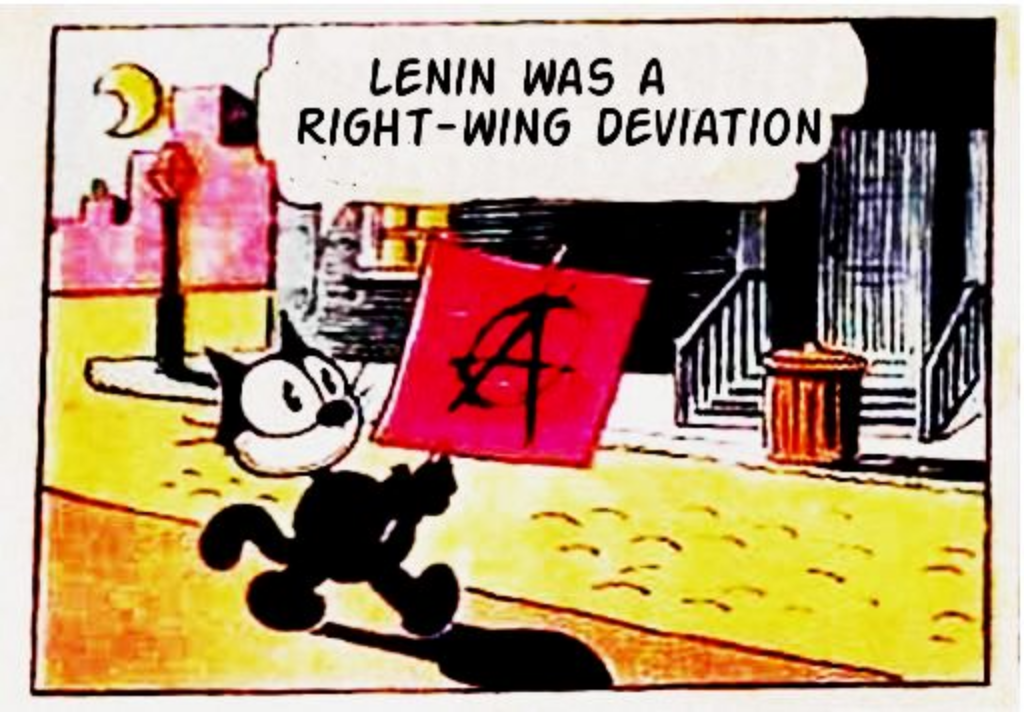
One of the clearest similarities is the reliance on well-worn catchphrases. Anyone who has spent time in these debates will recognise them instantly. From capitalist defenders: “That’s just utopian,” “It’s human nature,” “It’s been tried and failed.” From Marxist-Leninists: “That’s idealist,” “Read theory,” “You don’t understand material conditions.”
Different vocabularies, same function. These phrases act as shortcuts for dismissing an argument without actually engaging with it. They signal belonging to a particular camp, but they don’t move the discussion forward. What’s striking is how both sides use them to position themselves as the voice of realism. Capitalists claim to represent “how the world actually works.” Marxist-Leninists claim to represent “scientific socialism” or “material analysis.” In both cases, the implication is the same – we are grounded in reality, you are lost in fantasy.
Another shared pattern is the shift from engaging with ideas to defending identity. Criticise capitalism and you’ll often hear: “You’re just lazy,” “You’ve never worked hard,” “You live in your mum’s basement.” Criticise Leninism and the tone is familiar: “You’ve never organised,” “You don’t understand struggle,” and ““You live in your mum’s basement. Different wording, sometimes the same, but identical objective. The focus shifts from the argument itself to discrediting the person making it. It becomes a form of gatekeeping, deciding who is qualified to speak and who isn’t. Instead of engaging with critique, the conversation turns into a test of legitimacy, about who counts as a “real” participant.
Capitalist defenders present themselves as hard-headed realists who understand competition, scarcity, and discipline. Marxist-Leninists often mirror this tone, framing themselves as accepting the necessity of authority, coercion, and centralisation.
In both cases, anything that sounds cooperative or decentralised, mutual aid, horizontal organisation, people managing things themselves, gets dismissed as naïve or childish. But this performance often replaces actual analysis. Declaring something “necessary” doesn’t explain why it is, or whether alternatives exist. It simply shuts the door on further discussion.
Perhaps the most revealing similarity is the hostility to internal critique. Capitalist defenders often treat criticism as an attack on the system itself, something to be defended at all costs. Marxist-Leninists can respond in a similar way, framing criticism of socialist states or vanguardism as an attack on the revolutionary project. In both cases, critique gets reinterpreted as betrayal. Instead of asking whether it has merit, the focus shifts to why it’s being made. “You’re helping the enemy.” “You’re dividing the movement.” These kinds of responses shut down discussion entirely. If every critique is seen as serving the enemy, then there’s no space for reflection, and the ideology becomes self-protecting.
However, movements that can’t tolerate critique tend to stagnate. They repeat mistakes not because they lack intelligence, but because they lack the space to question themselves.
Another parallel is the reliance on slogans in place of sustained argument. “Socialism has never worked.” “Capitalism has lifted millions out of poverty.” “Anarchism has never succeeded.” “The state is necessary.” These statements function more like talking points than arguments. They compress complex histories into neat, repeatable lines. Slogans are designed for persuasion, not understanding. They simplify and flatten the contradictions within the systems they describe. When debate is reduced to competing slogans, it stops being about exploring ideas and becomes about scoring points.
So why do these similarities emerge? Part of it is the nature of online spaces, which reward quick, confident responses over careful thought, but there’s also something deeper. Both capitalist defenders and many Marxist-Leninists are invested in systems that prioritise centralised authority and top-down control. Even if their goals differ, their assumptions about power can overlap. There’s a preference for certainty, a suspicion of decentralised approaches, and a tendency to treat criticism as a threat. In that sense, the similarity in rhetoric reflects a similarity in how authority is understood and defended.
Recognising this pattern isn’t about scoring points. It’s about asking what it means when opposing ideologies end up sounding the same. For anarcho-communists, that question matters. If the goal is a society based on free association, cooperation, and self-management, then the way we argue should reflect those values. That means engaging with ideas rather than dismissing them, welcoming critique rather than shutting it down, and valuing participation over gatekeeping. Otherwise, we risk reproducing the same patterns of domination we claim to oppose.
If our politics are about liberation, then that has to show not just in what we argue for, but in how we argue for it.