Iranian poet and film-maker Forough Farrokhzad articulated female subjectivity, desire and dissent
~ Bleart Thaçi ~
For generations of Iranian women, who since the 1979 revolution have faced steadily shrinking rights, intense regulation of their bodies, and violent repression of protest, Forugh Farrokhzad’s life and writing have remained a powerful point of reference and a vital touchstone. It continues to speak forcefully at the present moment, with the recent wave of demonstrations beginning on December 28, in which women have emerged as some of the most visible and driving forces in the streets of Tehran, Mashhad, Kermanshah, Lorestan, Shiraz and Illam.
Today, 13 February, marks fifty-nine years since her untimely death, yet Farrokhzad’s verses continue to recall an earlier stage in the struggle of Iranian women for personal autonomy and the freedom to choose how to live, love, and exist. Formed within an authoritarian and deeply patriarchal social environment, and having paid a heavy personal price for her refusal to conform, Farrokhzad’s work articulated female subjectivity, desire and dissent at a moment when women’s public voices were expected to remain contained and obedient.
The title poem of her first collection, “Captive” (اسیر, Asīr), written by the nineteen-year-old Farrokhzad in 1954, speaks directly to her experience of confinement and emotional exhaustion:
I am thinking and I know that never
will I have the resolve to leave this cage
Even if it were the jailer’s wish
I have no strength left for flight
Married at sixteen, later divorced and stripped of custody of her only child, Farrokhzad became one of the first women in modern Iranian culture to claim a public voice for female desire and emotional autonomy, an act that exposed her to social ostracism, scandal and lasting moral condemnation. In the wake of that loss she suffered a nervous breakdown and was hospitalised, where she was subjected to electroconvulsive therapy. A period of travel in Europe followed, most notably to Italy and Germany, offering temporary distance from the intense moral scrutiny surrounding her private life.
When she returned to Iran, the public reception of her work remained deeply polarised and fraught with moral censure; in 1957 her poem “Sin” (گناه, Gonāh) became notorious for its explicit articulation of female sexual subjectivity, announced unambiguously in the line “I sinned a sin full of pleasure,” prompting widespread condemnation and reinforcing the tightly policed limits of women’s voice and legitimacy in Iranian public life.
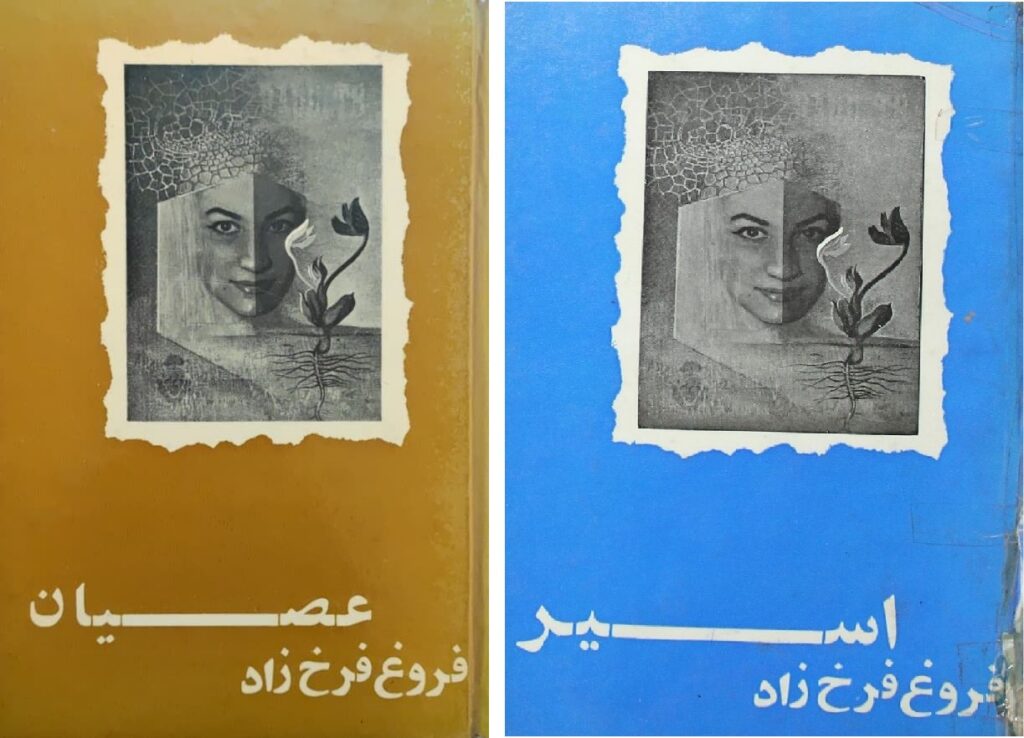
In 1958 Farrokhzad published “Rebellion”, a collection of seventeen poems composed in Rome, Munich and Tehran between August 1956 and the spring of 1958, marking a decisive turn away from the inward language of captivity toward a more confrontational engagement with moral and religious authority. In “God’s Rebellion” (عصیان خدا, Osyān-e Khodā), she imagines driving “the flock of pious ones / out of the green debauched pasture of Heaven” and choosing, instead of “the golden crown of divinity, / the dark and painful pleasure of sin’s embrace.” The poem’s stark inversion of heaven and hell, virtue and sin strips religious morality of its protective aura and recasts transgression as a deliberate and affirmative ethical stance.
Later that year, she entered the Golestan Film Unit, headed by the writer and film-maker Ebrahim Golestan, where she began working professionally as an editor and assistant on documentary productions. She briefly studied film in England in 1959 and continued to develop practical experience in non-fiction film-making before directing her own short work. Farrokhzad’s move into cinema was not incidental, but the result of extensive professional and technical work within a film production environment.
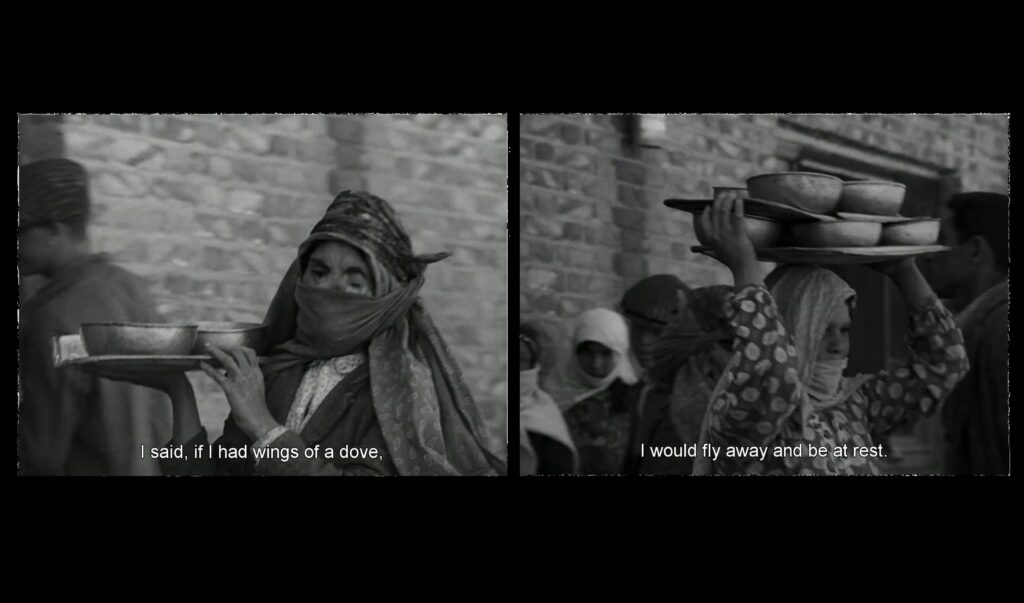
Her only completed film, “The House Is Black” (خانه سیاه است, Khaneh siah ast, 1963), can be read as an intervention into who has the authority to interpret suffering. Set in a leper colony in northern Iran, at a moment when leprosy remained a widespread and socially marginalised condition in the country (12,000 reported cases in 1964), the film unfolds within a medical and institutional environment structured to classify, manage, or normalise damaged bodies. Against this setting, the film replaces explanatory discourse with Farrokhzad’s own voice, weaving together passages from the Old Testament, the Qur’an, and her poetry. In doing so, it shifts interpretive power away from expert and administrative frameworks and toward a female authorial presence, proposing a politics of attention grounded in ethical responsibility and co-presence.
This reallocation is stated from the opening declaration, which frames the images as a moral demand on the viewer: “On this screen will appear an image of ugliness, a vision of pain that no caring human being should ignore.” Throughout the film, poetic and scriptural fragments organise the experience of what is seen. Lines such as “I speak of the bitterness of my soul… while I keep silent my bones wear out from screaming all day long” replace clinical description with a language of interior exhaustion and silenced speech, while invocations of flight and refuge, “if I had wings of a dove, I would fly away and be at rest,” echo the recurring desire for escape and release that runs through her poetry, from “Captive” to “Rebellion.” The relationship forged through “The House Is Black” did not remain confined to the screen. After completing the film, Farrokhzad adopted a young boy from the colony, Hossein, thus bringing into her own life the ethical proximity to suffering and exclusion that the film insists upon.
Farrokhzad’s struggle over voice and authority returns with particular force in the present cycle of protest, even though the political terrain has profoundly shifted. Women played a decisive role in the mobilisation that led to the 1979 revolution, including many religious women, housewives, or leftists who supported the overthrow of the Shah in the expectation that political change would bring greater dignity, freedom, and social participation. It soon became clear, however, that these hopes would not be realised. Instead, a new legal and moral order consolidated itself through increasingly restrictive regulations on women’s bodies, mobility, and public presence. After 1979, the Islamic Republic banned Farrokhzad’s poetry for more than a decade, and many passages remained subject to censorship, a telling measure of how threatening a woman’s authorial voice could appear to a regime built on moral regulation.
Her work continued to circulate and accrue meaning in private, informal, and diasporic networks, becoming a language of interior refusal and survival when public dissent was dangerous. That persistence matters for how we read her alongside today’s demonstrations: the struggle is still over who gets to speak, appear, and claim legitimacy in public life, but it now unfolds through a different media ecology, where poems are memorised, reposted, and recited as quickly as images travel.
Even in accounts of her post-revolutionary afterlife, young Iranian women are described visiting her grave and reciting her poems by heart.
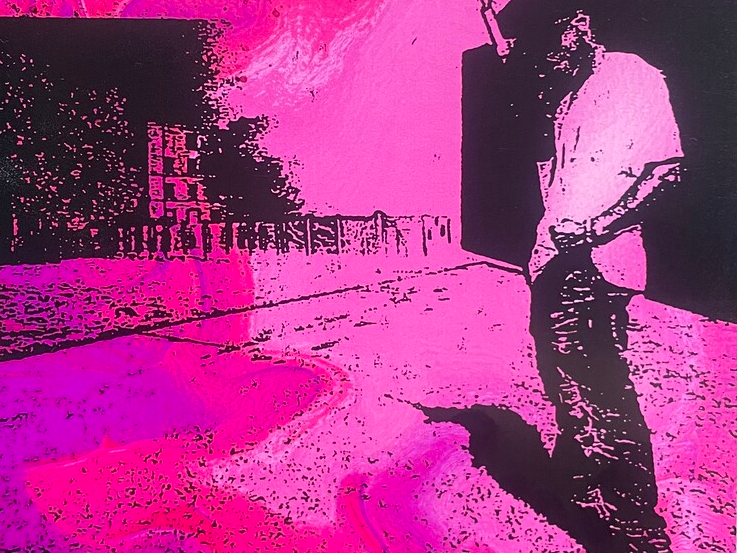
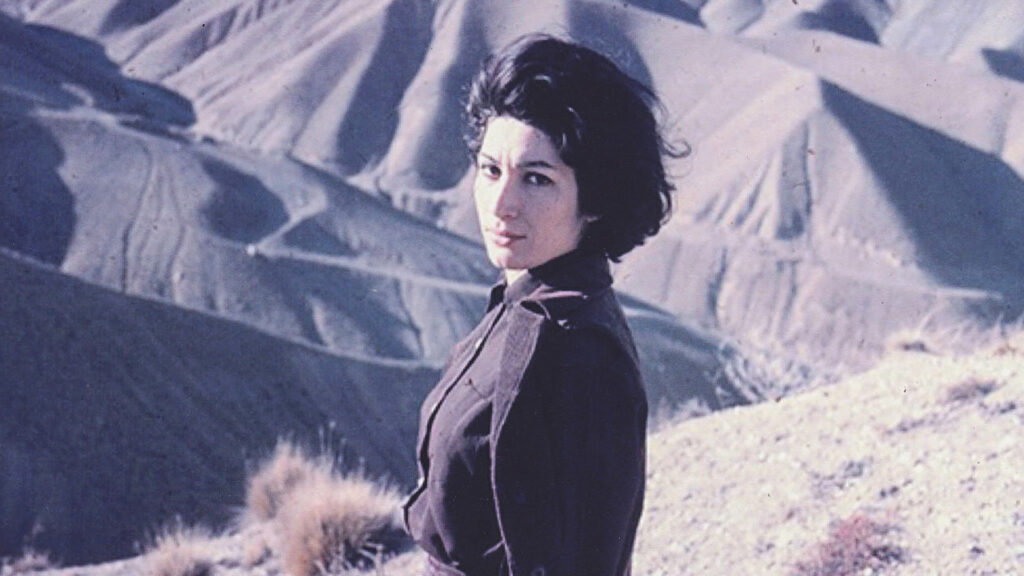
Top image: Forough Farrokhzad near Tehran circa 1966; photographed by Ebrahim Golestan.