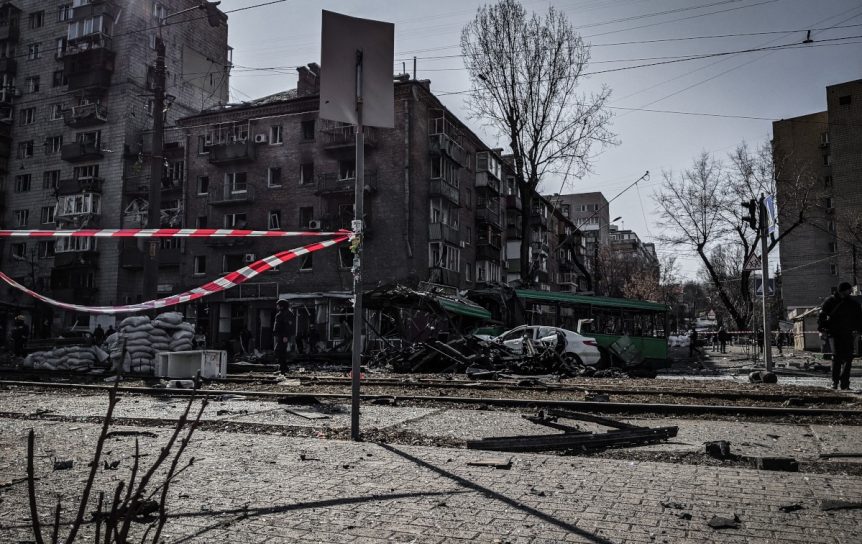
The conflicts in Ukraine and Gaza have been highly technological, pushing surveillance to new heights
~ Nikita Ivansky ~
As the first bullets fly and shells explode, we begin to learn the names of the war machines and the companies that manufacture them. We learn which weapons are the most lethal and cause the most harm.
However, during this learning process, the other side of the war often slips from our sight. The smaller companies, which work with information, are overlooked. From processing your personal data to AI that assists with bomb strikes, invasive technologies have a hard time passing through civil society in times of peace. However, when violence erupts, and we all look to the sky, hoping for no more drone strikes in our neighbourhood, we are happy about the eyes looking in all directions, trying to find an enemy.
The conflicts in Ukraine and Gaza have been among the most technologically advanced on this planet. But outside the traditional scope of war – where tanks and firearms kill and destroy – these technological wars push surveillance to new heights.
Four months after the full-scale invasion of Ukraine began, Palantir Technologies CEO Alex Karp personally visited the country to offer his services to the Zelensky government. For free.
Most activists following the surveillance sector are familiar with Palantir, a data-mining giant that law enforcement in many countries dream about. In Ukraine, the company has found a zone outside of regulations where it can test its software on the live data of millions of people. According to Time magazine, “Palantir’s software uses AI to analyse satellite imagery, open-source data, drone footage, and reports from the ground to present commanders with military options. It is responsible for most of the targeting in Ukraine.”
And not only targeting. Time also noted that Palantir was working with half a dozen ministries in the country, including the ministry of finance and education.
Palantir itself doesn’t produce the data. It doesn’t manage surveillance satellites or street-level CCTV cameras – those are handled by different companies. Palantir accumulates and processes data, assisting humans in decision-making. In a country like Ukraine, Palantir can operate with little oversight. While Ukrainian society struggles against the Russian invasion, help is accepted from any direction. The Palantir CEO understands this, as does most of the Western military-industrial complex.
Another role in processing data for the war was given to controversial American face-recognition technology (FRT) company Clearview AI. Officially its software is used to identify the bodies of combatants, and possible spies crossing into Ukraine. Police forces also use it to identify war criminals and those responsible for kidnapping Ukrainian children – a very wide scope of operations.
A Ukrainian digital security laboratory commented on Clearview AI’s usage in the country: “Initially developed for law enforcement purposes, Clearview’s technology matches the images against the database of publicly stored images scraped from websites, including social media platforms. Notably, despite not having unified legislation on the usage of such data, Ukraine still resorts to digital measures without legal framework and safeguards … arbitrary usage of FRTs by authorities may negatively influence citizen’s privacy, by continuing to be applied even when the emergency ceases to exist.”
While Clearview AI faces legal challenges in the US and EU, Ukraine provides space for its work without any serious challenges. From personal conversations, only some Ukrainian anti-authoritarian activist circles were aware of the facial recognition systems in their cities. This is mostly due to the fact that groups which would usually fight against a surveillance state are currently occupied with resisting the Russian invasion, while State repression is still very low compared to the rest of the region.
Both Palantir and Clearview AI are companies built around the extreme-right tech movement mobilised by billionaire fascist Peter Thiel. It is hard to imagine the role of these companies, as well as many smaller ones trying to enforce strong government control, fading away in the event of a ceasefire or peace agreement. The infrastructure is in place, and the State’s security forces have seen its effectiveness.
It is more likely that Thiel’s allies will continue to assist certain government branches. In a country with a growing far-right movement, this could pose a serious threat not only to anarchists but also to moderate leftists and liberals.
While we know little about surveillance processes in Russia, even before the invasion, Putin’s regime tried to create a network to control any opposition activity. It was used in 2022 to detain or force into exile many political opponents. In recent days, control, especially in occupied territories, has reached a new level, fuelled by a fear of saboteurs.
With the global ecological crisis only getting worse and the possibility of a full-scale war across Europe, we are looking at a very dire future of rapid surveillance expansion and automated data processing. Algorithms will make decisions about repressions against certain parts of society. This will certainly be a challenging future, but we must fight to stop fascism today, as tomorrow will be too late.
This article first appeared in the Winter 2025/26 issue of Freedom Journal
Image: Alex Ustinov CC-BY-NC