President threatened “terrorism” designation for national strike against cancelled diesel subsidies
~ Aldo Santiago, Avispa Midia ~
Social and indigenous organisations in Ecuador called on the population to join a national strike following the latest measure by President Daniel Noboa, who eliminated a diesel subsidy in the South American country by executive decree. This decision had an immediate effect on fuel prices of up to 56%, which, combined with other measures implemented by Noboa, such as the increase in VAT from 12% to 15%, has sparked outrage among various sectors of society.
One of the largest organisations, the Confederation of Indigenous Nationalities of Ecuador (CONAIE), expressed its rejection of the presidential decree and called for a national strike. Following an extraordinary assembly attended by three of its regional organisations (Ecuarunari, CONFENAIE, and CONAICE), they decided to call for immediate and indefinite nationwide protests.
Following the blockades carried out by transport workers in the capital, Quito, the Noboa government responded by declaring a state of emergency for a period of 60 days in seven of the 24 provinces of the South American country. In addition, the executive branch implemented measures such as curfews in five of them and has issued warnings of arrests for those who block communication routes and violate the restrictions.
President Noboa stated that he will classify those who pressure the population to participate in the protests as “terrorism.” Furthermore, in an official statement , the Ecuadorian government warned that the measures it will implement to respond to the blockades, which it described as “illegal,” do not constitute repression, but rather compliance with the law.
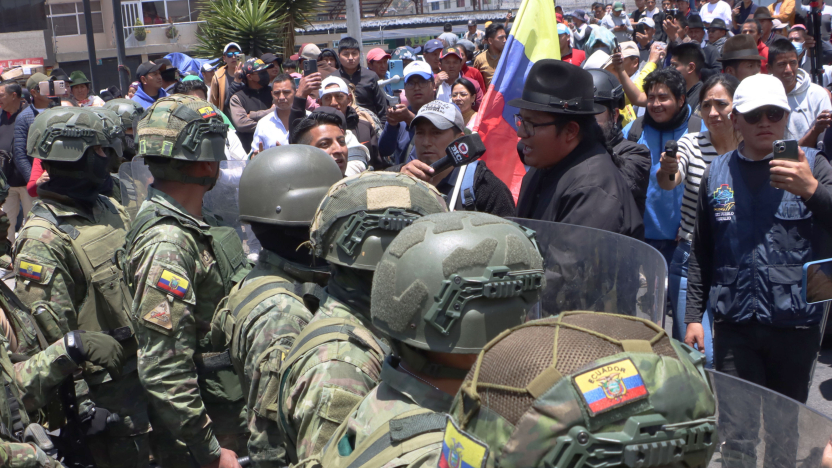
Thus, on Sunday night (21 September), around 500 military personnel were deployed on the E35 highway in the province of Imbabura, where the officer in charge noted that the action will seek to contain protests in “sectors of greater conflict” where, due to a state of emergency, “progressive use of force will be made with potential demonstrators.”
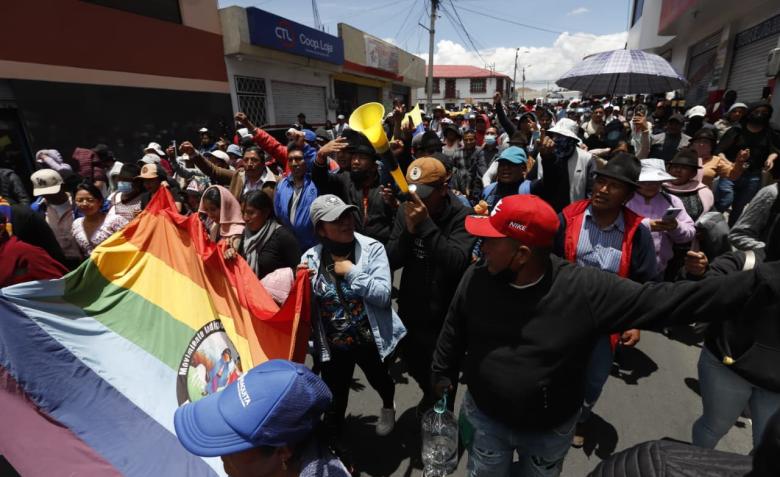
On Monday morning, multiple acts of protest were reported throughout Ecuador, suggesting an escalation of mobilisations in different territories. However, as is the case in Lacatunga, Cotopaxi province, where a state of emergency is in effect, armed forces are preventing the peaceful mobilisation of the Pachakutik indigenous movement.
The Noboa administration justified the elimination of the diesel subsidy as a measure to recover more than $1.1 billion from the national budget, an amount it promised would be channelled toward the implementation of social programs. In contrast, the president of the National Institute of Statistics and Census (CONAIE), Marlon Vargas, described the measure as an attack on the country’s most impoverished sectors of the population and accused it of being made without dialogue or consultation with the population.
According to Vargas, the elimination of the fuel subsidy represents “the deepening of the neoliberal package,” and he warned that its effects will be reflected in a significant increase in the basic food basket.
However, CONAIE is not limited to demanding the repeal of the recent decree; it has also announced a ban on the entry of law enforcement officers into Indigenous territories. For the Indigenous organisation, one of its main demands is the revocation of environmental licenses for three mining projects, in addition to an end to the implementation of extractive policies.
As part of the call for a national strike, the National Confederation of Indigenous Peoples (CONAIE) denounced that the bank accounts of national leaders, as well as those of regional organisations, were blocked in response to “state orders,” which they denounce as a “clear act of intimidation and pressure” against those exercising their right to protest. “The economic blockade of indigenous leaders is not an isolated act, but rather part of a strategy to criminalise social protest and weaken the demands of the people,” they stated in a statement released on Saturday (20 September).
On Monday morning (22 September), the Integrated Security Service reported sections completely closed due to protests, mainly in the provinces of Imbabura and Pichincha, in the northern Ecuadorian Andes, while the temporary headquarters of the executive, in Lacatunga, province of Cotopaxi is completely militarised.
In addition, road closures are reported on the Pan-American Highway, a key corridor connecting the capital, Quito, and the northern Sierra. Meanwhile, responding to calls from indigenous organisations, the unions planned to march in Quito on Tuesday, September 23.
At press time, repressive actions were being reported, such as those that occurred during a march held by communities in Peguche, Otavalo, where a platoon of approximately 100 police officers repressed protesters. Furthermore, in the Pijal community, González Suárez canton in Imbabura, residents have reported police firing bullets to repress the protesters. Therefore, they are urgently calling on international organisations to monitor what they describe as “flagrant” violations of their human rights by the Ecuadorian government.
Machine translation