The tiny group following the upward economic path is assisted and enabled by the State at every turn
~ David D’Amato ~
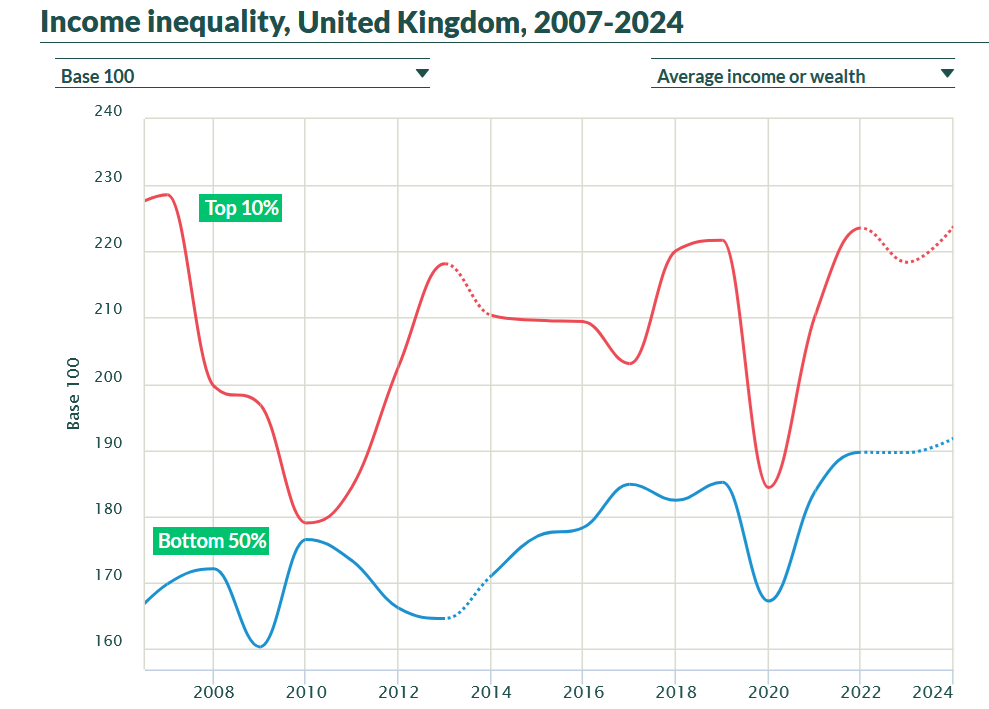
The corporate press has a new obsession, the so-called K-shaped economy. This is meant to describe a system in which one group of people, represented by the upward-inclining line of the K, watches its fortunes rise, while the other group’s fortunes shrink. The odd sudden fixation on metaphor gives the impression that it is somehow a new phenomenon, perhaps some anomaly in the aftermath of the Covid-19 pandemic.
The ridiculous sudden outpouring of headlines about something called a K-shaped economy obscures a long-running historical process of upward wealth redistribution. Our borderline-illiterate pundit class has treated this is a neutral divergence in outcomes, rather than the result of deeply structural and historical relations of domination.
Instead of a “K-shaped economy,” we would do much better to call this mode of capitalism an extraction economy or a rentier economy, perhaps an oligarchy. The tiny group following the upward path on the K is assisted and enabled at every turn by the state, while the downward group, the overwhelming majority of people, is fed to the wolves.
The scale of this system’s extraction is staggering. An analysis by economists at UC Berkeley recently revealed that in 2024, the 19 richest households in the United States added $1 trillion to their wealth. “This was the largest one-year increase on record and an amount that’s greater than the entire economy of Switzerland.” More broadly, Oxfam reports that “[i]n 2025, the world’s 12 richest men owned more wealth than half of humanity.”
Yes, you read that right: a dozen obscenely rich individuals, all of whom benefit from coercive state power to enrich themselves at the public expense, have more wealth than more than 4 billion people combined. We’re meant to see this grotesque state of affairs as natural and politically neutral, the product of some abstract notion of economic freedom.
In The Code of Capital, legal scholar Katharina Pistor explains how capital obtains its power: the legal system, not blind economic forces, is what turns ordinary assets into means of compounding, effort-free accumulation by imbuing them with special rights. Accumulation over time “requires additional fortification that only a code backed by the coercive powers of a state can offer”, writes Pistor. “the fact that capital is linked to and dependent on state power is often lost in debates about market economies”.
The U.S. tech sector, for example, has never operated in anything remotely close to a ‘free market’. Big Tech has always depended on taxpayer funding of riskier upstream research, which has often come in the billions through federal government agencies like the Pentagon. There has been little daylight between the bleeding edge of technological “progress” and Washington’s military empire. The companies only proceed to privatise the massive profits associated with these technologies, and embed themselves even deeper within the state through privileges like IP protections, federal contracts, and regulatory moats.
This is just one example of a design feature of the state-capital complex. Capitalism is not about fair competition but rather a game of deep structural asymmetries in which the state intervenes on behalf of capital through seizing and enclosing common-pool resources; foreclosing natural opportunities; creating special benefits like limited liability, IP monopolies, bailouts, grants, tax breaks, loan guarantees, and government contracts; and tightly controlling the labour pool through a host of tools which in the U.S. include a system of mass imprisonment.
In 2026, it would be difficult to overstate the total value of the special favours that the state grants capital, free of charge. Economic freedom describes a system that is decentralised, organised from the bottom-up, and based on commons — not this command and control structure, or the K-shaped red herring it waves in front of our faces.
Graph: World Inequality Database