Police brutality towards jubilation in the streets showcases everything the establishment has learnt during his reign
~ Gabriel Fonten ~
It was Saturday evening on 30 May and Paris was burning again. Piles of electric bikes were on fire alongside unfortunately placed vehicles. Flares were lit and plumes of red smoke rose high around national monuments. And fireworks, shot from some unknowable point in a sea of people, crackled in the sky. But the acrid smoke was mingled with tear gas, producing that very specific scent: a French riot.
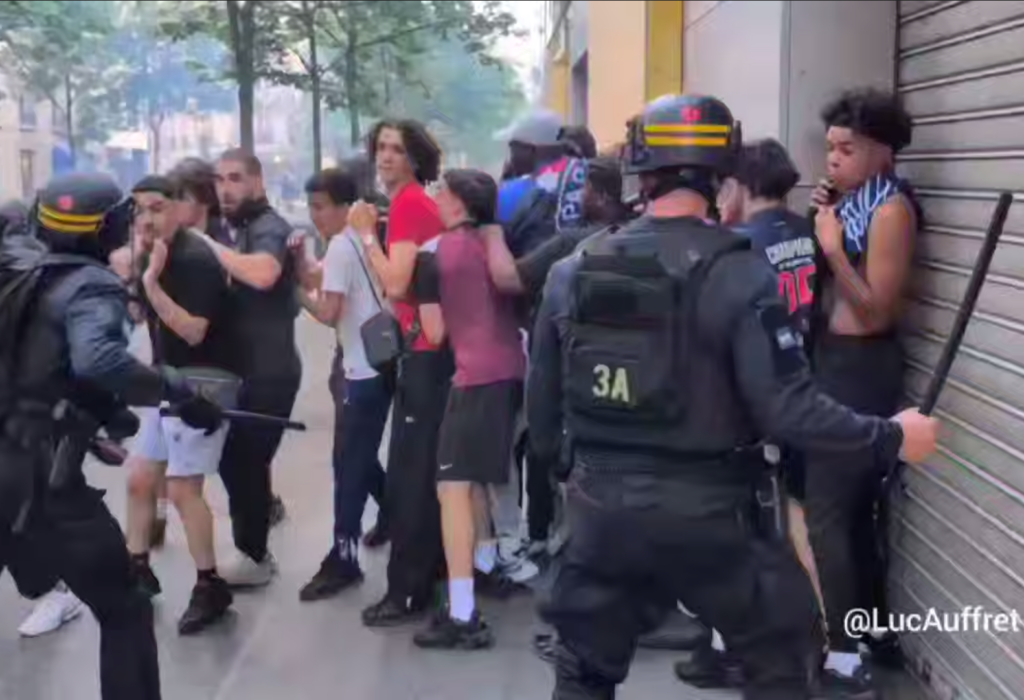
After weeks of planning and a day of waiting, thousands of police were finally unleashed upon the crowds celebrating Paris Saint-Germain’s victory in the Champions League final. Like an endless tide they charge, draw back, and charge again, dragging with them a couple unfortunate souls each time. In most places the crowd has no stones or fireworks with which to respond to the tear-gas. As crowds flee or become trapped against walls, police formations break apart, truncheons ready, beating the people sheltering helplessly beneath their own arms.
With one person killed and 219 people injured, Paris displayed all the aspects of French state repression that have been expanded during Macron’s reign.
The police deployment matched the height of the Yellow Vest Movement, a series of protests in Macron’s first term that were (at the time) the most violent mobilisations the city had seen since 1968. Since then, these massive protests have been matched in scope and cost by two others: the strikes and protests against Macron’s pension reforms, and the weeks of riots triggered by the police murder of Nahel Merzouk. The latter caused over a billion Euro in damage during just the first week, including the targeted destruction of police stations and at least 400 bank branches.
Indeed, Macron’s reign and massive unpopularity has seen every event that brings people together on the streets become a potential staging ground for popular resistance, transforming such events into a laboratory for repression.
As I previously wrote, the tactics of the French state reflect a constant ‘arms race’ between itself and the different groups it aims to repress. The Yellow Vest movement’s ability to cause mass disruption in 2018-19 lay in part with the anonymity of its thousands of participants. In response, the French state instituted a “ban on wearing a mask or other face covering without justification”, the ability to ban certain individuals from attending demonstrations, and a mass investigation and monitoring of “extreme-left” activists within the Yellow Vests. The movement’s reliance on WhatsApp alongside the state’s massive use of police violence made this repression effective, and participation dwindled.
During the anti-pension reform protests of 2023, the accompanying general strike meant the sheer numbers of protesters were much larger: half a million people took the streets for May Day in Paris alone, with 2.3 million nationwide. The police as a result adopted a broadly defensive stance, attempting to funnel the masses into routes where damage could be minimised, and there were only 271 arrests. The adaptability of police tactics showed that while unable to enforce the law, they were able to save the regime.
The final development in France’s security state comes through its newfound focus on controlling the conditions of protest. Unable to contain popular anger at Nahel’s murder, cities across France implemented curfews targeted at majority working-class and Arab neighbourhoods, as well as young people. Public services were cut between the outer and inner cities to protect luxury shops and upper class neighbourhoods, and Police were allowed to inflict violence on the “vermin” and “savage hordes”, as their unions openly called protesters.
Fearing such spontaneous eruptions of anger, the French state has carefully controlled instances where people may be brought together any time since. During the Olympics, a swathe of barriers cordoned off the city centre from “undesirables” who threatened Macron’s spectacle. In preparation for last weekend’s PSG match, fans were banned from congregating in the traditional viewing areas, and were monitored by drones with officers waiting in the wings.
Now, the French right and far-right are champing at the bit in competition over who can unleash the most racist and dehumanising rhetoric against Parisians. Far right leader Marine Le Pen was quoted saying that “only in France does a football club’s victory spark riots.” While factually incorrect, the quote speaks to the attitude of one side of the country’s arms race: France’s ruling class. Perpetually exasperated by their country’s riotous spirit, they turned to Macron to re-forge France into a docile state. But for all the new weapons his regime has given to forces of reaction, his project of taming France seems no closer to completion than when he first took office.
Try as he might, Macron’s laboratory of repression has failed to cure France of its revolutionary spirit.
Images and video: Luc Auffret via Popular Front on Telegram