A accessible and engaging account of the Amistad slave-ship rebellion
~ Jay Arachnid ~
Since the rulers of class societies began to impose themselves on cultures without classes, there have been rebellions. And whether peasant or slave revolts, they have been almost exclusively chronicled by those whose power was being challenged, rather than the people who challenged that power.
Despite individual outliers who might have become learned surreptitiously throughout history, slaves and peasants have generally been forced to remain illiterate. Naturally enough, then, what readers learn from official chronicles is lopsided, exaggerated, scurrilous, sneering, and negative – however based on dispassionate facts they might be.
Most European radicals know about the Spartacist uprising in Berlin in 1918-19 (and many know about the Munich Council Republic that arose months later, which included the participation of many anarchists (see All Power to the Councils, by Gabriel Kuhn), but how much do they know about the former Thracian gladiator Spartacus, who led a slave revolt against the Roman Empire? Even the official name of the revolt is Roman: The Third Servile War. Neither revolt was anarchist in any meaningful way, as is to be expected; the Berliners who rose up against the nascent government of the Social Democratic Party did so because it was insufficiently anti-capitalist, while the escaped slaves who flocked to Spartacus were never in a position to defeat the Empire.
Escaped slaves in the modern era have created maroon communities, mostly (but not exclusively) in the Western Hemisphere. There’s an anthology of maroonage, Gone to Croatan (Sakolsky & Koehnline) that was published by Autonomedia back in 1993 that’s a must-read for those interested in geographical and philosophical refusal and withdrawal.
The most spectacular and successful maroon community in South America, with an estimated population of 30,000 at its height, was the quilombo of Palmares, which lasted almost 100 years. Its last and greatest leader was Zumbi, who eventually became known as the King of Palmares; his defeat effectively ended its existence.
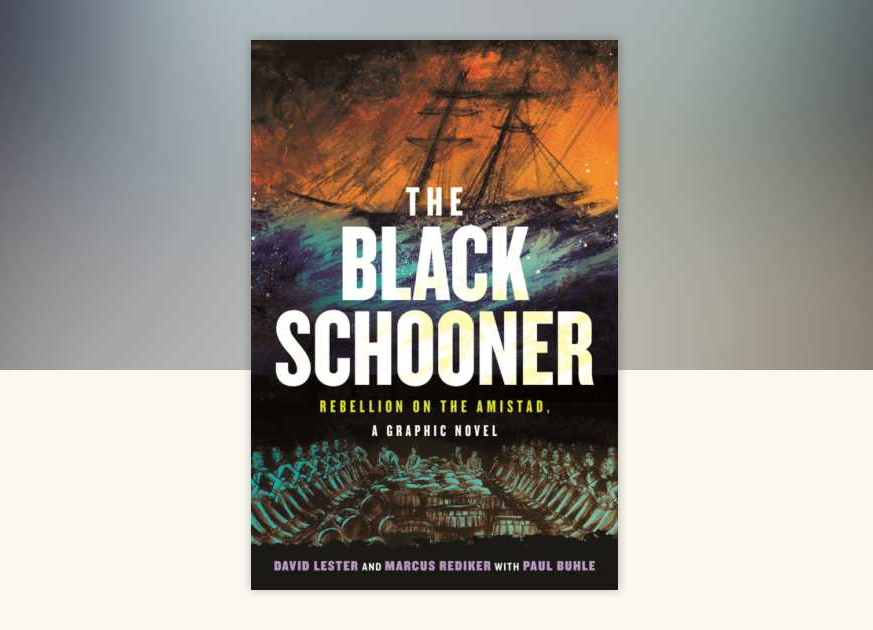
The Black Schooner tells the story of the rebellion aboard slave ship La Amistad, made famous by a Spielberg film in 1997. Typically, the film focused not on the rebellion itself or those who fought for their freedom, but on the White Saviour, former US president John Adams, who successfully argued the case before the US Supreme Court. Cinque is featured, of course, but his story has no narrative arc, no inner conflict that must be overcome for some personal or collective redemption … just a relentless fight for freedom. The graphic novel, deliberately choosing history over cinema, tells much of the story through contemporary interviews as well as journal entries of the rebels. The choice of a graphic novel is deliberate, since most of the published interviews were accompanied by portraits (journalistic photography being several decades in the future).
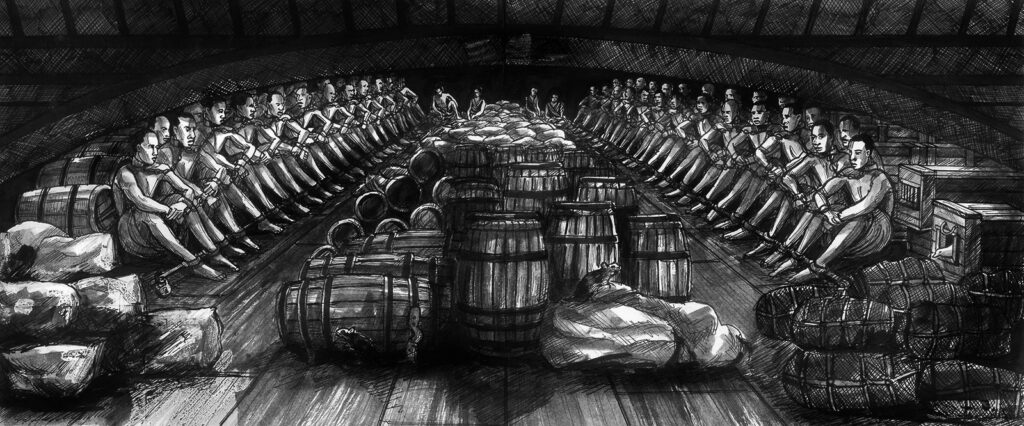
An interesting aspect of learning more about the rebels is what might today be called code switching, as when they are interacting with the Christian missionary Abolitionists – whose desires were theological as well as political – who rush to their defence the Africans didn’t wish to alienate or offend them, and so learned to communicate in English and spend time in Bible study, despite not really finding much utility in either.
While the Abolitionists were eager to bring a legal case that would challenge the entire institution of chattel slavery in the US, the rebels just wanted to go home. Unlike the more famous Nat Turner rebellion of the previous decade (which similarly horrified slaveholders, and which ended with very different results), eventually the US Supreme Court ruled that in this particular case the rebels who rose against their captors and killed most of them were justified, since they had clearly been kidnapped from their homes in Africa. Chattel slavery endured another 25 years. Does that mean that one particular slave revolt’s legal victory that didn’t affect the entire institution of slavery was unimportant in the history of slave revolts?
The Spartacus insurrection lasted only two years, and didn’t have the abolition of slavery throughout the Roman Empire as a goal. Nor did it aim to topple the Empire. Does that mean it was not important? Quilombos and maroon communities were not direct attacks on slaveholders, but were defensive withdrawals from slavery. They provided refuge and respite, and while they were occasionally centers of guerrilla actions, their residents did not usually engage in open warfare. Does that mean they are less important in the history of slave revolts? What anarchist can fail to be inspired by the desire of oppressed people to be free?
Still, what are anarchists supposed to do with rebellions where the state isn’t attacked, where hierarchies are not rejected, where one or a few rebels attain the status of a new leadership? In the near absence of heroic anarchist rebellions, it is understandable that anarchists would look elsewhere for inspiration.
The point of learning about the history of rebellions isn’t to re-enact them, but to apply the lessons to future improvements. While it is certainly a mistake to claim them as anarchist, anarchists can – and should – look to the experiences of the neo-Zapatistas in Chiapas, the revolutionary Kurds in Rojava, the piqueteros in Argentina, the occupiers of the Arab Spring, the Landless Workers’ Movement in Brazil, and countless other smaller and more local self-organised projects that challenge the smooth(ish) operation of the economic and political status quo.
The Black Schooner tells one such important story, in a way that’s both accessible and engaging.
The Black Schooner: Rebellion on the Amistad, A Graphic Novel. By David Lester and Marcus Rediker, Edited by Paul Buhle. Beacon Press, 136pp.
This article was first published in the Summer 2026 issue of Freedom anarchist journal