Update on Budapest Complex case and interview with François from the Budapest Solidarity Committee in Paris
~ Silke, Graswurzelrevolution ~
On 7 March 2026, an international solidarity event took place in Montreuil, near Paris, dedicated to the “Budapest Complex”—the largest cross-border state persecution of anti-fascists in decades. The event was organised by the Comité Solidarité Budapest, which brought together various approaches and thus opened up new perspectives.
Those accused in the Budapest Complex are alleged to have participated in physical confrontations with Nazis in the Hungarian capital in February 2023. The incidents are said to have occurred on the sidelines of anti-fascist protests against the Nazi mega-event “Day of Honor,” the largest Nazi-glorifying march in Europe. Since then, the Hungarian and German states in particular have been persecuting a large number of anti-fascists, who face up to 24 years in prison in Hungary under inhumane conditions. Maja, a non-binary person from Jena, was extradited to Budapest by German authorities in a blatantly unlawful manner (as reported by GWR).
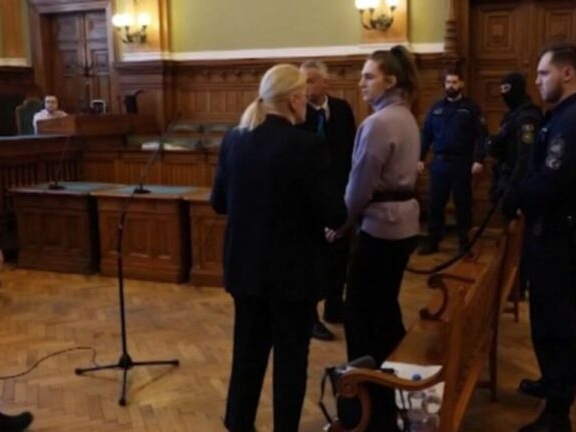
Meanwhile, many accused individuals are sitting in German prisons and on trial despite a lack of evidence. Investigators are constructing a “criminal organisation” and even accusing them of “attempted murder.” The sentence they face in Germany is illustrated by the verdict against Hanna from Nuremberg, who was sentenced to five years in prison in September 2025 – even though the trial yielded hardly any evidence that she was even in Budapest during that time.
Other countries are refusing to comply with Hungary’s extradition requests: Both Italian and French courts have rejected the extradition of accused individuals and are not initiating their own proceedings. Solidarity groups have formed in both countries to support the affected anti-fascists.
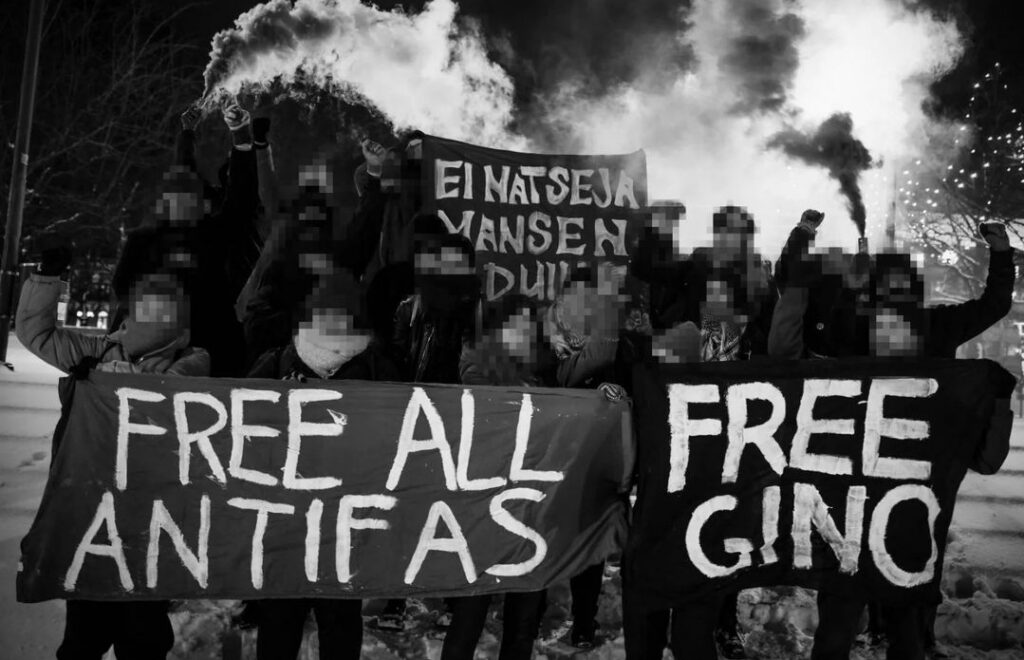
Gino, who grew up in Italy, and Zaid from Nuremberg fled to Paris, but are currently facing new legal proceedings there because German and Hungarian authorities are demanding their extradition.
Currently, the court proceedings in Paris continue: At the last hearing on April 15, the Court of Appeal, in Zaid’s case, requested further details from Hungary regarding his detention conditions, guarantees of a fair trial, and the independence of the judiciary, setting a two-week deadline. The next hearing is on May 13. In Gino’s case, the review of the German arrest warrant was postponed until June 17.
Interview with François
Monitoring the court cases of Zaid and Gino is a key focus of the work of the Paris-based Comité Solidarité Budapest and affiliated support groups. At the same time, these cases cannot be viewed in isolation, nor should they remain confined to a small left-wing public sphere. Therefore, the conference at the cultural centre “La Parole Errante” on March 7th addressed the issue more broadly. Extensive discussions brought together the perspectives of solidarity structures from various countries, highlighted the importance of artistic interventions, and provided legal experts with an opportunity to inform the public about the situation. The discussion with Zerocalcare, author of the graphic novels “Down in the Hole” and “In the Nest of Snakes” about the Budapest complex, drew a large audience. The exchange of information at the numerous information booths and a concluding concert rounded off the event.
In the aftermath, François from the Budapest Solidarity Committee agreed to an interview.
GWR: Can you briefly introduce the Budapest Solidarity Committee and your work?
François: Our committee was founded in December 2024 after Gino’s arrest. The goal was to gain political support for his case and to oppose his extradition to Hungary. In January 2025, seven other defendants in the Budapest case turned themselves in to the police in Germany. Following this, we shifted our focus and began considering the entire case from a broader perspective. After Gino’s first legal victory in April 2025, when the Paris court rejected his extradition to Hungary, we recognised the need to advocate for global solidarity and the fight against repression. In doing so, we aim to address broader issues such as the criminalisation of antifascism and the techniques of state repression.
We are currently working on the new trial against Gino, who faces extradition to Germany, and the trial against Zaid, who is fighting extradition to Hungary. We support them by organising demonstrations on the dates of the trials, securing media coverage, and participating in a growing international solidarity network. Solidarity collectives for antifascists affected by the Budapest Complex have been established in Germany and Italy. This has helped us become part of an international solidarity movement that supports antifascists across Europe.
You organised a solidarity conference with a cultural program in Montreuil on March 7th. What were the topics of the discussions?
We had three panel discussions: one on international solidarity, one on the role of culture in politics, and one on legal mechanisms.
The first panel included the Budapest Antifascist Solidarity Committee and Rote Hilfe e.V. from Germany, the Graz Solidarity Committee from Austria, and the Comitato Antirepressione Milano and Assemblea Dax from Italy. They all spoke about their respective cases of repression, the possibilities of international solidarity, such as supporting prisoners, and about joint political struggles.
The second panel, with comic book author Zerocalcare and Mattia Tombolini, provided an opportunity to discuss the role of culture in political struggles—both in terms of visibility and in setting political priorities.
The first panel, with comic book author Zerocalcare and Mattia Tombolini, offered an opportunity to discuss the role of culture in political struggles—both in terms of visibility and in setting political priorities.
The first panel featured the Budapest Antifascist Solidarity Committee and Rote Hilfe e.V. from Germany, the Graz Solidarity Committee from Austria, and the Comitato Antirepressione Milano and Assemblea Dax from Italy.
At the last panel discussion, Laurent Pasquet-Marinacce and Matteo Zamboni, the lawyers for Ilaria, Gino, and Zaid, as well as constitutional law expert Eugenie Mérieau and a representative from the data privacy organisation La Quadrature du Net, spoke. Their contributions addressed technologies of repression, but also legal and administrative repression.
One of your goals was to inform a large number of people and the media. Was that successful?
In France, media coverage of the Budapest Complex was easier and more positive than in other countries. We didn’t have to contend with the same negative press as in Germany.
For this reason, we were able to organise several press conferences, always inviting journalists to the court hearings and also to our event last weekend. The movement for Maja’s release, as well as Zerocalcare’s comic, were particularly successful in informing people about the Budapest Complex.
On March 7, hundreds attended our event. Several journalists were also present to report on the panel discussions and film a documentary about the Budapest Complex
What are the next steps?
The upcoming court dates are crucial, and we are mobilising to show our solidarity. We will continue to fight until all antifascists involved in the Budapest Complex are free. We want to strengthen our international connections and advocate more actively for imprisoned antifascists worldwide.
Machine translation