The philosopher and novelist was the first to formulate the modern conception of anarchism
~ Ruby Tuke ~
In 1812 the young radical poet, Percy Bysshe Shelley, wrote of his ‘inconceivable emotions’ on discovering that his hero and later father-in-law, William Godwin, was still alive. After Godwin’s death on 7 April 1836, the conservative-leaning Gentleman’s Magazine suggested ‘it might have been better for mankind had he never existed’.
Before being heralded as the founder of philosophical anarchism in the early twentieth century, Godwin was briefly the central radical intellectual in Britain in the 1790s, both for his daring political philosophy and his pioneering novels associated with the Romantic movement. He was then reviled and sidelined. This attests to a writer whose scathing critique of government and vision of a decentralised society threatened the established social and political order.
Born in Cambridgeshire in 1756, Godwin was raised in a Dissenting household, which later shaped his suspicion of religious and political authority. Studying at London’s Hoxton Academy, he was exposed to John Locke’s idea of the mind as formed by experience, and guided by education and free enquiry. The Academy’s emphasis on liberty and its conviction that truth could be arrived at through private judgement, and aided by frank conversation, made a lasting impression on him.
When Godwin returned to London as an adult, he quickly became part of the literary and intellectual milieu. The outbreak of the French Revolution (1789) prompted an outpouring of support from radicals and reformers in Britain, and inspired a spate of reactionary and radical publications. Godwin later wrote that ‘my heart beat high with great swelling sentiments of Liberty’ when recalling his early enthusiasm.
Although published during the height of political unrest, Godwin’s greatest work, An Enquiry Concerning Political Justice (1793), departed from earlier English radicalism. Rather than supporting rights-based majority rule and uprisings, the political treatise was a rational defence of the perfectibility of humankind – the capacity for continued social and moral improvement – and the use of private judgement to determine the best course of action. Amidst increasing terror in France and repressive practices of the British government against potential sympathisers at home, he urged readers to ignore the ‘false fire of the moment’ and focus on long-term social improvement. Godwin cautioned that violent upheaval of the government in Britain would not secure liberty. Instead, careful reflection, enquiry and discussion could transform society.
But Political Justice is no less radical just because it did not get swept up in the tidal wave of revolutionary fervour. In fact, it is a devastating philosophical critique of political authority. It clearly points to the ‘brute engine’ of government as being responsible for ‘the vices of mankind’. Godwin argued that their coercive and oppressive laws entrench inequality and resentment. Private property creates the ‘narrowest selfishness’ rather than concern for the welfare of others. It leads to a state of inequality, crime and misery.
For Godwin, ‘the laws of eternal reason’ should guide our actions and not the laws of states. Instead of a centralised power with law courts and prisons, Godwin envisioned a gradual transition to ‘parishes’ comprising voluntary associations of free individuals. These individuals would participate directly in open debate, but ultimately assess for themselves the best course of action for achieving the ‘general good’. Through decentralised communities based on mutual assistance, the autonomy of the individual would be maintained while supporting voluntary cooperation.
The writer quickly became the most celebrated radical intellectual of his day. The author William Hazlitt later said, reflecting on this heady, optimistic time, that Godwin made other political heavyweights, Edmund Burke and Thomas Paine among them, pale in comparison. This only intensified the conservative backlash that followed.
Godwin was virulently ridiculed by the establishment. As the radical project collapsed in Britain, he was simultaneously lambasted by reactionary publications for ignoring the importance of familial affections in his rationalist belief in perfectibility, and for his highly controversial personal life, which contradicted his philosophical assertions.
In Political Justice, Godwin had critiqued the institution of marriage for trapping husbands and wives in miserable situations by law, turning humans into property and tending to ‘thwarting, bickering and unhappiness’. Yet only a few years later, in March 1797, Godwin married Mary Wollstonecraft, who was pregnant with his child. After she died, following complications from childbirth, Godwin published a memoir of his wife. It was unsparing in revealing personal details, including a previous relationship and illegitimate daughter, and two suicide attempts. The revelations caused Godwin to be rejected in both liberal and conservative quarters.
To make matters worse, in June 1798 Thomas Malthus published An Essay on the Principle of Population. Malthus, initially anonymously, challenged Godwin’s theory of perfectibility by arguing that populations tend to outstrip the supply of food, making misery inevitable. This proved a timely narrative for Godwin’s opponents and accelerated his marginalisation.
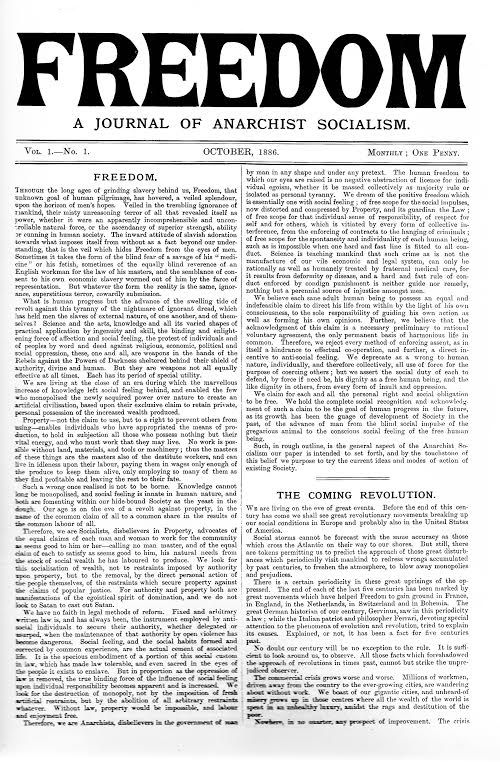
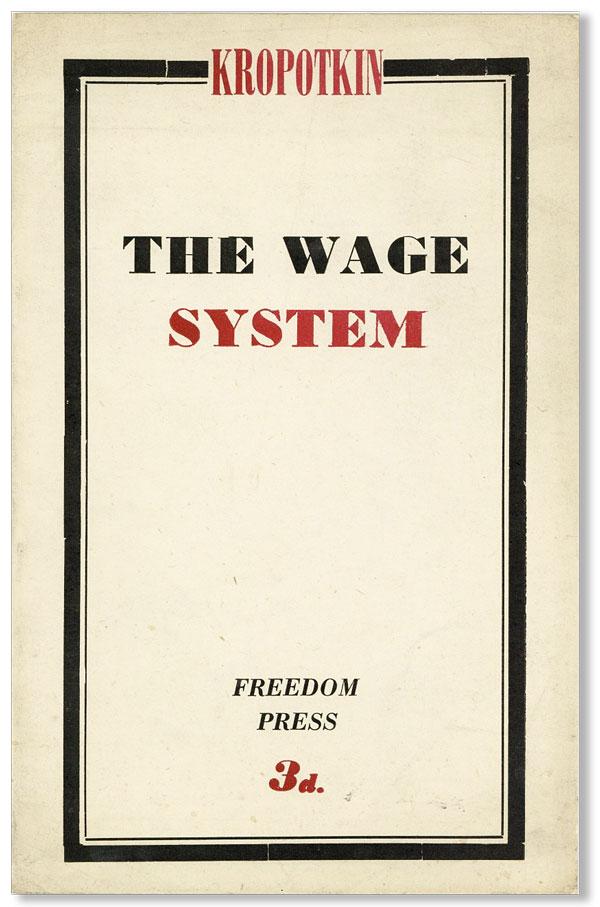
Yet his ideas did not disappear. From the 1830s onwards, they spread among early socialist and Chartist circles in Britain, and through the reformist networks associated with Robert Owen and Robert Dale Owen in the United States. By the early twentieth century, both Peter Kropotkin and Rudolf Rocker acknowledged Godwin as the first author to articulate the modern political and economical conceptions of anarchism.
Interest in William Godwin has only grown in recent decades as governments adopt increasingly oppressive strategies. One hundred and ninety years after his death, his ideas remain strikingly relevant, exposing how systemic oppression devastates both the individual and humanity.
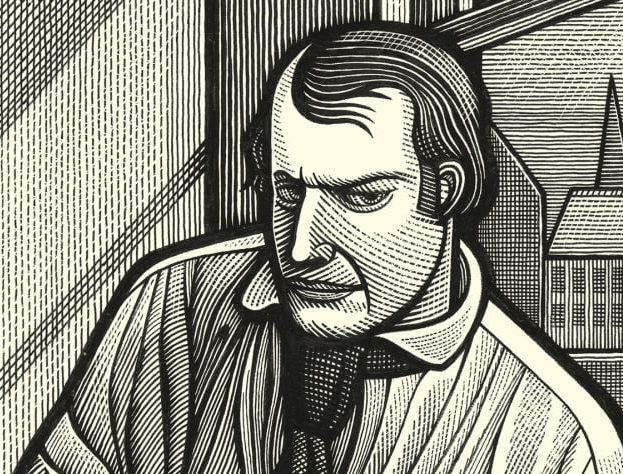
Illustration: Clifford Harper