A British- and American-sponsored coup in Iran caused widespread bloodshed in 1953 — then, as now, states are aggressors and people are victims
~ punkacademic ~
In mid-August 1953, death and bloodshed were visited on the people of Iran at the whim of faraway empires. In Operation Ajax, a British-conceived coup executed in concert with the United States, elected Prime Minister Mohammad Mosaddegh was toppled and the Shah, Mohammad Reza Pahlavi, given absolute power.
The motivations, from the British perspective, were simple: Britain had long exploited Iranian oil reserves from a concession granted by the previous dynasty, and Mosaddegh – the leader of a fractious coalition which initially included both communists and religious activists – was elected at the head of the National Front in large part due to his commitment to oil nationalisation.
After Eisenhower took office in January 1953, the US – which had initially refused British pleas for help in toppling Mosaddegh – became more amenable. As the witch-hunt for communists gathered pace at home and abroad, Britain pitched ousting Mosaddegh as a key step in frustrating Soviet ambitions. American oil companies would also be ‘cut in’ in the aftermath.
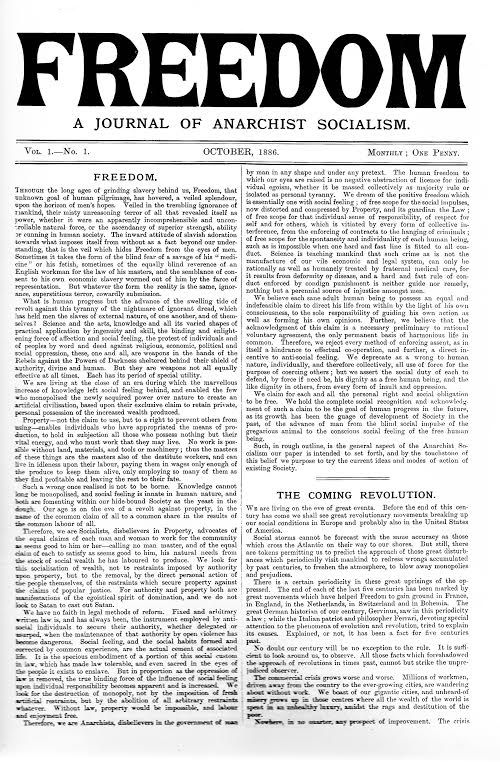
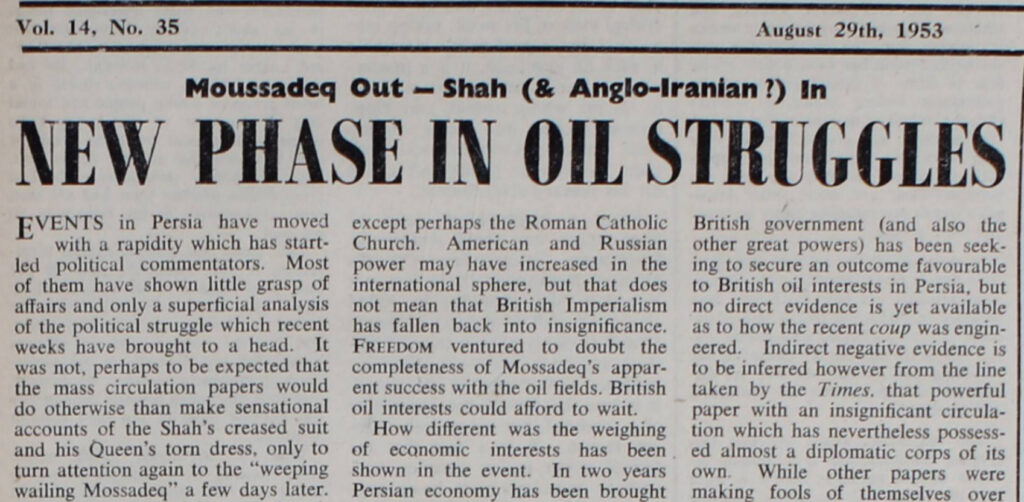
Freedom at the time viewed the official justifications for the coup with deep scepticism. As the front-page article below from 29 August 1953 shows, anarchists were neither willing to accept narratives of Western benevolence, nor (unlike some) to justify the depredations of others, including Mosaddegh’s own authoritarian turn.
Last month, we covered anti-regime protests in Iran, which were put down with exceptional violence and brutality. The current attack on Iran by the US and Israel has claimed civilian casualties, including the lives of children. Such casualties are inevitable when large amounts of high explosive are rained on cities. But the choice to rain those weapons on cities is not inevitable, and the deaths themselves are inexcusable. Bloodshed for the sake of empires’ economic interests is in the nature of imperial capitalism.
The tragedy of Iran in 1953 and in 2026 is the tragedy of states themselves, and what they do to their victims, at home and abroad.
—————
Mossadeq Out – Shah (& Anglo-Iranian?) In
NEW PHASE IN OIL STRUGGLES
EVENTS in Persia have moved with a rapidity which has startled political commentators. Most them have shown little grasp of affairs and only a superficial analysis of the political struggle which recent weeks have brought to a head. It is not, perhaps to be expected that the mass circulation papers would do otherwise than make sensational accounts of the Shah’s creased suit his Queen’s torn dress, only to turn attention again to the “weeping, wailing Mossadeq” a few days later. It is more surprising to find such papers as the New York Times or the Manchester Guardian so completely in the dark. The former, in an editorial written after the apparent failure of General Zahedi’s attempted coup of August 16, described Mossadeq as having made himself “absolute dictator of Iran”. The Manchester Guardian on August 18 declared that he held “in an iron grasp the reins of all the effective forces in the country—the army, the police, the town mobs, the electoral machine . . .” Yet the next day, Mossadeq was under arrest.
Events in Persia were discussed in Freedom at the time of the nationalisation of oil and the expropriation of the Anglo-Iranian Oil Company’s £300,000,000 plant at Abadan. Control of Persian oil was clearly not simply the interest of the Persians and the Anglo-lranian. [The] British government was obviously involved, but the United States and Russia were also keenly interested parties. Hence a variety of very powerful factors were operated behind domestic politics in Persia.
British Imperialism Can Wait
The apparent ease with which Mossadeq and the Persian Nationalists took over the Anglo-lranian Company was widely regarded at the time as evidence of the degeneration of British Imperialism (under the Labour Party) into a spent force. Others saw the British Government as in the pocket of the United States, having to go cap in hand asking for help. Freedom did not subscribe to these views. British Imperialism has the longest history and the most experience of any international force except perhaps the Roman Catholic Church. American and Russian power may have increased in the international sphere, but that does not mean that British Imperialism has fallen back into insignificance. Freedom ventured to doubt the completeness of Mossadeq’s apparent success with the oil fields. British oil interests could afford to wait.
How different was the weighing of economic interests has been shown in the event. In two years Persian economy has been brought to virtual bankruptcy. One of the contributory causes of Mossadeq’s fall was the fact that government salaries had in many instances not been paid. Virtually no oil had been sold and the government’s in come of £16,000,000 annually from Abadan had ceased. How different the situation Of Anglo-lranian! In 1952 it paid a dividend of 30 per cent, and despite the loss of a three hundred million pound capital asset it paid a cash bonus of one shilling per one pound share! The nationalists may have won in prestige, but relative economic strength was very different.
The Shah has said that Persia needs economic help from abroad in the shape of an outright gift. But such things are unknown except as propaganda. Such a “gift” may materialise and the giver fix no interest payable, yet conditions will in fact be attached. Similarly with the oil nationalisation, the decree may not be reversed for political reasons, but it will be surprising indeed if British technicians do not return to Abadan and some measure of control be retained by British oil interests.
Behind the Scenes
So far there have been no reliable reports of affairs behind the scenes in the governmental reshuffle in Persia. If the Manchester Guardian and the New York Times are so poorly informed it is hardly likely that Freedom could have such information. Our analysis as always is made on what we know of the general principles of power and politics, and must remain general. One can be quite certain that the British government (and also the other great powers) has been seeking to secure an outcome favourable to British oil interests in Persia, but no direct evidence is yet available as to how the recent coup was engineered. Indirect negative evidence is to be inferred however from the line taken by the Times, that powerful paper with an insignificant circulation which has nevertheless possessed almost a diplomatic corps of its own. While other papers were making fools of themselves over Persia, the Times never committed itself in an editorial comment at all last week. One suspects that the Times knew much about the interior moves in the game and preferred to await the outcome, rather than join in the uninformed comments of mere ignorant spectators.
Socialists’ Line
A curious commentary is provided by Michael Foot’s article in Tribune. So concerned is he to denounce British Imperialism—though his article is the only one generally in the press to indicate an awareness of the strength and persistence of Imperialism—that he finds it necessary to praise Mossadeq as an “honest, skilful, if stubborn champion of Persian Nationalism”. Socialists of the left are still hypnotised by nationalist aspirations. They give the impression that any opponent of Imperialism must therefore be seen as an ally. (Some anarchists even took this view over Indian nationalism ten years ago). Michael Foot seems to forget Mossadeq’s imprisonment of opponents, suppression of free speech and press (such as they ever existed in Persia), and manipulating of elections on the Soviet-Nazi pattern.
Nor should one forget General Zahedi’s flirtation with Nazism. The truth is of course that they are all to some extent puppets of one great power or another. Mossadeq attempted to “use” the Persian Communist (Tudeh) Party for his own ends, but once again such embraces turn out to be the kiss of death for there seems little doubt that fear of Russia made many Persian interests see Britain as the lesser evil and so unite to play into the hands of British policy. Nevertheless the struggle still goes on, for countries like Iran are so placed strategically that they can never know peace while the great powers continue—as they must—to plan, for advantage.
Freedom, vol. 14, no. 35, August 29th, 1953