Marking a century since the death of the successful strike organiser and tragic victim of the class judiciary
~ Maurice Schuhmann ~
The French port city of Le Havre was an important industrial centre until its near-total destruction during the Second World War. For the past twenty years, however, it has primarily gained recognition as a UNESCO World Heritage site due to its distinctive concrete architecture. These two sides of Le Havre are each symbolised by a personality: the “new” Le Havre by the architect Auguste Perret, the “old” Le Havre by the revolutionary syndicalist and anarchist Jules Durand. Both remain omnipresent in the cityscape.
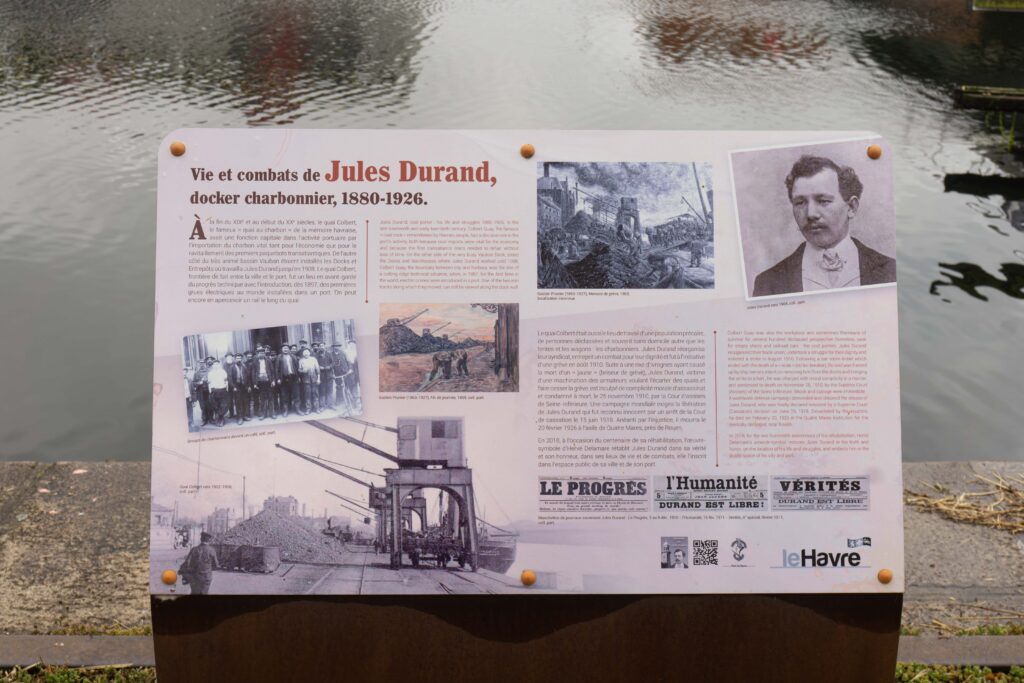
Born in 1880 in Le Havre (Normandy, France), Jules Durand, a docker, reportedly became an anarchist at an early age after studying the works of Karl Marx, Pierre-Joseph Proudhon, Auguste Blanqui, Jules Vallès, and Fernand Pelloutier. As a class-conscious dockworker, or charbonnier (coal handler), he was a member of the CGT and in 1902 co-founded the trade union branch responsible for this sector, serving as its secretary. At the time, Le Havre was a major workers’ city with a high level of unionisation in the already strong CGT.
In August 1910, the CGT section he led as secretary—still strongly influenced by revolutionary syndicalist ideas—called for an indefinite strike by the coal workers. The strike was not without conflict. “Yellow” unionists and other strikebreakers undermined the CGT, leading to tensions and occasional violent clashes. One such altercation ended on September 9 at the Quai d’Orléans with the death of a strikebreaker, Louis Donge.
Durand was held responsible for Donge’s death—at least as the alleged instigator of the killing. On November 10 of the same year, he was put on trial in Rouen and, after only a few days of proceedings, was sentenced to death on November 25 for complicity in murder. To this day, it has not been conclusively clarified whether Donge’s death was a homicide or an accident.
Durand was seen as the organser and figurehead of the strike, and it was in this capacity that he was prosecuted—much like Sacco and Vanzetti in the United States were tried as representatives of anarchism rather than as proven perpetrators. All available evidence spoke against his involvement or any call to violence.
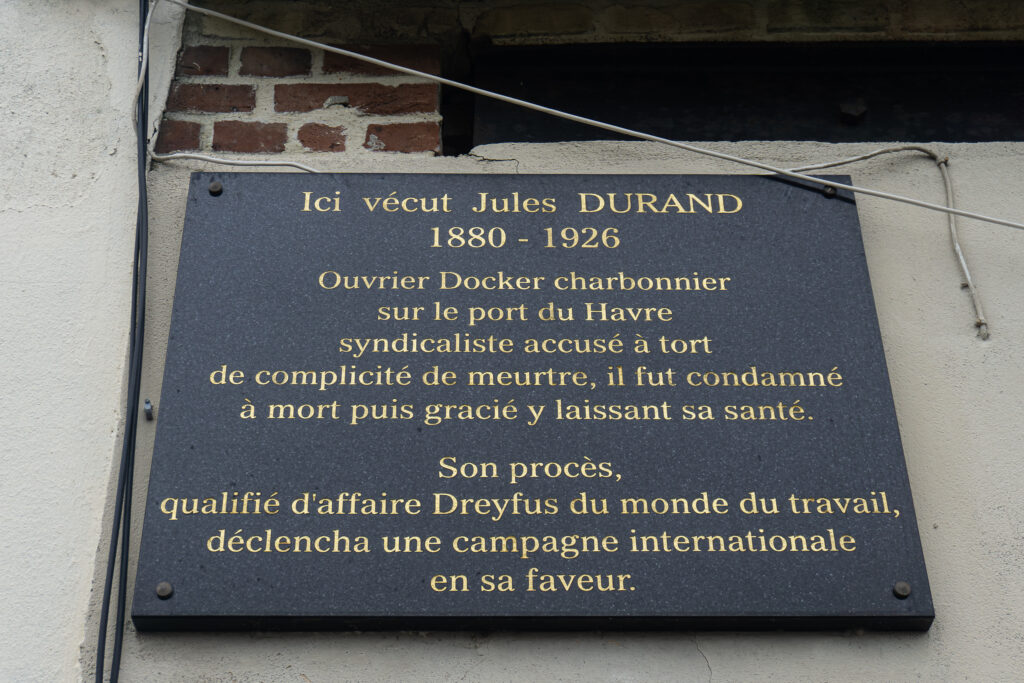
In his account of the case, Une Affaire Dreyfus au Havre (1910–1918), the author Roger Colonvier writes: “Finally, Commissioner Henry, head of the Le Havre security service, stated in his December 1910 report that none of his agents or informants who had mingled with the strikers or questioned port operators had observed a belligerent attitude on the part of Jules Durand, let alone any call to kill a non-striking coal worker.” (Author’s translation.)
After his conviction, an anarchist magazine wrote about the trial: “We examine the trial for the alleged crime in detail. Dreyfus was condemned, though innocent, because he was a Jew; Durand was condemned, though innocent, because he was a union secretary.” (Author’s translation.)
Subsequently, his case came to be described as the “Dreyfus Affair of the working class.” However, this characterisation has been criticised in trade union and left-wing historical circles, as it risks obscuring the class-based nature of the proceedings against Durand. Many prefer to describe him instead as a victim of class justice.
Imprisoned in the Bonne Nouvelle prison in Rouen, established in 1860 and still in operation today, and awaiting execution, Durand suffered a nervous breakdown from which he never fully recovered.
Meanwhile, numerous solidarity events took place outside the prison walls. In France alone, the CGT is said to have organised 1,500 events. The Ligue des droits de l’Homme also campaigned for the presumably innocent trade unionist. Solidarity actions were held in Belgium, Spain, and Great Britain as well.
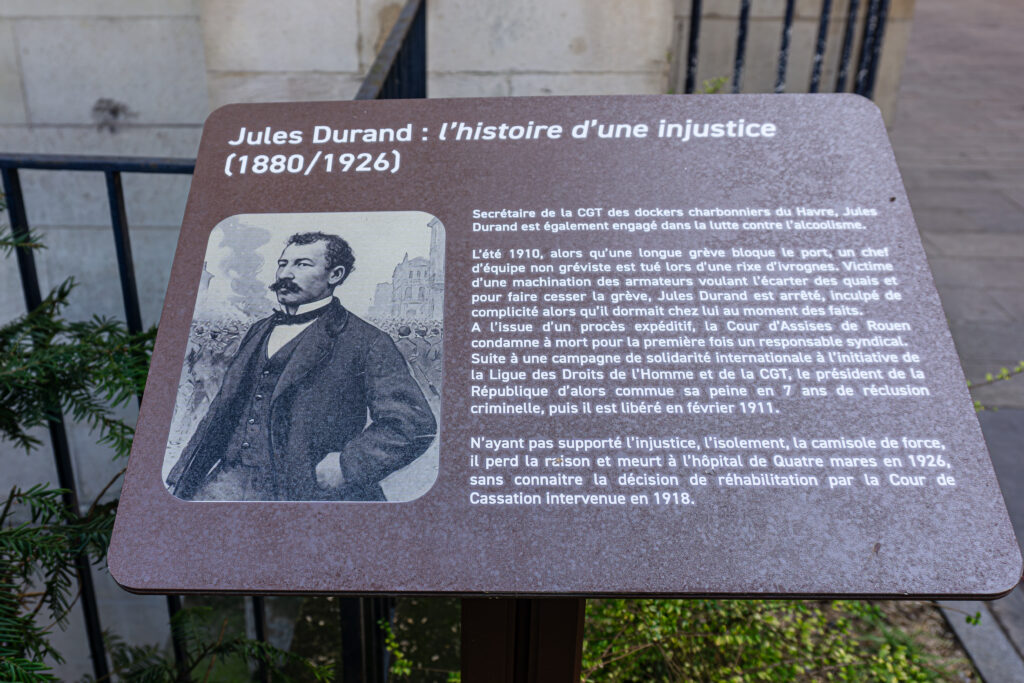
On New Year’s Eve 1910, Durand’s death sentence was suspended and commuted to imprisonment. Two and a half months later, on February 16, 1911, he was released. By that time, however, his mental health had already deteriorated severely. He was therefore committed to the Quatre Mares psychiatric hospital in Rouen, where a commemorative plaque is to be installed this year.
The case against Durand was reopened, but he was no longer mentally capable of following the proceedings. On June 15, 1912, he was fully acquitted and rehabilitated in a retrial.
Nearly fourteen more years followed in a psychiatric institution near Rouen, where he died on February 20, 1926, a broken man.
His fate has never been entirely forgotten in Le Havre and among the local working class. Among the still strongly organised dockworkers and within the CGT, his memory has been preserved for decades. Anarchist circles also continue to claim the revolutionary trade unionist as one of their own.
An assessment of Durand
In anarchist publications, Durand is repeatedly described with four or five attributes: anarchist, antimilitarist, teetotaler, revolutionary syndicalist, and “Dreyfus of the working class.”
Alcohol abstinence was an important issue within the working class at the time. Alcohol was not only an intoxicant offering temporary escape from a bleak daily reality but also, for example in the form of beer, a cheap source of calories. The temperance movement was divided: on one side stood a religiously motivated movement demanding complete abstinence; on the other, a current emerging from the labour movement that focused its struggle primarily against hard liquor such as spirits and schnapps. Durand belonged to the latter.
Little can be found in the literature regarding Durand’s anti-militarism. The CGT, where he was mainly active, only began addressing this issue in later years. For this reason, this attribution should be treated with caution.
As a classic workers’ city, Le Havre at that time had a strong anarchist movement. Documented are, among others, lectures by the anarchafeminist Louise Michel and Sébastien Faure. To what extent Durand participated, which works he actually read, or whether he knew anarchism more from the accounts of fellow workers than from his own reading is difficult to reconstruct today. The label “anarchist” is closely linked to the reasoning behind the verdict against him, in which the judge used the term primarily in a pejorative sense to discredit Durand.
The image of Durand as a revolutionary syndicalist—also what made him a target of class justice—overshadows other aspects of his life. As secretary of the CGT, which remains relatively strong to this day and was then shaped by the spirit of the 1906 Charter of Amiens, he is primarily remembered. He played a decisive role in organising the legendary 1910 strike, which has been treated in literature several times, including by the author Philippe Huet in Les Quais de la Colère (2005).
The declaration of Durand as the “Dreyfus of the working class” also has a direct historical reference point. One of the organisations that early on advocated a revision of the verdict against him was the Ligue des droits de l’Homme, formed from circles defending Dreyfus, and to which Durand himself is said to have belonged for a time. Durand and Dreyfus certainly share the fact that both were innocent men who were convicted; beyond that, little connects them at first glance. For many, the comparison seems somewhat cynical, since—unlike Dreyfus—Durand faced the death penalty rather than mere degradation.
Commemorative culture for an anarchist
Durand’s particular significance in Le Havre stems from several aspects: beginning with the fact that he was a docker—a profession enjoying special status and high unionisation locally—through the major strike he helped organise in local history, to his trial, in which his lawyer was the later French president René Coty, and not least the dramatic literary treatment of his case by the Norman writer Armand Salacrou in Boulevard Durand (1960). Today, the association Les Amis de Jules Durand, founded in 2012, actively preserves his memory. Among the local dockworkers, known to this day for their pronounced class consciousness, he has never been forgotten.
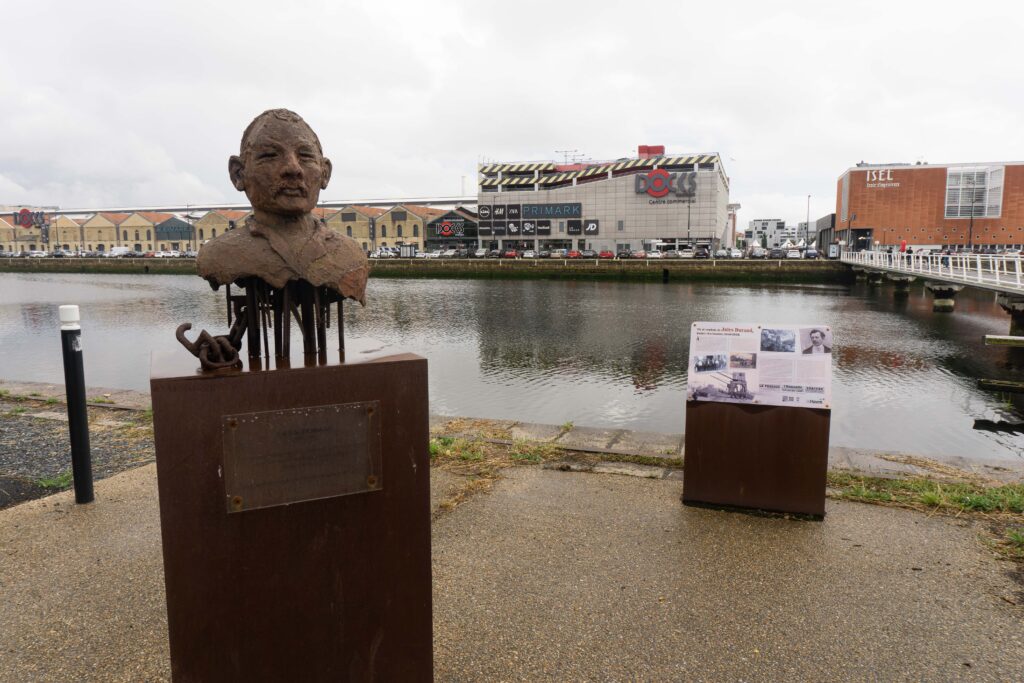
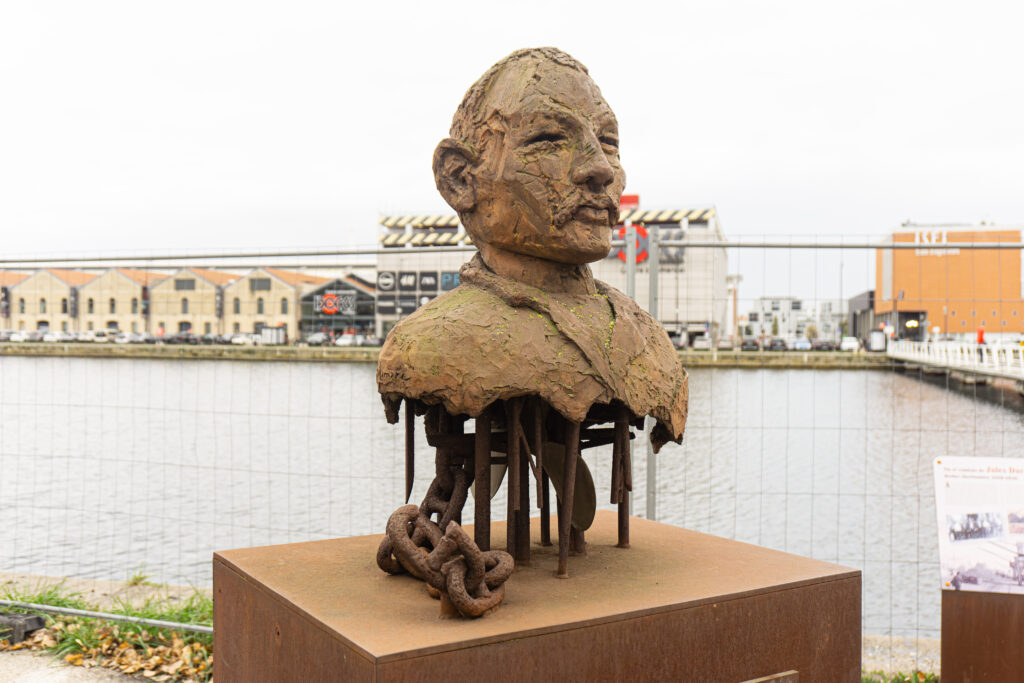
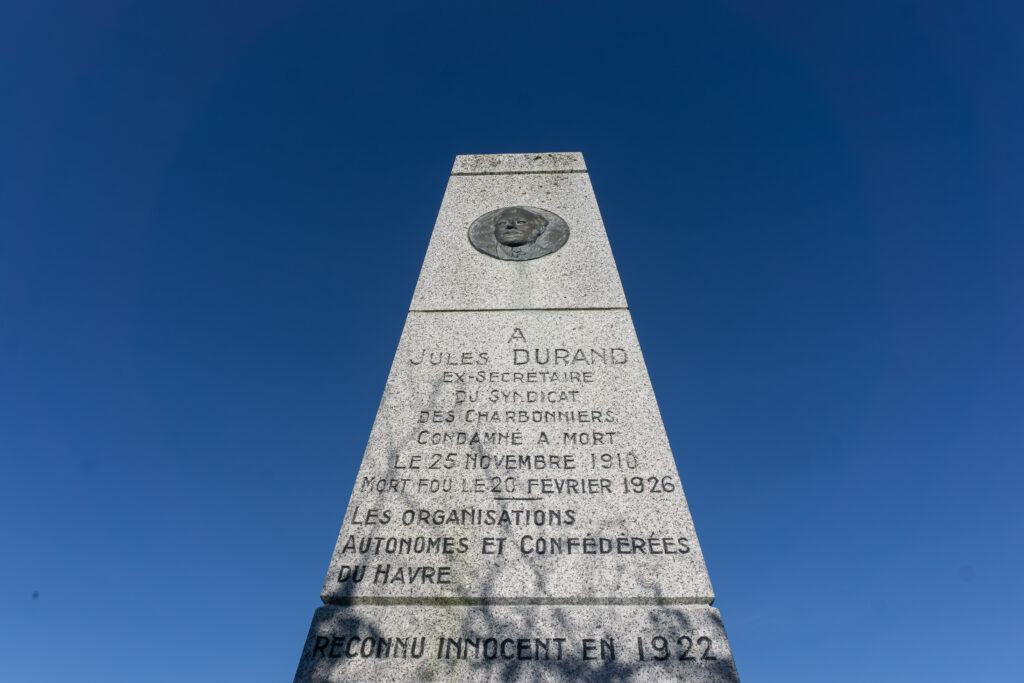
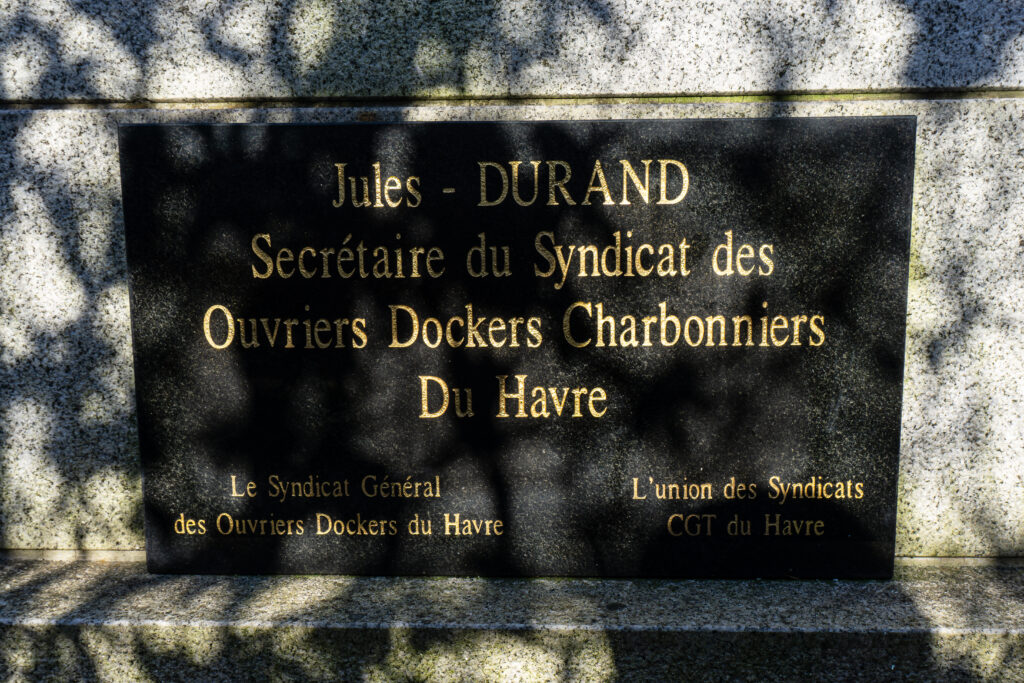
In Le Havre’s cityscape, remembrance takes many forms: from his imposing grave at Sainte-Marie cemetery—remarkably not even marked as a prominent grave on official cemetery maps—to a boulevard and university lecture hall bearing his name, a commemorative plaque in the union building, and another plaque and a bust made from a ship’s propeller near the docks and railway station. (None of these, however, are mentioned in official travel guides.)
In Rouen, where his trial took place, a plaque today commemorates the judicial scandal that turned him into the “Dreyfus of the working class.” Nearby, a church recalls another miscarriage of justice—the burning of Joan of Arc, the Maid of Orléans.
Even beyond Normandy, individual squares and streets—for example in Paris—bear his name, underlining both the memory of this trade unionist and the significance of revolutionary syndicalism for French culture and history.
On the occasion of the 100th anniversary of his death, an extensive year-long program of events—city tours, film and theatre performances, readings, a musical, and an exhibition—will be held, especially in his birthplace. The program is mainly organised by Les Amis de Jules Durand and the CGT. Encouraged by this year’s municipal elections in France, political figures—including the right-wing conservative mayor and former minister under Emmanuel Macron, Édouard “Doudou” Philippe, who currently governs the former left-wing stronghold—are also seeking to associate themselves with the commemoration.
Photos: Yvonne Schwarz, Semiramis Photoart